IThe seal
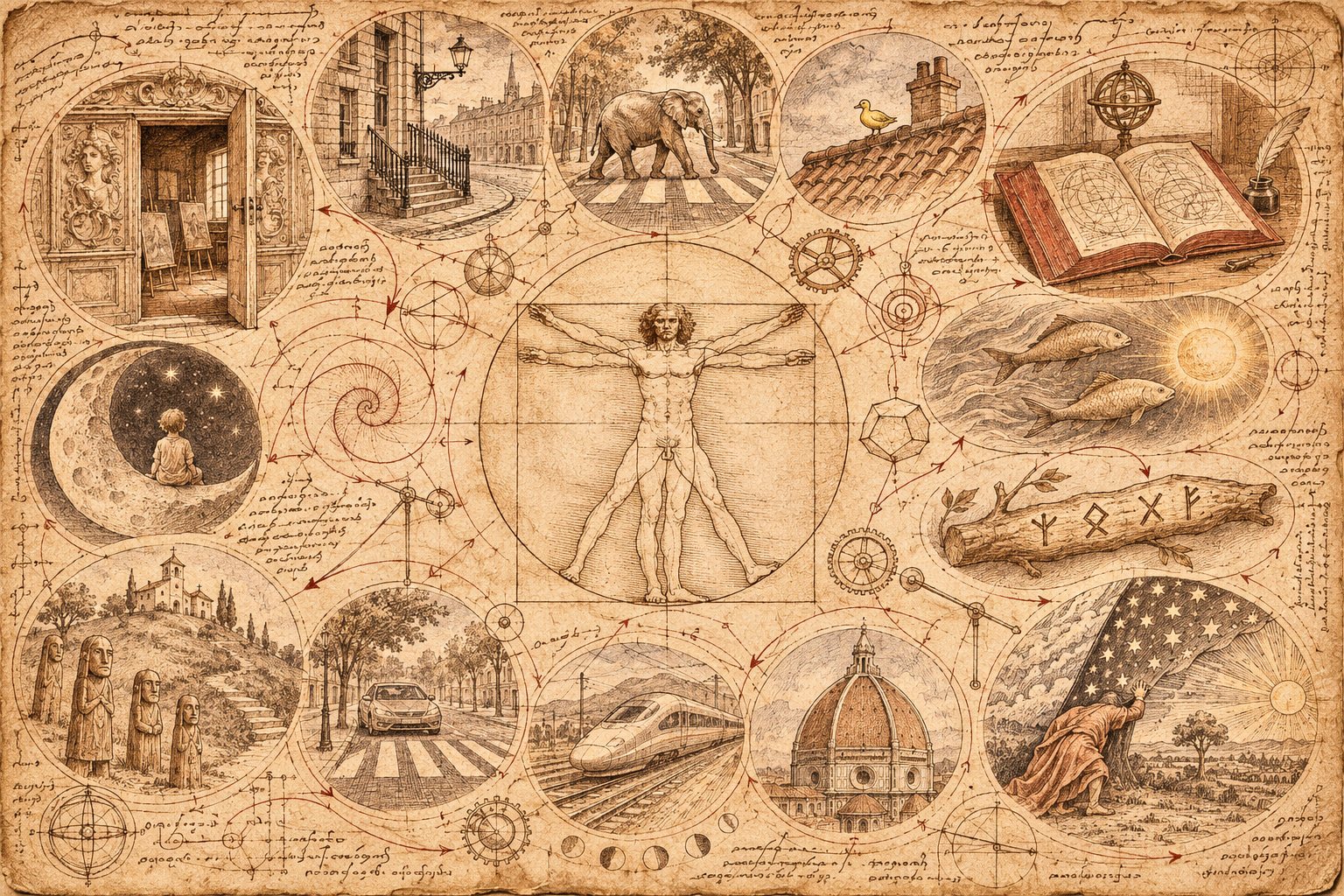
For a long time I have been writing a book called Virtuvian Odyssey. I named it after the figure I was sure I knew: Leonardo's man in the circle and the square. I wrote posts under that name, built its visual world, and spoke of the Virtuvian man as of Leonardo's. I never once doubted the spelling.
On 26 November 2026 I moved my whole website to a domain of its own and called it by the same word. The order and the time are recorded by the registrar.
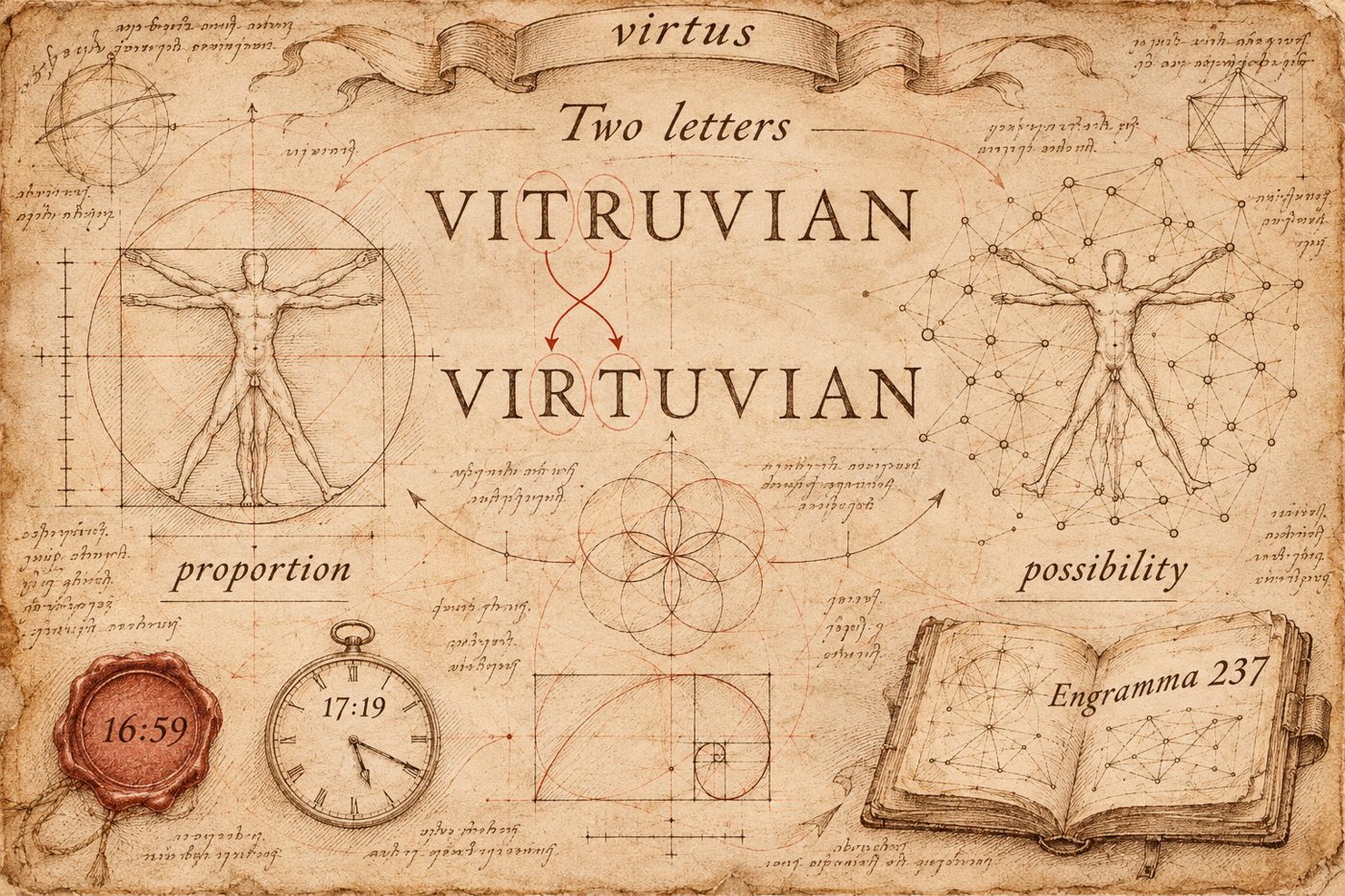
- 26 Nov 2026 · 16:59The registrar confirms the order for virtuvian.eu. The name is paid for. It is, in effect, a seal.
- 17:01The registrar confirms the first change of the domain's settings.
- 17:19I ask an AI what the word means and how it is written in Latin letters. The answer puts two words side by side: Vitruvian and Virtuvian.
- the same eveningI look for an explanation and find a peer-reviewed article from July 2026 titled Between Vitruvian and VIRTUvian.
At first I did not understand why the answer kept giving two names. Then I looked at the letters. VITRUVIAN. VIRTUVIAN. Nothing was missing and nothing was added. Two letters had simply changed places, in my memory, years ago, and nobody, not I and not the machines I worked with, had noticed.
The order matters. The name was fixed and paid for before the discovery, not chosen after it. Nothing on this page was arranged backwards to fit.
IIThe two letters
The real word comes from Marcus Vitruvius Pollio, a Roman architect of the first century BC. In the third book of De architectura he describes the well-formed human body as the source of proportion for temples. Around 1490, in Milan, Leonardo drew that description: a man inscribed at once in a square and a circle. Leonardo's own title was The proportions of the human body according to Vitruvius. The drawing is in the Gallerie dell'Accademia in Venice.
Linguists call what happened to me metathesis, from the Greek for transposition: two sounds or letters in a word exchange places. It is one of the most ordinary slips there is, and this one is especially common. The word VIRTU sits inside words we use every day, virtue, virtuoso, virtual, while VITRU sits inside nothing. Memory slides toward the familiar.
The slip itself is not rare. A 1995 scholarly article on Leonardo's drawing is listed in its university archive as Leonardo's Virtuvian Man: A Renaissance Microcosm. Shops, brands and museum labels make the same swap. A misspelling alone proves nothing. What follows is about what the misspelled word turned out to carry.
IIIWhat the word already meant
The two words lead to different roots. Vitruvian goes back to a man's name. Virtuvian falls onto the Latin virtus: strength, capacity, worth, the power to act. From the same family come virtuoso and, through the medieval virtualis, the word virtual, that which exists in potential. If the Vitruvian man is the human of proportion, the Virtuvian man is the human of possibility.
I was not the first to see this. Two women had already worked inside the gap between the two words.
Petit is an architect. Her argument is a history of how the human being has been measured. In Vitruvius and Leonardo the measure is the body and its stable proportions. With Brunelleschi and Alberti the measure becomes the eye of an observer standing in perspective. In online games it becomes the avatar, a body that is curated, edited and different in every player. And today it becomes data: the human tracked by sensors and recalibrated by algorithms, broadly what we call artificial intelligence. Her VIRTUvian body, she writes, is “not simply a misspelling … but a deliberate co-opting” of Leonardo's figure. It occupies the place the Vitruvian man once held, but without his stability and his universal proportions.
Her irony is that the more immaterial this measuring becomes, the heavier its apparatus: air conditioners, satellite dishes, cameras and sensors bolted onto the faces of buildings from Sofia to Bangkok. Her bibliography also lists a work titled The VIRTUvian Man, Rotterdam 2006, by R. Boteva. The idea of the swap is at least twenty years old.
Meshi, a new-media artist, moves in front of a recognition algorithm and lets it analyse her body. Mostly it labels her a person. At moments it reads her as a cat, a chair, a horse, a refrigerator. Her starting point is the same figure: Leonardo's man in the circle and the square stood for the measurements of the ideal human; today we are overlaid by digital doubles inscribed in the algorithm's rectangles. Her later work went further: for a year she lived as a joined human and AI being, speaking with a language model's voice.
Two women, two disciplines, one figure. Both take Leonardo's measured man and ask what he becomes when the measuring is done by machines.
IVWhere it meets my work
This is the part that cannot be found in any dictionary, and the reason I am writing this page.
My path into art began before artificial intelligence entered my life, at a time when I stood far from technology altogether. In 2021 I made a project called The Anthropocene: the age in which the human being becomes the force that changes the planet. In 2022 I painted Transformation / Threat, with the stencilled names of technology and biotech companies around its edges. Both are already on my coincidence map.
In May 2026 I heard the philosopher Mikhail Epstein, in an interview on Radio Svoboda, speak of the passage from the Anthropocene to what he calls the Noocene: the age in which thought itself becomes an evolutionary force. He dates it to the day, 30 November 2022, when ChatGPT was released, and writes of human, artificial and hybrid intelligence reshaping culture together; AI for him is not an imitation of the human mind but an alter intelligence. On 29 May 2026 I answered him with an essay, From Anthropocene to Noocene, built around my painting: before I knew the name of the force, I painted its pressure. My Anthropocene of 2021 had, without my knowing it, been standing on the threshold of his Noocene. The morning after I heard him, a friend request from Epstein arrived. That is recorded as its own coincidence in my registry.
Then, in the autumn of 2026, I wrote The Noocene Virtue. The Diamond Rule of Conscience, from a talk of Epstein's on ethics. Its axis runs: Epstein, the Diamond Rule, Robert Sardello's twelve virtues, conscience, the Noocene, and what Epstein calls the syntellect, the joined thinking of human and machine. Virtue and the Noocene stood together in the title of my own essay weeks before I learned that the word on my book falls onto the Latin virtus. The meaning the slip turned out to carry was already in the work. It was not brought in from outside to fit.
And my book, Virtuvian Odyssey, is the journey of a traveller through exactly this passage. Its method is the method of this website. For years I have been measuring my own life together with machines: the Room of 1.7%, a model of how improbable a chain of events is; Monte Carlo simulations of a single morning on Dorset Street; a map of thirty-five chains, each checked for what is fact and what is interpretation. Even the Codex sheets at the heart of that map are Leonardo's figure drawn again, not by a hand but by an AI.
The Vitruvian man is measured by his body.
The Virtuvian man is measured together with the machine.
Without knowing it, I had been doing for years what Petit's word describes: a human being measured, and measuring himself, through the digital and through AI. The name I gave my book by mistake, and sealed on a domain before I saw the mistake, turned out to be the exact name of what the book is about.
VThe elephant in the room
The last section of Petit's article is called The elephant in the urban room. On my map the elephant is a whole chain: in 2023 I planned a painting of an elephant standing on the Dorset Street crossing, my private measure of how improbable two meetings on one corner had been; a sketch made in half-sleep turned out to be made of elephants; and the founder of the Irish mental-health platform The Elephant in the Room wrote under it that the work was central to what he was trying to do.
There is a real rhyme here. In my chain the elephant was a measure of the improbable. In Petit's text the elephant is the heavy apparatus of measuring. But the elephant in the room is a common English idiom, and my map has more than fifteen recurring motifs. Had her article echoed any of the others, the door, the crossing, the room, I would have felt the same. So the elephant is recorded as an echo inside this case, checked and not counted.
The same applies to a date. Epstein's Noocene begins on 30 November 2022, exactly one year after the morning on Dorset Street, 30 November 2021. A match of day and month has a chance of about one in 365, and my story holds dozens of key dates. Noticed, and given no weight.
VIA third word: siquilistics
Until now my map has used the words that already exist. Synchronicity: an inner state and an outer event meet in meaning, at the same time, with no visible cause between them. Serendipity: something valuable is found by chance while looking for something else. Neither describes what happened here, because the meaning did not arrive at the same time as the event. It arrived years later.
Synchronicity
Inner and outer meet in meaning, at the same time, without a cause.
Serendipity
A valuable find by chance, while looking for something else.
Siquilistics
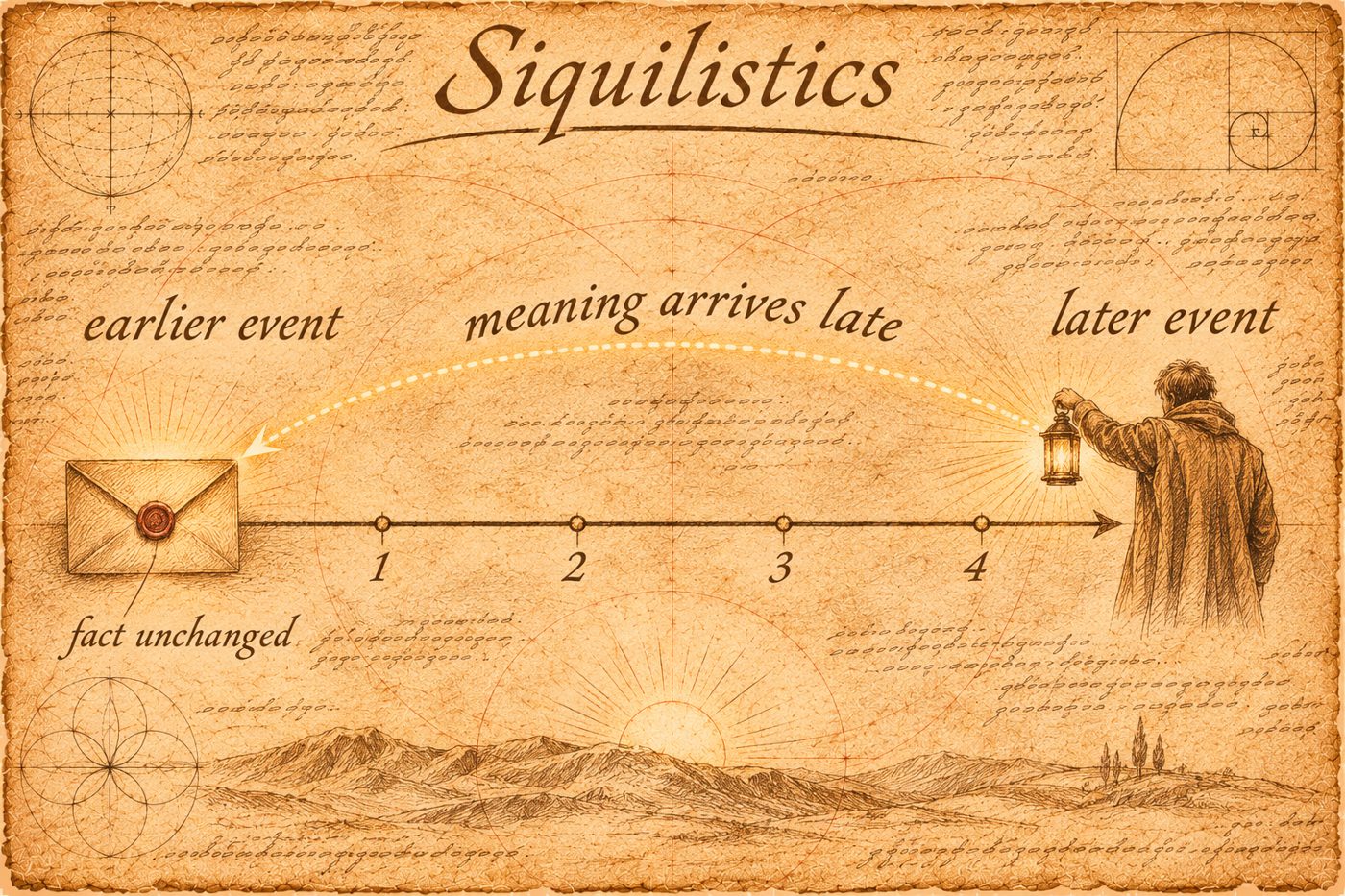
An earlier event, often a slip or a chance act, receives its meaning later, through a later event, while the earlier fact itself stays unchanged. The meaning comes late. The word grows from siquilizm, a term that came to me in a dream in October 2026: a later event can change the understanding of a chapter already written.
So that siquilistics does not become a polite name for apophenia, the human habit of seeing patterns in noise, a case has to meet four conditions:
- The seal. The earlier event was fixed and documented before the later one.
- Independence. The later event does not depend on me.
- Prior content. The new meaning matches something already present in the work, not something invented to fit the find.
- No retouching. The earlier event is not edited after the fact.
This case meets all four. The domain was paid for twenty minutes before the discovery. Petit's article appeared in July, without me. The human being and AI has been the subject of my book and my map for years, and virtue and the Noocene already shared the title of one of my essays. And the name stays as it was. Inside it there is also a piece of serendipity: looking for an explanation of my mistake, I found the article that gave the mistake its content.
VIIFact, experience, interpretation
I keep the name. VITRUVIAN is the human of proportion. VIRTUVIAN is the human of possibility. A word that changed its meaning through the order of two letters now names a project about meaning that changes through the order of events.
The same day, told as a story, with the song that played at its end: Sleep Will Come →
VIIISources
Ralitza Petit, Between Vitruvian and VIRTUvian. The Ironic Heaviness in Contemporary Immateriality, La Rivista di Engramma 237, July 2026.
Avital Meshi, The New Vitruvian. Digital doubles inscribed within bounding boxes, RAI 2022; The New Vitruvian: Becoming-with an AI Recognition Algorithm, MOCO 2024; Digital America page.
Charles Carman, “Leonardo's Virtuvian Man: A Renaissance Microcosm”, Quidditas 16, 1995 (title as listed in the archive).
Mikhail Epstein, Noocene. Thought as an Evolutionary Force, bilingual publication, since December 2025.
My essays: From Anthropocene to Noocene (29 May 2026); The Noocene Virtue. The Diamond Rule of Conscience (autumn 2026).
Vitruvius, De architectura, book III; Leonardo da Vinci, The proportions of the human body according to Vitruvius, c. 1490, Gallerie dell'Accademia, Venice.
My own: Synchronicity & Serendipity, the coincidence map; Trembling on Dorset Street.
Aivar Drukalski · Ealoiontoir · 26 November 2026
A page of the book Virtuvian Odyssey, written in the present tense alongside the life it describes.