IThe morning, and another Odyssey
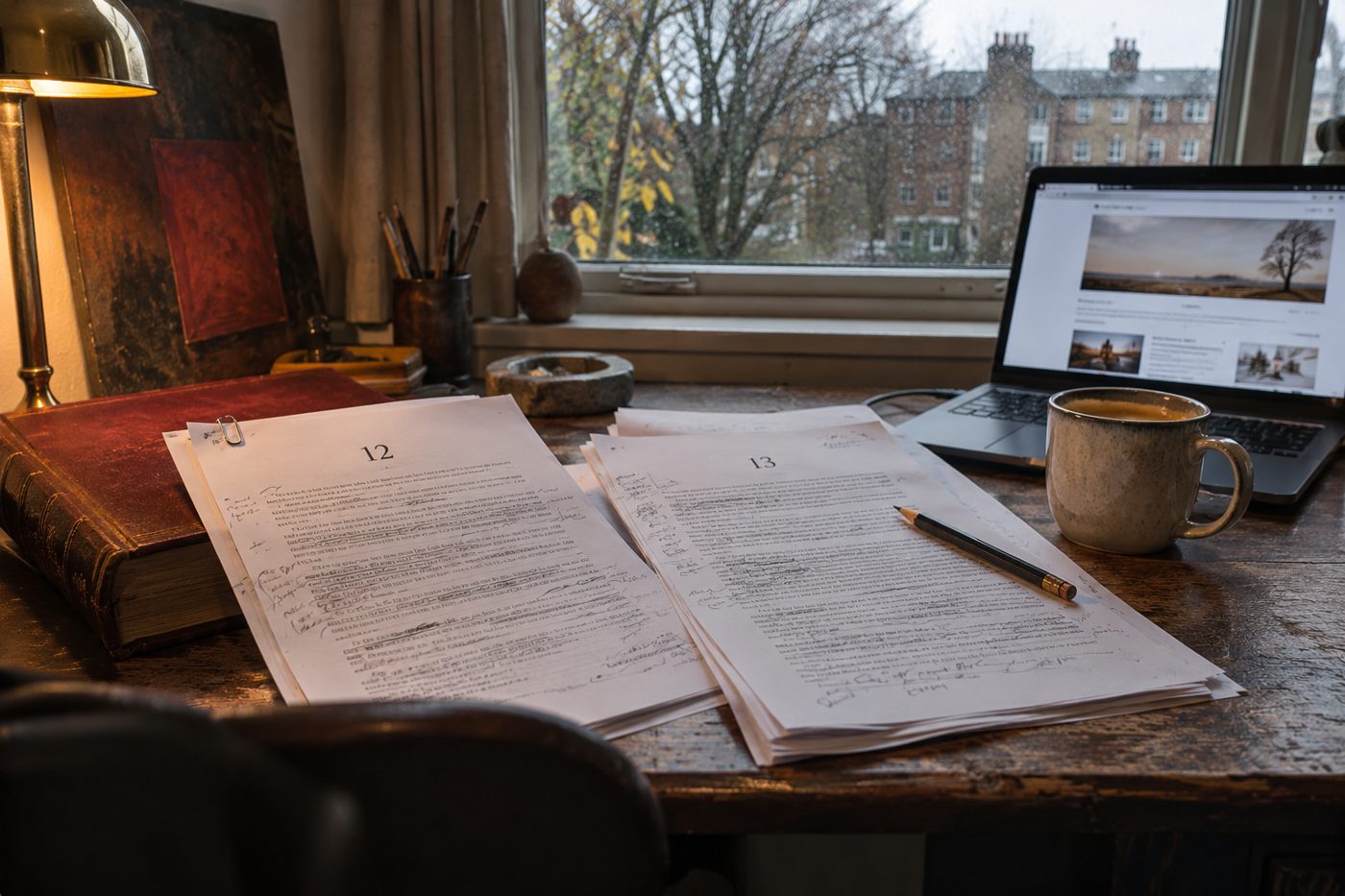
For a long time I used to begin my mornings with the book, and that morning, too, I had been sitting over chapters twelve and thirteen of the Virtuvian Odyssey, the one about an envelope that must not be opened and the one called The Other Shore, in which my traveller, carrying a small device in his pocket, has to decide whether to let it choose the next step for him, or whether a path that lights up before him has been chosen a moment before he chose it. I had moved the axis of the book a little, the way one moves a heavy table a few centimetres across a floor and finds that the whole room has changed its light, and then, half an hour later, almost in passing, as one asks the time of a stranger, I asked whether there was anyone else in the world who kept a record of coincidences the way I did.
The answer gave me only a name without a door, A Collection of Coincidences, and I had to type it myself, and the search, which I had begun the way one opens a drawer without much hope, led me to a writer in Ontario, Daniel Scarcello, who for ten years had kept his coincidences in a journal and let them guide the novel he was writing, a novel about a writer who hands his plot to coincidences and begins to believe that God is speaking to him through the book. Two of his pieces came up. I opened one. It began with The Odyssey.
What went through me then was not only the familiar prickling of the skin but something slower, a wave that passed down through the body and could not decide whether it was cold or warm, whether it was sinking or rising, and that arrived, as it always does, before I had time to think anything at all; the body, I have come to believe, keeps its own ledger of these moments and enters them before the mind has found its pen.
I spent the middle of the day reading all forty-four of his posts, and as one reads the letters of a person one has only just met, looking for one's own handwriting in theirs, I found the places where our roads ran side by side, Jung's advice to read a series of dreams rather than a single one, the ethics of writing about the living, the temptation to hand one's judgement to a machine, and I also found, which pleased me more, the places where they did not touch at all: no Ireland in his pages, no Latvia, no Red Book, no elephants, no crossing, no desert. A date that seemed to rhyme with one of mine I set aside, because, counted honestly, about one such rhyme was to be expected by chance.
IIA notebook in the manner of Leonardo
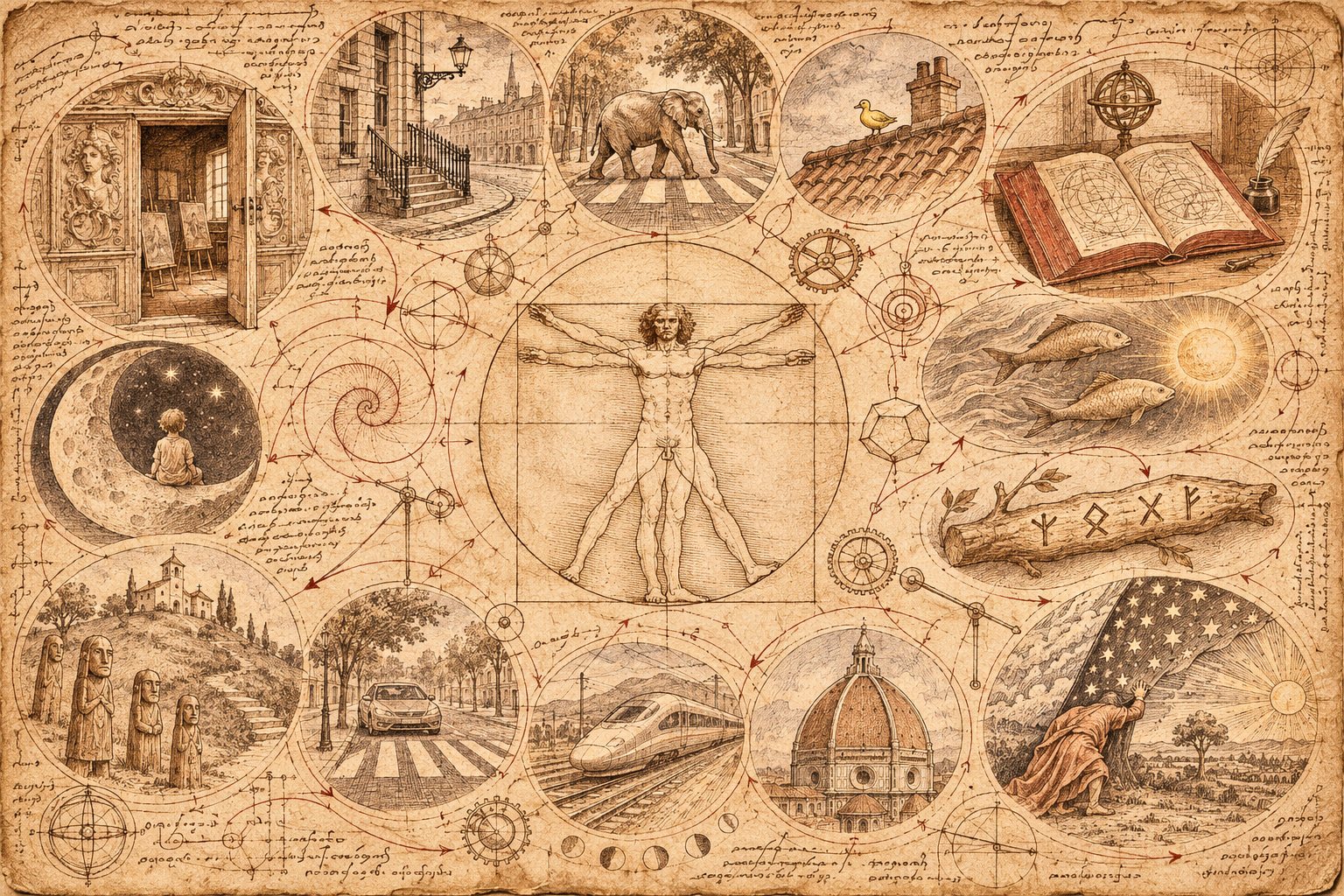
All afternoon I was drawing, or rather the machine was drawing for me and I was correcting it, sheets in the manner of Leonardo's notebooks, brown ink, warm paper, cross-hatching, and at the centre of the largest sheet a figure measured by a circle and a square, around which the motifs of five years of my life arranged themselves like the objects in a room one returns to after a long absence: the door, the steps, the elephant on the crossing, the duck on the roof, the Red Book, the two fish, the wanderer at the edge of the sky. On one of the sheets, which I called The Red Book · 1959, there were already, though I did not yet know they would be needed before night, the letters of a woman named Helen that I had bought at a car-boot sale in November 2022 and laid into a red painting, the passage from 1959 to 1960, the music of Arvo Pärt, and my Odysseus sailing over sand.
It did not occur to me then, as it did not occur to anyone, that the figure in the middle of the sheet had a name I had been mispronouncing for years.
III16:59
That afternoon I was also moving my whole website away from the rented rooms where it had lived for years to an address of its own, and I gave the address the name of the book. At 16:59 the registrar confirmed the order for virtuvian.eu; at 17:01 it confirmed the first change of its settings. I remember nothing of the moment except a small satisfaction, the kind one feels on closing a door that used to stick, and yet I know now that it was a seal, that the word had been fixed and paid for and set down in a public register, and that whatever happened to it afterwards could not be arranged backwards to fit.
IV17:19. Two letters
Twenty minutes later, out of nothing more than the wish to say the name properly in Latin letters, I asked what the word meant. The answer kept giving me two words, side by side, as if it were holding up two objects and waiting for me to notice that they were not the same, and for a while I did not understand why it insisted, until I looked at the letters themselves.
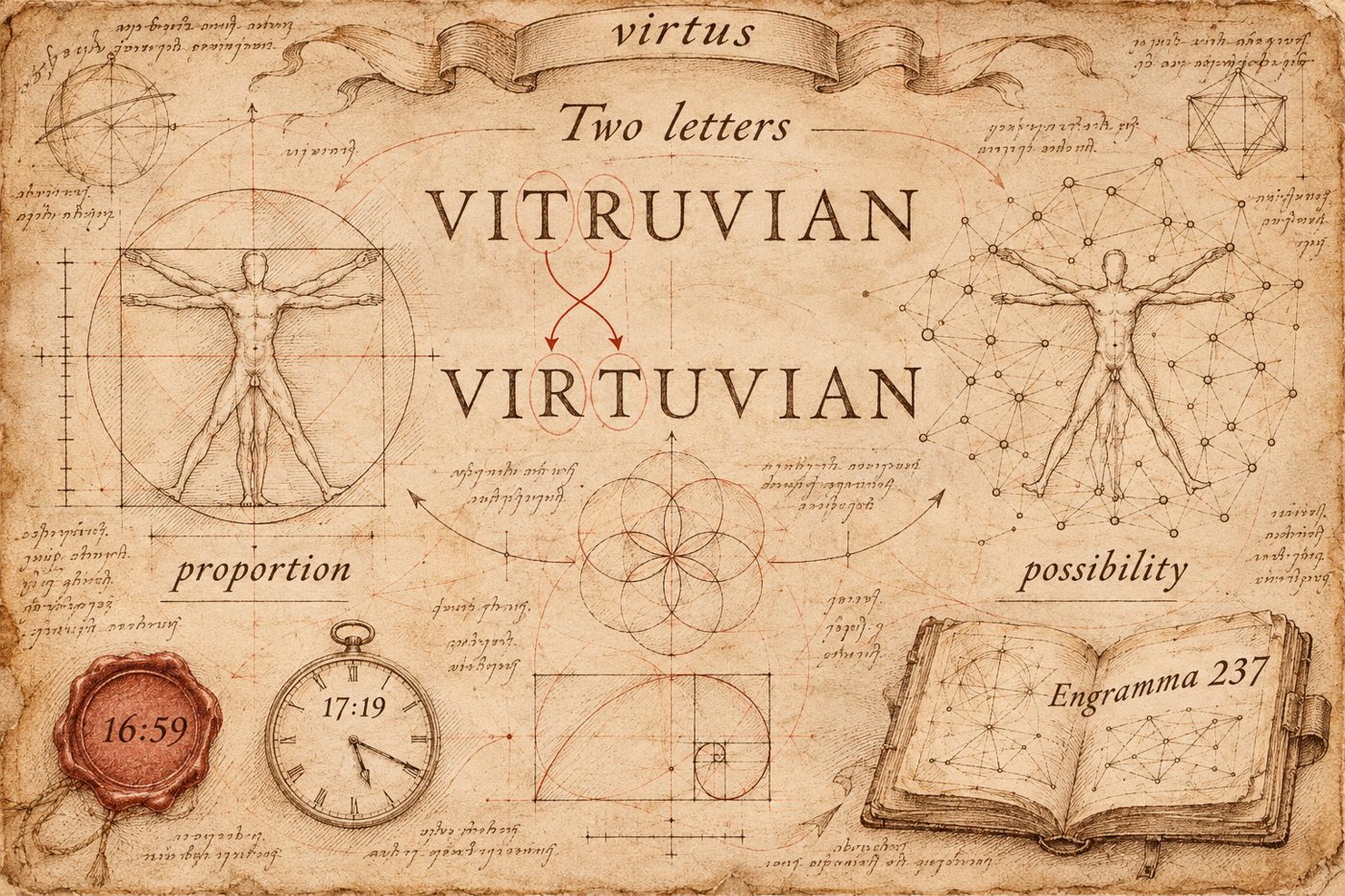
Nothing was missing and nothing had been added. Two letters had simply changed places, somewhere in my memory, years ago, and I had carried the changed word into the title of a book, into posts, into a project, into the visual world of a film, and now into a public register, and no one had noticed, neither I nor the machines I work with, who had repeated it after me with the perfect politeness of a mirror. Leonardo's word comes from a Roman architect, Vitruvius, who described the proportions of the human body as the measure of temples. Mine had fallen, without my knowing, onto the Latin virtus, strength, capacity, worth, virtue, the root from which virtuoso grows and, through a medieval word, virtual, that which exists in possibility. The man of proportion, and the man of possibility.
It is a common slip, linguists call it metathesis, and it is made by shops and brands and even, I learned later that evening, by a university archive that lists a 1995 article on Leonardo's drawing as Leonardo's Virtuvian Man. A misspelling alone proves nothing. What I did not yet know was what the misspelled word had been carrying all this time.
VThe article that already knew
I went looking for an explanation of my mistake the way one goes back into a house to look for a dropped glove, and found instead, as one sometimes finds in an old coat a letter one had forgotten receiving, an article published that July in an Italian journal of architecture and memory, La Rivista di Engramma, by the architect Ralitza Petit, under the title Between Vitruvian and VIRTUvian. It told a history of the ways the human being has been measured: first by the body and its stable proportions, as in Leonardo; then by the eye of an observer standing in perspective; then by the avatar, a body each player edits for himself; and now by data, by sensors and algorithms that recalibrate us continuously. Her VIRTUvian body, she wrote, was not simply a misspelling but a deliberate co-opting of Leonardo's figure; it stood where the Vitruvian man once stood, without his stability.
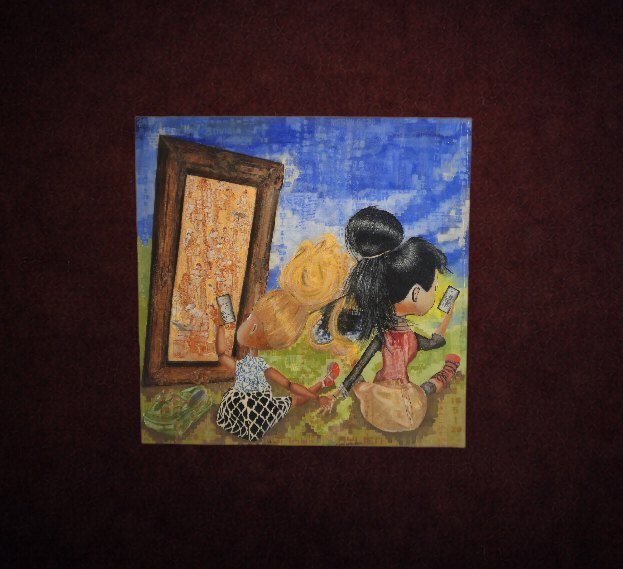
And it was then, reading her, that the whole of my own road came back to me at once, not in order but all together, the way the town of Combray rose out of a cup of tea: the project I had called The Anthropocene in 2021, when I still stood far from all technology; the painting of February 2022 with the names of Tencent, Meta, Google, Microsoft and NVIDIA along its edges like the walls of a room; the morning in May of this year when I heard the philosopher Mikhail Epstein speak of the passage from the Anthropocene to the Noocene, the age in which thought itself becomes an evolutionary force and human and other minds think together, and the friend request from him that arrived the next morning; the essay I wrote in answer on 29 May, From Anthropocene to Noocene; and, most surprising of all, an essay from this autumn whose title I had written myself and forgotten to read, The Noocene Virtue. Virtue. Virtus. The word onto which my slip had fallen was already standing in my own title beside the Noocene, weeks before I noticed the slip.
The Vitruvian man is measured by his body. The Virtuvian man extends his knowing through another mind, and keeps the measure his own.
VIWhat I did not count
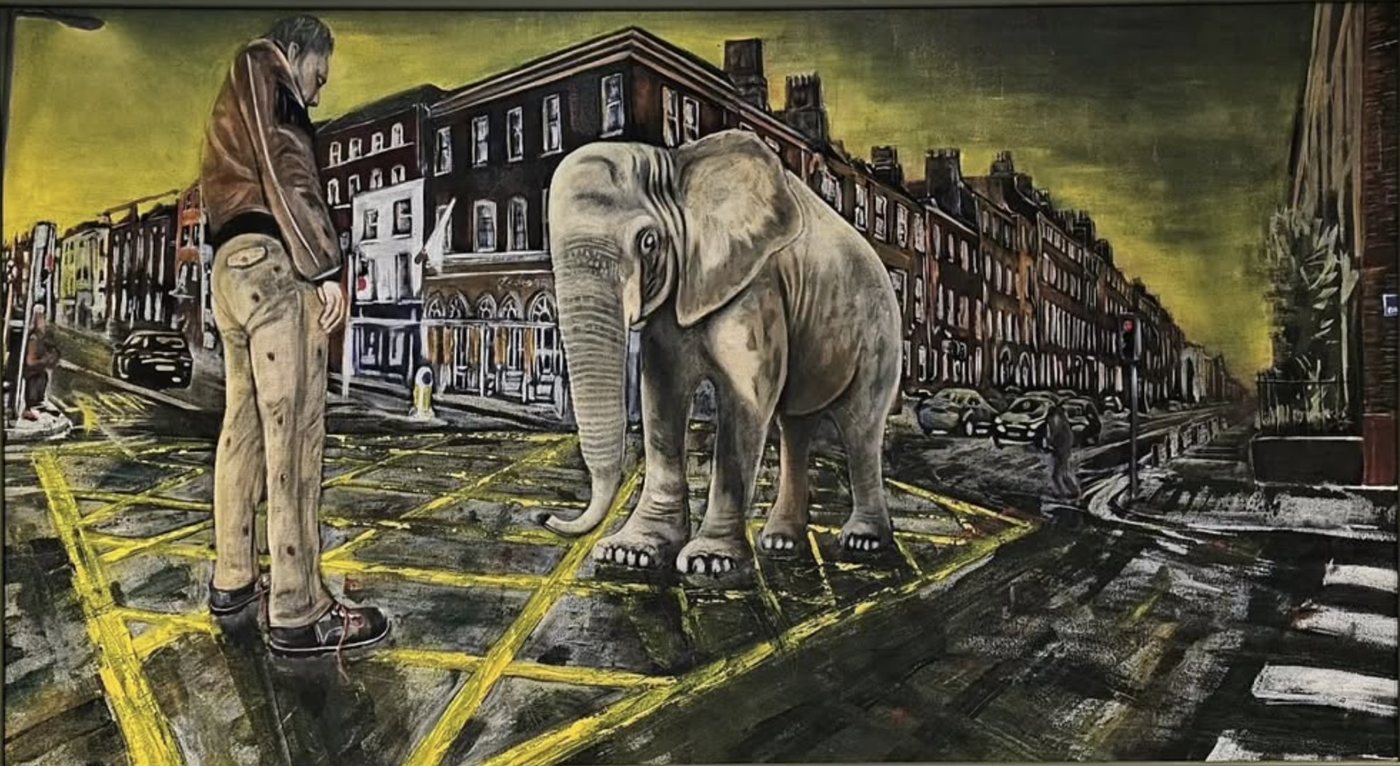
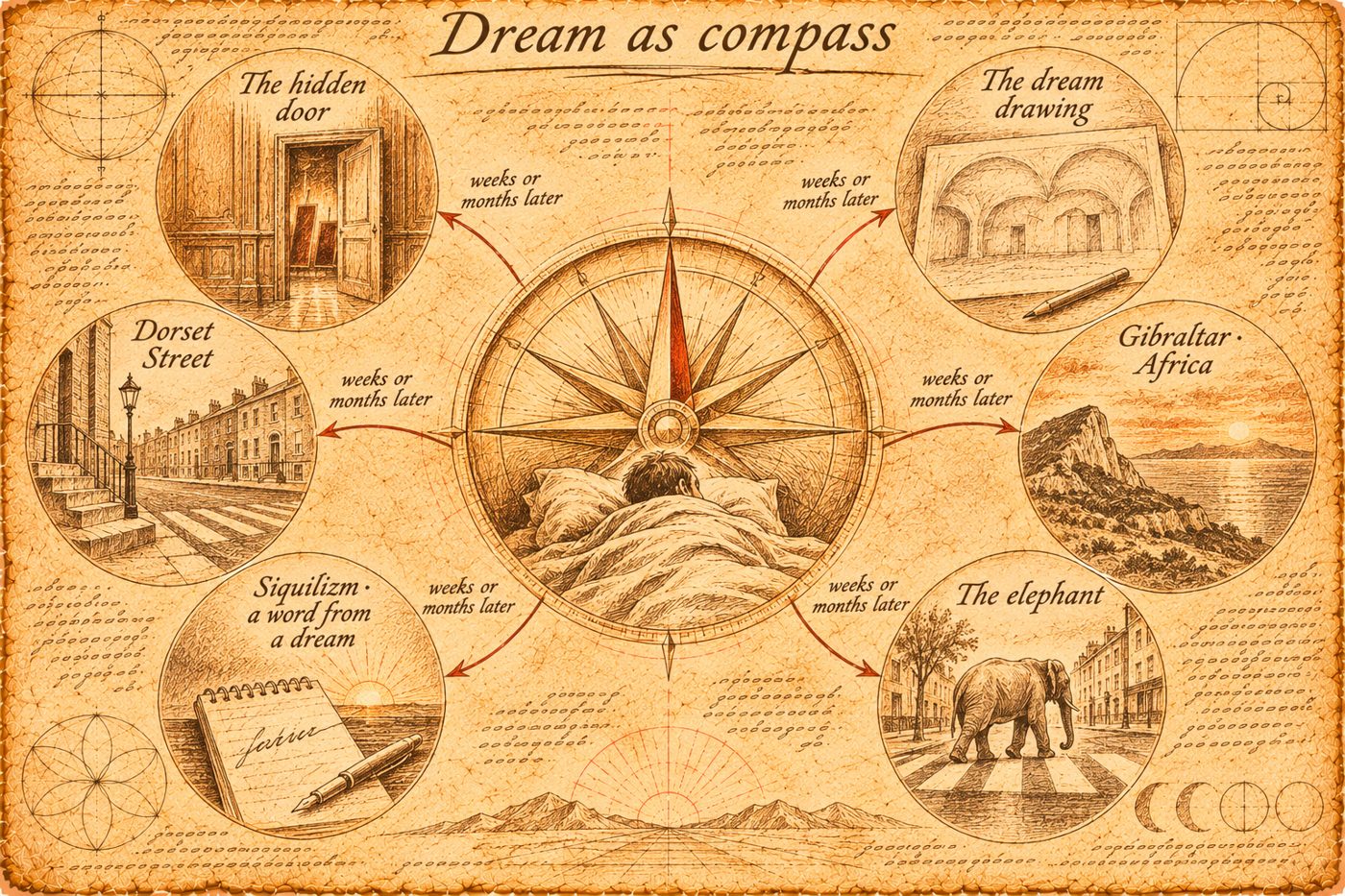
The last section of her article was called The elephant in the urban room, and I felt the wave again, because on my map the elephant is a whole chain, a painting of an elephant standing on the Dorset Street crossing that I had planned in 2023 as my private measure of the improbable, a sketch from half-sleep that turned out to be made of elephants, and a stranger whose platform was called The Elephant in the Room writing beneath it that the work was central to what he was trying to do. And yet the phrase is a common idiom, and my map holds more than fifteen recurring motifs; had her article spoken of a door or a crossing or a room, I would have felt the same wave. So I wrote it down, and did not count it.
Nor did I count the date, though it shone for a moment like a coin in the gutter: Epstein dates the beginning of the Noocene to 30 November 2022, the day the machine I now talk to every day was released, exactly one year after the second morning on Dorset Street. A match of day and month comes about once in three hundred and sixty-five, and my life holds dozens of dates I care about.
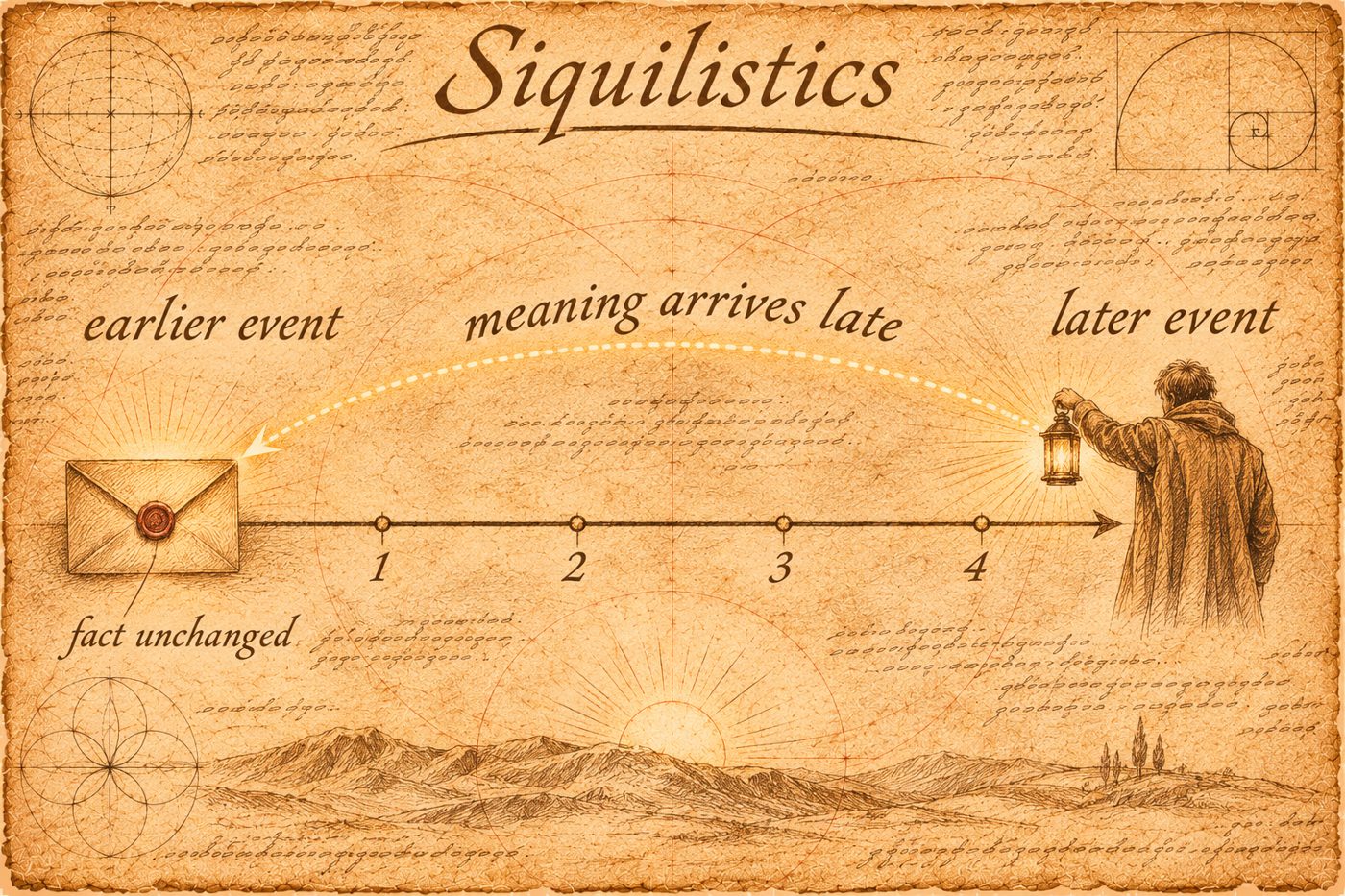
By seven in the evening I had given the case a name and the map a new colour. Beside synchronicity, where inner and outer meet at the same time, and serendipity, where a valuable thing is found while looking for another, I wrote a third word, siquilistics, for the meaning that comes late, and I grew it from siquilizm, a word that had come to me whole, in large blue letters in a notebook among my late grandfather's things, in a dream on the night of 13 October.
VIISleep will come
I thought the day was over. I had written its chronicle, section by section, as one closes the shutters of a house one by one before going to bed, and at a quarter past seven I gave the chronicle to the other machine, the one with which I am writing the book, and it began its answer by saying that it would mark 26 November as a date of its own in the history of the Virtuvian Odyssey, the day on which the subject of the research, the researcher and the book itself had found themselves inside one and the same process. At the very moment I was reading those words, with the music playing on shuffle as it often does in the evening, a song began whose title I photographed at its forty-seventh second: Sleep Will Come, by Bliss.
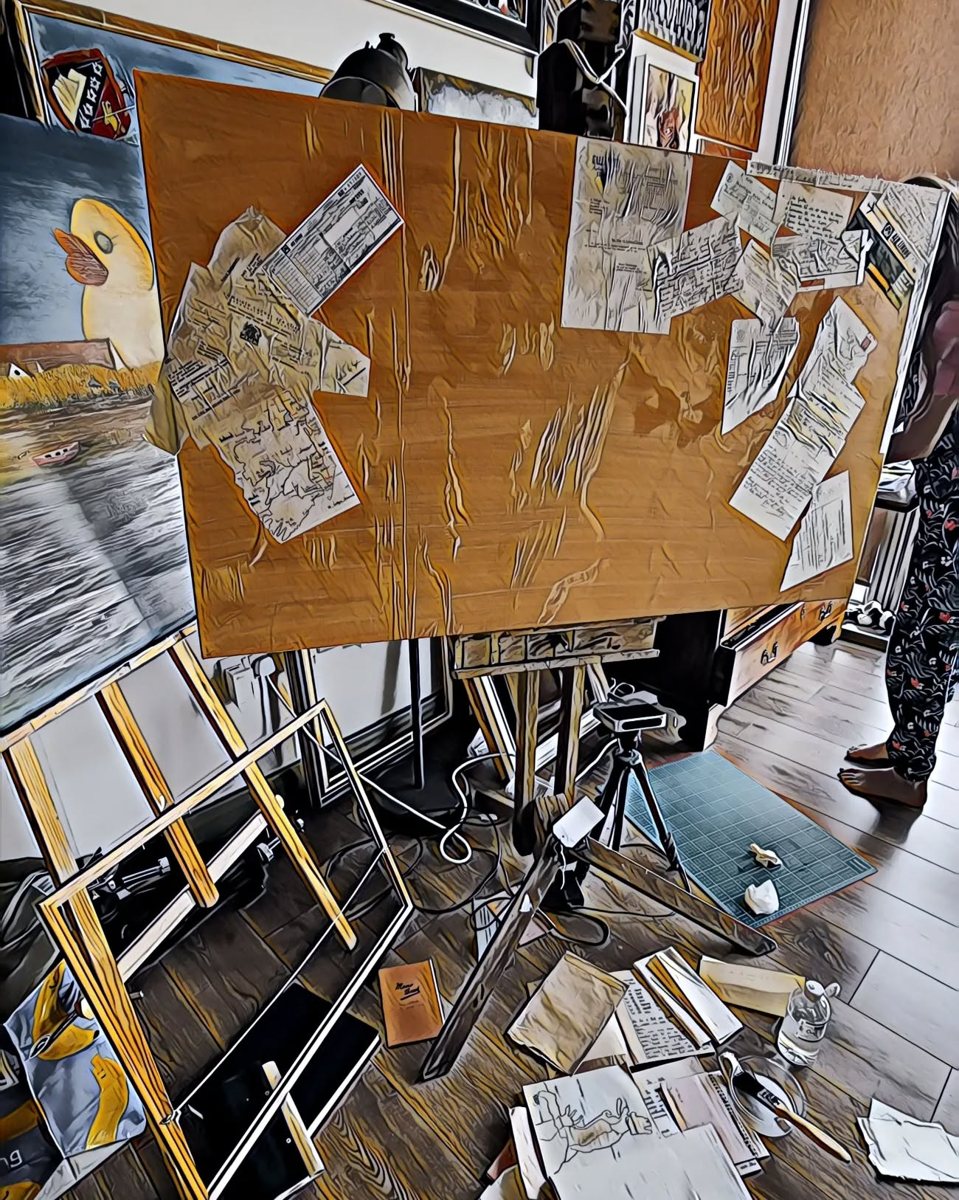
The machine saw at once what I had not had time to see, that the song was speaking of sleep on the evening when everything I had done all day had come, in the end, from a dream, from the night of 13 October and the word in blue letters. But it did not see the second thing, and it was I who gave it back: the album was called Quiet Letters, and I had once had a project called Letters from the Past, built on the letters of Helen from 1959 and 1960, which lay on that very sheet of the codex I had drawn at noon, beside the Red Book and the music and the boat on the sand. The machine found one thread, I found the other, and its next answer was richer than either of us had been alone, which is, I think, the whole of what I mean by Quiet Collaboration.
Later the same machine and I spoke about what we call the Core, which is not the archive but the memory, the method and the reflection that our long conversation has formed, and agreed that the book grows out of it and not the other way round, that a meaning has the right to arise but not the right to declare itself true merely because it has moved us. And it corrected, gently, the sentence I had been so pleased with at seven o'clock: to say that the Virtuvian man is measured together with the machine, it said, leaves open who sets the measure. So the definition changed once more, on the same day, as definitions do in a book that is written in the present tense.
VIIIThe whole day, seen at once
When I look back at it now, I see it not as a line but as a single figure, the way one sees a cathedral from a distance and no longer the stones.
In the morning a man whose Odyssey began where mine is still sailing; at noon a sheet of drawings on which the letters were already waiting; at one minute to five a name set in a register; twenty minutes later the discovery that the name was not what I had thought; in the evening an article that already knew what it meant, and my own forgotten title that had known it too; and at night a song about sleep from an album about letters, which returned me at once to the dream from which my method came and to the letters from which one of my first works was made. None of these things was changed by the others. The letters remained letters, the mistake remained a mistake, the song remained a song. Only the whole in which I understand them changed, as the last note of a melody changes how we hear the first.
My Odysseus has not reached Ithaca. But on that night, I think, he could drop anchor.
The past is not rewritten. It goes on opening.