Synchronicity & Serendipity
Thirty-three chains of coincidence, eighty single coincidences, one field. Dreams, paintings, a street corner in Dublin and the people through whom the chains passed. Click a point to open its story.
Overture
Everything here happened. The facts are checked against the record; only the language is allowed to dream.
It did not begin with an idea. It began with a morning in November 2021, at the corner of Dorset Street and Blessington Street, when I stopped the car for no reason I could name and photographed a stranger on the steps whose hands were shaking; and with the next morning, when on exactly that stone stood a man I had last seen more than twenty years earlier in a boutique in Riga, and it was my own hands that shook. Time stamps in the photo files keep those two mornings honest: 10:38 on the first, 10:25 on the second. The rest is what I lived between them.
Since then the coincidences have not stopped, and they rarely come alone. A dream of a hidden door waits half a year for a theatre set; a bundle of papers bought for five euro at a flea market in Balbriggan returns, three years later, as one German word in a lecture; a twig with four burned runes lies in a park I have crossed for fifteen years, on the one morning after I saw my soul as a child on the Moon. Like the madeleine in Proust, each of them opens not a single memory but a whole room, and in that room older objects are already waiting, as if the house had been furnished before I arrived.
I try to walk through those rooms without inventing the furniture. Every chain below is split into what the record shows, what I lived and how I read it, with a note of how sure each part is. Where a person, a book or a machine passed something to me, I say so. Where a date is only my working date, I say that too. The images are of three kinds: my own paintings and photographs, public pages, and illustrations made with AI in the visual world of my book Virtuvian Odyssey, each marked as such.
The places
The same chains, set down where they happened: Dublin, Latvia, a rock above Africa, a building in the Swiss hills. Every light is a place, its size the number of coincidences in its chain; the arcs join the places of one chain and the chains that continue one another.
One field, many chains
Each coloured point is one chain: several coincidences joined by one meaning within a short span of time. Its colour shows where the chain began, in a dream, in a waking image or thought, or in an event outside. Every single coincidence inside a chain is counted on its own and has its own type: it is one of the small moons around the point, and its colour shows the type. Together the coincidences form the chain, which as a whole can be something more: several separate synchronicities that, taken together, make one serendipity. The diamonds are images that keep returning, the squares are places, the circles are people and mediators. Solid lines mark a direct continuation, where one chain leads straight into the next. Dashed golden lines are echoes: two chains that share one concrete element, a person, a place, an image or a date.
The codex of connections
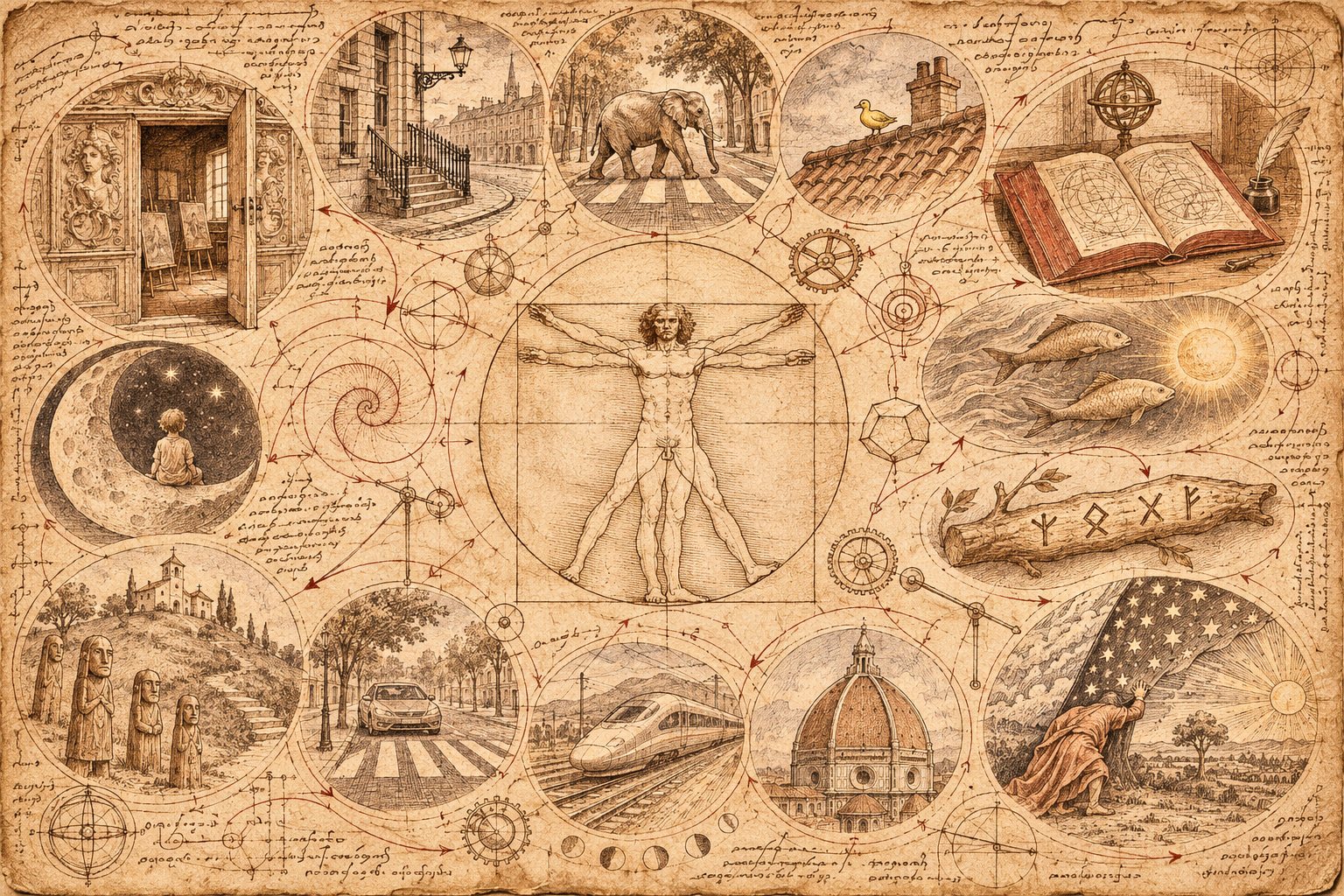
Each returning image, place or road of the field, drawn as one notebook page with the chains it joins.
AI illustrations in the manner of Leonardo's notebooks, in the visual world of my book Virtuvian Odyssey. The words on each sheet are only the names of real chains and their dates; nothing on a sheet adds a link that is not in the record below. Click a sheet to enlarge it, a name to open the chain.
The stories
In order of time. Each opens with its documents and images.
The words used here
The types follow the psychiatrist and coincidence researcher Bernard Beitman, often described as the first psychiatrist since Jung to systematise the study of coincidences: Connecting with Coincidence (2016), Meaningful Coincidences (2022) and Life-Changing Synchronicities (2025). One chain often carries several types at once. The last type, siquilistics, is my own addition: a third word beside synchronicity and serendipity for meaning that arrives late.
How the field is read
Method, after Bernard Beitman, and the rules I keep against inflation
Bernard Beitman, a Yale-trained psychiatrist and former chair of psychiatry at the University of Missouri, often described as the first psychiatrist since Carl Jung to systematise the study of coincidences, has spent decades building coincidence studies as a field. He describes a coincidence by its anatomy: two events that resemble each other, joined by a span of time. Each of the two can be a mental event, a thought, image or dream, or a physical event in the world. The two primary measures are the time between them and how similar they are; surprise and ownership come next. In a later essay he weighs the quality of a coincidence by its probability, its impact on the person and how much explanation it demands, and secondly by the degree of similarity, the weirdness of the pattern and the width of the time window.
I use these measures directly. Every story window on this page has a short Reading after Beitman: whether the chain began with a mental or a physical event, its time window, how many single coincidences it holds, whether the body answered, whether someone or something mediated it, and whether it is checked or still a draft.
Every story window also ends with The check: is it inflation? Four lines: what record exists and when it was made; whether anything was written down before the match; the ordinary explanations, in the terms the statisticians Persi Diaconis and Frederick Mosteller proposed (a hidden cause, the many possible endpoints we would also have counted, memory and attention); and how I finally count the chain. Where checking found a likely hidden cause, as with the duckling, it stays on the page.
Conditions: transition, emotion, need
Beitman finds that coincidences gather around three conditions: times of transition, high emotion and strong need, such as a death, a move, a new love or a creative crisis. Mine follow the same pattern. Many cluster in my years at NCAD, when I came to art late and my picture of reality was changing; others around my stepfather's death in February 2022, around a long search for people with a similar path, and around finding old friends again in Latvia. Where I know why a coincidence touched me, the story window now has a field Why it mattered. A synchronicity is not only a match of two events. It lands on something unfinished in the person, and that is part of its meaning.
Counting without inflation
- Every single coincidence is counted once, with its own type. A chain made of several is one entry, with its own character as a whole.
- Links that passed through people who share my interests, or through AI systems that answer what they are asked, are marked as mediated and kept apart in the numbers.
- After the first find, attention is primed: once I am looking for a motif, I will see it more often. I treat later links inside a family as weaker for that reason.
- Drafts from my registry are shown with a dashed rim and do not count as checked until I have gone back to the original record.
- A link between chains is drawn only when there is one concrete shared element: the same person, place, object, image or date. Shared moods or themes are not enough. The dashed golden lines are such echoes; there are only a few, on purpose.
- I keep three layers apart: what happened (fact), what I lived (experience) and what I think it means (interpretation).
Work in progress
The registry. Behind this map is a longer case registry: in its version of 25 November 2026 it holds 68 entries in 18 families, from 2019 to now. The map shows the chains that are best documented, and keeps growing as I check more of them. For each entry an AI estimates a low and a high probability, while I set its impact on my life, from 0 to 10, before I see the numbers, so that the estimate cannot steer my sense of meaning. The unit of analysis is the family, not the single entry.
The Room of 1.7%. In June 2025 I imagined a room where people with a similar inner path could find each other with the help of AI: not by likes or opinions, but by the long trajectory of their life, how symbols return and change over years. Time is the filter, since style and words can be copied but years of slow change cannot. No hierarchy, no ranking, and nothing without consent. The provisional model scores a path in eight modules, 100 points converted to a coefficient up to 2; the threshold of the room is 1.70. The name is a mark of rarity, not a statistic. Now I am adding an entry parameter that reads the improbability and uniqueness of a person's coincidences together with the history of the pattern, while keeping the Room's other measures. The Room of 1.7% · Where the Room came from
Dorset Street. The morning on Dorset Street in November 2021 is still the threshold of everything. I am reopening its calculation with more inputs and a coefficient for the whole series as one pattern, not for the single event alone. Film: Trembling on Dorset Street
The book. All of this belongs to my book in progress, Virtuvian Odyssey, written in the present tense, alongside the life it describes. The illustrations marked as AI on this page come from the same visual world as its film chapter.
Siquilizm
Siquilizm is the working term for what the field shows as a whole. Unlike events arrange themselves over time into one sequence of meaning. Each new link continues the meaning of the one before, though it comes from another part of life: a dream, a painting, a street, a book, a person. From inside it is experienced as being led. It differs from seriality, which rests on the repetition of the same thing, a name or a number, and from a single synchronicity, which joins one inner state to one outer event. Siquilizm describes the chain of such moments and how one leads to the next.
Siquilistics is the name for the single case of it: an earlier event, often a slip or a chance act, receives its meaning later through an event that does not depend on me, while the earlier fact stays unchanged. I count a case only under four conditions: the earlier event was fixed before the later one; the later one did not depend on me; the new meaning matches something already present in the work; and nothing was edited afterwards. The clearest example is the name of this project, told in Two Letters.
What the field does not prove
The field counts what was remembered and written down. It cannot show the days when nothing happened, or images that led nowhere. Several links passed through people who share the same interests, or through AI systems that answer what they are asked; they are marked as mediated, because they are less independent than the rest. The strongest links are those where my own part was smallest: the man from Riga standing on the spot photographed the day before, a death on Warhol's date, the duck on the roof. A log of misses, kept from now on, is the only honest answer to the question of selection.
Privacy
Private people appear by first name only, and some only by their relation to me. There are no photographs of private people's faces: the images are my own paintings, drawings and objects, film stills made with AI, and public pages. The AI illustrations show me as the figure from my film Trembling on Dorset Street; every other figure in them is invented. Health, faith and other sensitive details of other people are left out. Scholars, artists and public figures are named in full where their public work is part of the story. If you appear here and would like something changed or removed, write to me and I will do it.