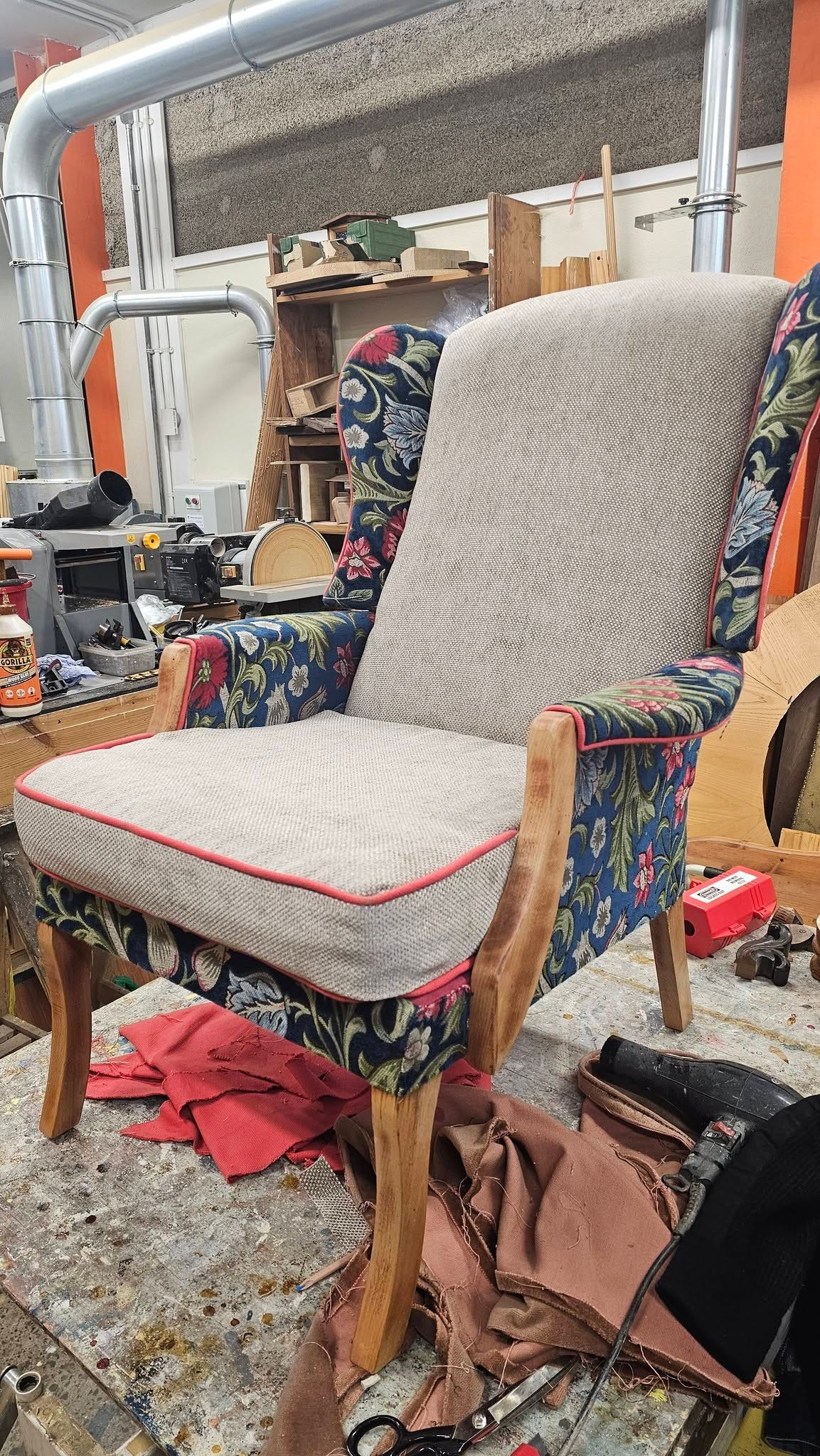
Sometimes time moves a person forwards in a rather strange way: by taking them back. Not literally into the past, but towards ancient relationships between a human being and the world — hand, material, tool, time. That is how I unexpectedly found myself facing an old armchair.
At first it was simply an object that needed to be taken apart: remove the fabric, pull out the staples, reach the structure, see what remained inside, where the wood had weakened, what had happened to the springs, what could be kept and what would have to be made again. Gradually, though, the object ceased to be merely an armchair: it began to unfold as a history.
When you take old furniture apart, time reveals itself physically. Beneath one layer lies another: under the fabric, canvas; under the canvas, stuffing; then webbing, springs, wood. Old nail holes. Tool marks. Places where earlier repairs were made. Another person's mistakes. Sometimes, the exceptionally precise work of a craftsman who is long gone. And then you realise: what lies before you is not a surface, but time in cross-section.
The hand that remembers
Something else surprises me: at a certain point I began to notice my own hand changing. Its movements become more precise; my fingers begin to feel the tension of the fabric, the resistance of the wood, the pressure of the tool. After working with small details, you approach wood differently; after wood, you understand upholstery differently: one craft gradually teaches you another.
A kind of knowledge emerges that is difficult to put into words. You can watch 100 videos about stretching fabric, but at some point the hand has to feel for itself: a little more; enough; tighter here; no rushing there.
This knowledge lives somewhere between body and mind — and perhaps humanity understood it much better before we began handing more and more actions over to machines.
Before the factory
For a long time, furniture restoration did not exist as a separate profession in the modern sense: carpenters, cabinetmakers and joiners repaired the things they made themselves; repair was a natural continuation of making. The diary of the American apprentice cabinetmaker Edward Jenner Carpenter contains an almost improbably simple entry: on 29 May 1845, the young craftsman noted that he had spent the morning repairing a desk. For historians of restoration, the entry is interesting precisely because it is so ordinary: the craftsman saw no great distinction between making an object and allowing it to continue.
Traditional upholstery itself is much older than the modern furniture industry. Before foam, synthetic fillings and pneumatic staple guns, an armchair was gradually built by hand from webbing, canvas, jute, horsehair, wool, cord and springs. Many of the basic upholstery methods took shape in the 18th century; sprung construction spread later and became part of the European tradition of making upholstered furniture.
This is a fundamentally different way of producing something: an armchair was not assembled in a few minutes, but came into being gradually, layer by layer. So today, when you take an old armchair apart, you are in effect repeating the movements of people who made such things 200 years ago. Technique becomes a form of memory.
The economy disappears
But what matters most to me now is not even technique. It is the chance to make something without the constant pressure of a result. In ordinary economic life there is always an invisible stopwatch: what does an hour cost, how much time is worth spending, could it be done faster, would it not be cheaper to buy something new? Once you start calculating like this, old furniture almost always loses: a new object really is easier to manufacture industrially.
But there is another question: why must it necessarily be done faster? At the Rediscovery Centre, I now have a rare opportunity to step outside this logic. No one stands beside me with a stopwatch — I can stop, look, redo something, come back tomorrow, try another technique, learn something I did not know before.
And at some point you notice an unusual state: the economy disappears, but the work remains. You are doing it not because every minute must be turned into money, but because you want to understand the material and because the process itself gives you pleasure. It is an almost forgotten form of freedom.
Material has a biography too
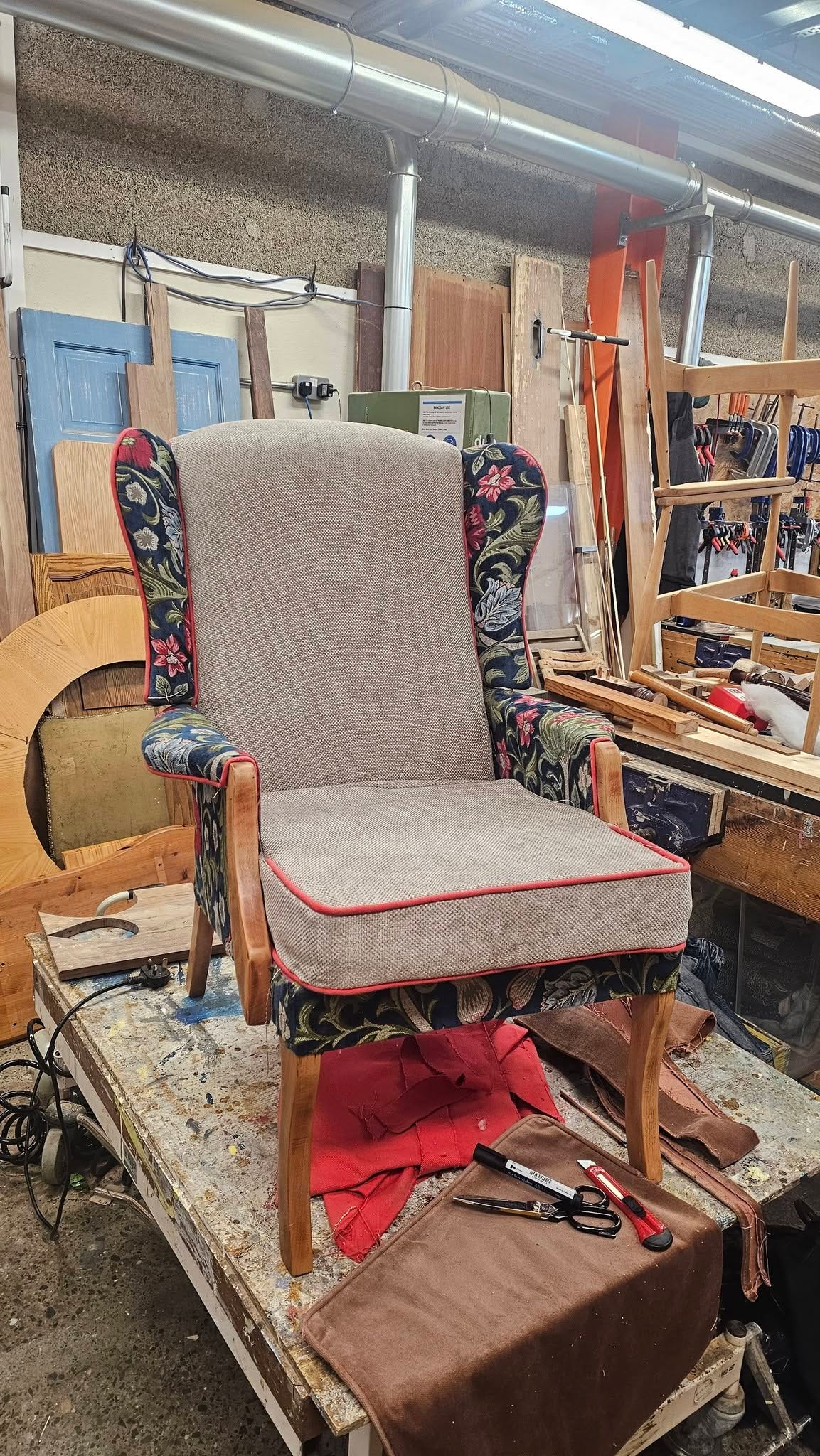
Something else important happened with this armchair: for its new life I used old canvases brought from a castle. Here restoration suddenly became something more than technical repair, because material has a past too. The fabric had another place, another architecture around it, another light, other people, another air. Now part of that material enters the armchair's new story.
A strange chain emerges: one thing completes its original function and becomes part of another. Material does not disappear; it migrates. This is where, for me, the elusive magic of working by hand appears — not mystical in the banal sense, but almost phenomenological.
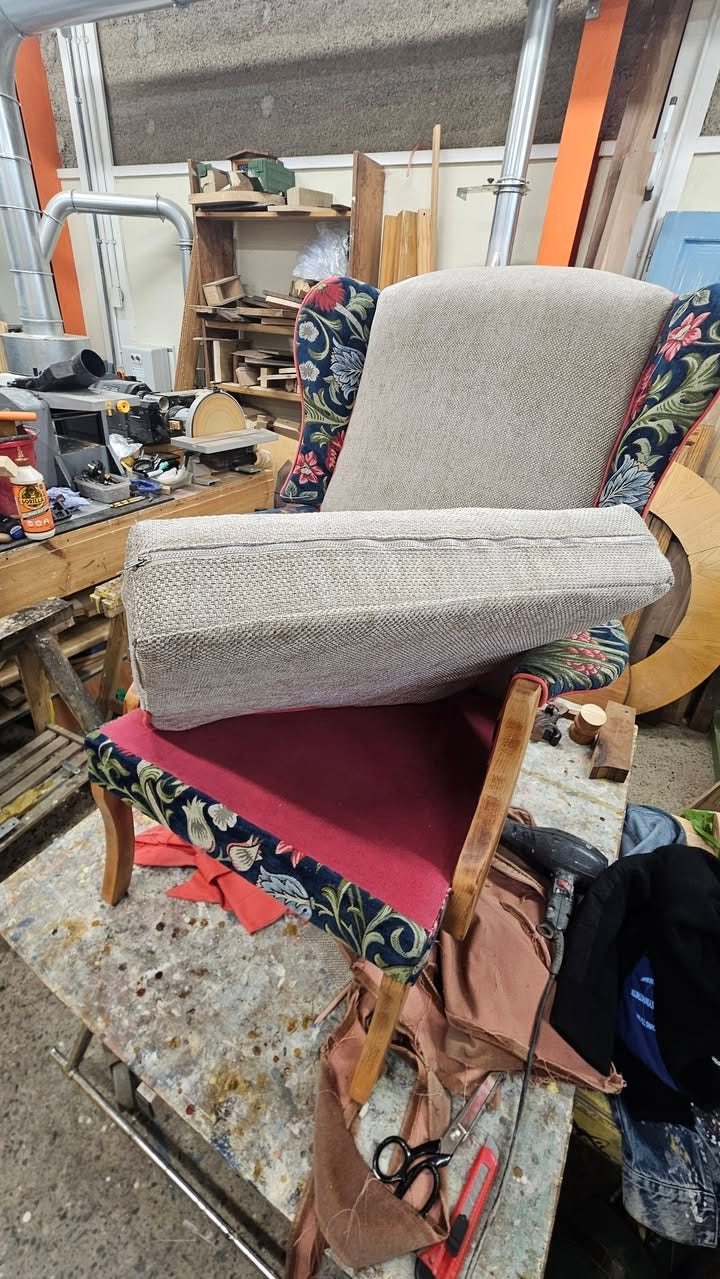
Every object retains a trace of the relationships it has passed through. Someone worked the wood. Someone built the armchair. Someone sat in it for many years. Someone threw it away. Someone saved fabric from another place. And then all these lines unexpectedly meet at a single point: in your hands.
The restorer does not begin the story
Modern conservation has gradually arrived at an important idea: an old object cannot simply be regarded as a damaged new one; its alterations themselves become historical evidence. In old furniture, even the arrangement of nail holes, a thread left beneath a fastening or a fragment of earlier fabric can tell us about its original upholstery and later alterations — which is why conservators try not to destroy such traces unnecessarily.
I feel close to this way of thinking. A restorer should not behave like someone who has come to correct the past: they have come to enter into a conversation with it. That is why I understand restoration less and less as an attempt to make something as good as new — sometimes an entirely new surface destroys what is most interesting.
Wear can be the memory of a hand. A small dent, the trace of an event. A hole, evidence of an earlier covering. A scar is not always a defect: sometimes a scar is a biography.
Grandmother's armchair
Imagine an ordinary armchair: for decades it stood in a grandmother's home. Newspapers were read in it; someone held a child on their lap; someone sat through the night beside a sick person; someone talked on the telephone; someone was silent.
Then the home changed, there were fewer people, and the armchair was no longer needed. Modern logic says: throw it away, buy another — the new one will be cleaner, lighter and cheaper.
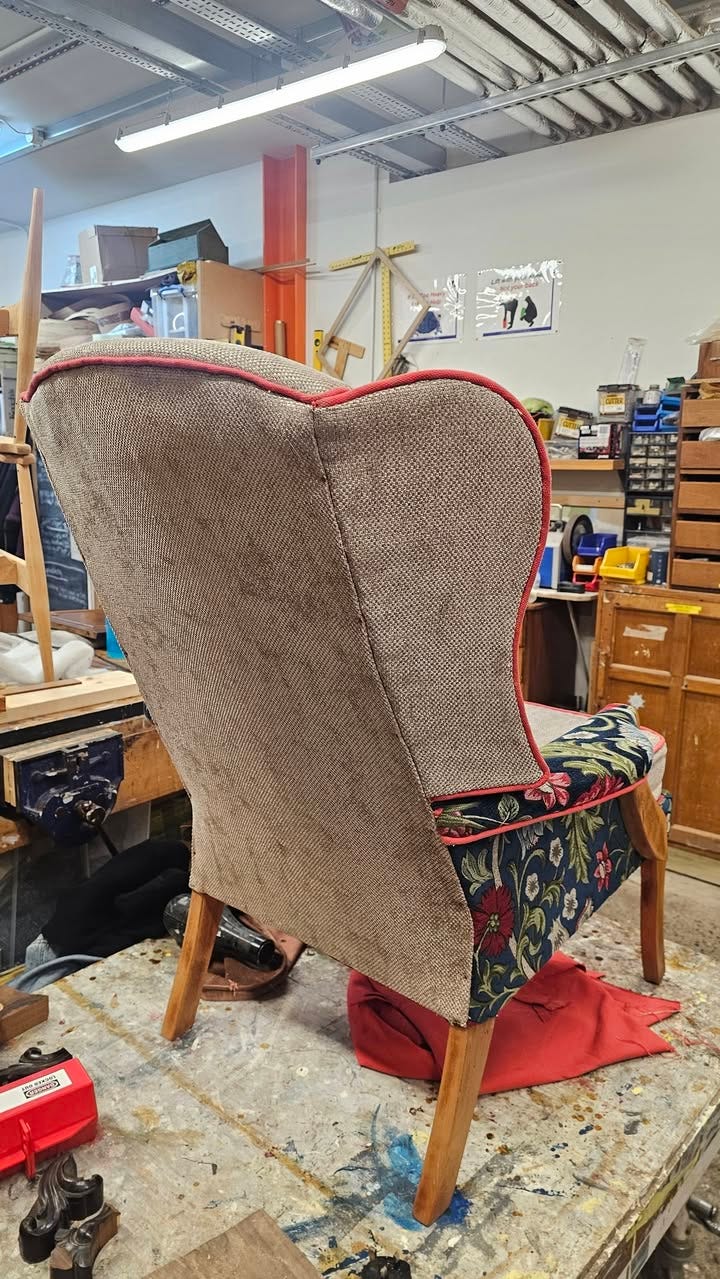
But if we take the old armchair apart, strengthen the joints, restore the springs, replace the worn layers, preserve the wood and choose fabric, something more interesting happens. We do not take it backwards; we give it the possibility of moving forwards. Someone else will sit in it now, but inside there will still be the old wood, the traces of earlier fastenings, part of the earlier structure — perhaps even a little dent that no one outside the family will ever notice. This is no longer simply furniture. It is material memory.
The object against consumption
We are used to talking about the second life of things. But I am beginning to think the expression is slightly inaccurate: why a second? An object can have 10 lives. The wood was a tree, then became a plank; the plank became an armchair. The armchair belonged to one home, then another. It was repaired, reupholstered, painted, forgotten, found again. After 100 years, someone stripped it back to its frame once more. An object is constantly changing states.
We live in a culture where an object is more often treated as a temporary episode in consumption: buy, use, discard. But an entirely different culture is possible — a culture of continuation. Then the question is no longer how much this thing is still worth, but what else might happen to it.
For the Rediscovery Centre, this idea feels especially natural: rediscovery means literally finding again — not merely recycling material, but rediscovering value.
Joseph and tekton
There is another ancient image that unexpectedly arises alongside all this. In the Christian tradition, Joseph is known as a carpenter, but the Greek word tekton, used in the Gospel context, had a broader meaning — a craftsman, someone engaged in building or manual trades.
What interests me here is not the religious narrative, but the archetype itself: a human being stands before matter; the wood resists them, and they have to understand it. You cannot persuade wood with words or negotiate with a joint — if it is poorly made, it will come apart; if the fabric is stretched incorrectly, it will reveal the mistake. Material possesses an extraordinary honesty. Perhaps that is why, for centuries, craft was connected not only with labour but also with inner discipline: the hand gradually educates the person.
An object's digital biography
There is another peculiarity of our time. After restoration, an old armchair receives something it never had before: a digital memory of its own. I made a separate web page devoted to this process: https://ealoiontoir.github.io/Spirit-of-Time/armchair-restoration.html — and suddenly traditional craft from the 18th–19th centuries stands alongside HTML, photography and the internet. I like this contradiction: the hand works in an ancient way, while digital technology preserves the path of that hand.
Usually a person sees only the finished armchair. But a website lets us leave another kind of testimony: what it was like, how it was dismantled, what materials were inside, how the wood was restored, how the new upholstery was built, what decisions were made. In other words, it is not only the object that is preserved — the object's process of becoming is preserved too. And perhaps this is where old craft meets our own time most naturally: the machine does not replace the hand; technology becomes the hand's witness.
Time without clocks
Perhaps the most unexpected result of all this work has been my own experience of time. You can spend several hours on a small part of an armchair without feeling that time has been lost. On the contrary, it becomes denser.
For a person today, time is usually tied to a result: what you managed to do, what you obtained, what you earned. But another kind of time exists — the time of a process. The Greeks distinguished chronos, sequential, measurable time, from kairos, the moment when something must happen precisely now. It seems to me that craft sometimes returns us to just such a state: the clocks go on ticking, but you cease to belong to them. There is wood, fabric, the movement of a hand, a task, silence — and that is enough.
I do not know where this work will eventually lead me. Perhaps, after a while, I shall be doing entirely different things. But now I feel grateful for a rare convergence of circumstances: somehow the stars really have aligned to give me the chance to do this now. Not to hurry; to learn, make mistakes, redo things, work with my hands — and take pleasure not only in the result, but in inhabiting the process itself. This is a great blessing, because sometimes a person thinks they are choosing a new occupation, only to discover that the occupation was something they themselves needed.
When the armchair is finally finished, most people will see a single object: a beautiful old armchair with a new life. But I shall probably see several things at once: the old wood, the traces of the earlier craftsman, the springs, days of work, mistakes, new skills, canvas that came from elsewhere carrying its own history, the Rediscovery Centre, my hands — and that strange state in which, for a few hours, the need to hurry anywhere disappeared.
So I am no longer sure that it is right to say: I restored an armchair. Rather, something reciprocal happened — I was giving the armchair its form back, and the armchair was gradually giving form back to my hand. And perhaps this is restoration's deepest meaning.
We preserve old things not because we are afraid of parting with the past. We preserve them because the past is still capable of working within the future.
Restoration is not the return of the past. It is permission for the past to have a future.
The full restoration story, with photographs and video of the process, is here:
https://ealoiontoir.github.io/Spirit-of-Time/armchair-restoration.html
АЦХ · ADC 🪶
Dublin · Rediscovery Centre · 2026
Sources and further reading
- Original Facebook essay
- Edward Jenner Carpenter’s Journal, American Antiquarian Society
- Antoine M. Wilmering · Traditions and Trends in Furniture Conservation
- Colonial Williamsburg · evidence preserved in upholstery
- V&A · furniture conservation and reversible upholstery