Specimen 01
Neutral ground cloth
A quiet, close-woven cloth in a warm neutral, used across the seat, inside back and main body panels. It carries the volume without asking for attention.
Rediscovery Centre ·Furniture Department ·Ballymun ·Dublin
One armchair, taken down to its frame, repaired and rebuilt by hand. The photographs and the film come first; the account of the work follows.
See the work01 The Record
Three plates and a film, taken at the bench during the project: the full sequence, the new parts cut for the wings and back, and the transformation itself. Everything written below is simply a reading of these.
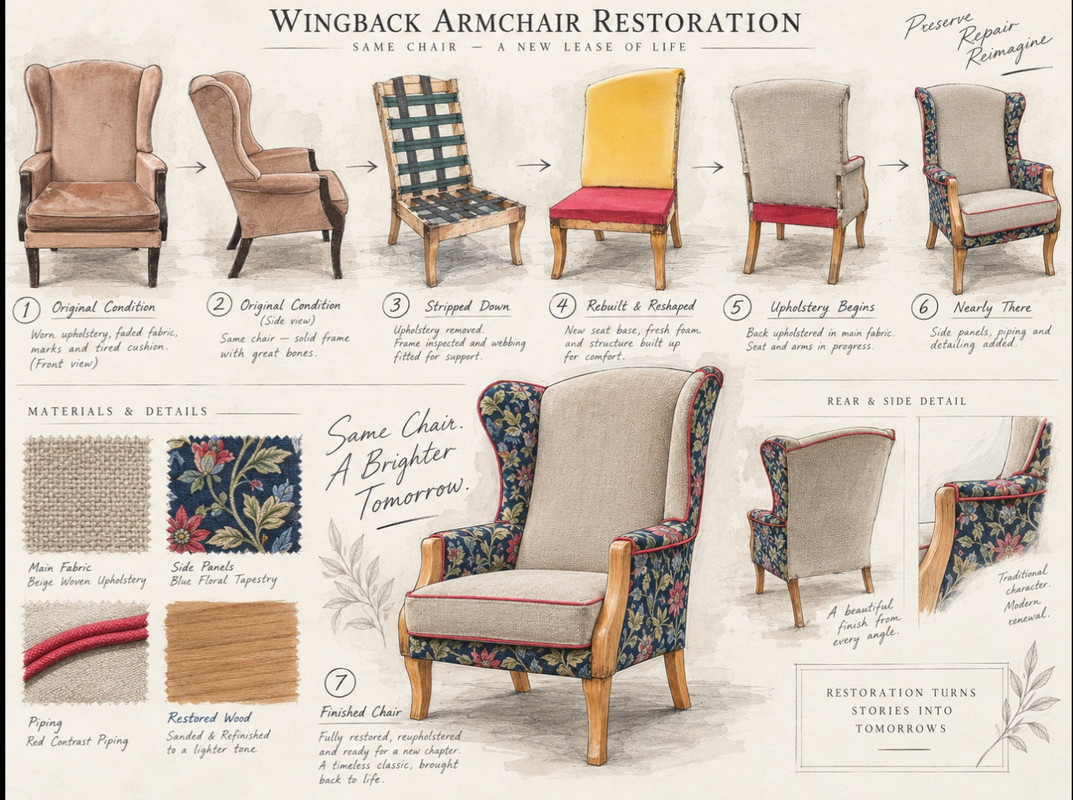
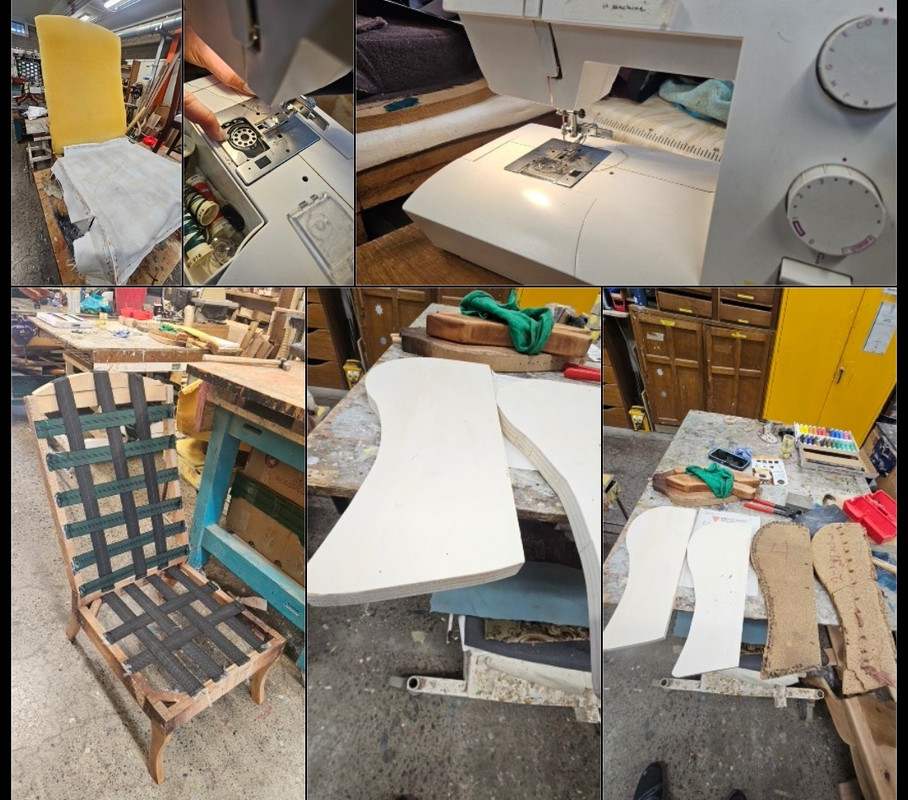
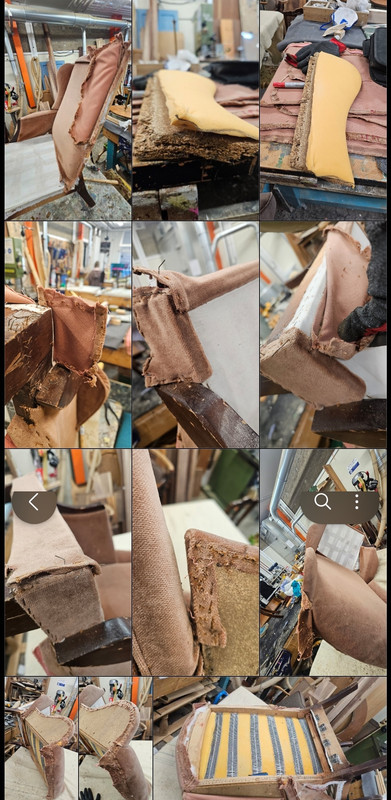
The chair moving through the project — dismantling, the exposed structure, rebuilding, and the finished piece. Nothing plays until you ask it to.
Workshop film · Furniture Department, Ballymun. Hosted on Google Drive; the player is requested only after you press play.
Repair is not disguise. Restoration is not replacement. Craft is a form of attention.
The chair was not reupholstered. It was dismantled, understood, repaired and rebuilt.
02 The Centre
The work was done at Rediscover Furniture, the furniture department of the Rediscovery Centre in Ballymun — Ireland's National Centre for the Circular Economy, housed in the former boiler house that once heated the Ballymun flats.
The building makes the argument first: an obsolete industrial structure kept and re-purposed rather than demolished. Inside, the same logic runs at the scale of objects — paint remixed, bicycles refurbished, textiles re-cut, and furniture that would otherwise be skipped repaired and returned to use.
The department works as a social enterprise and as a school. Alongside commissioned restoration it runs workshops and courses, so the skill leaves the building along with the furniture. Its stated aim is to give discarded pieces “a whole new story to tell.”
03 The Process
Nine stages, in the order they happened. Each one is visible somewhere in the compilation and the film above.
Cover, fillings and old fixings removed in reverse order of assembly, so nothing was lost that could serve as a pattern later.
With the frame exposed, every joint was tested. The carcass was sound; what had failed were the consumable layers.
New support webbing strained across the rails and interlaced in both directions — the tensioned plane the whole seat depends on.
Where movement was found, joints were cleaned and re-secured. Reinforcement was added only where the frame asked for it.
The exposed wood was cleaned and sanded by hand, then fed and protected with furniture wax — depth returned, gloss withheld.
Base and padding fitted in sequence — the red and yellow working layers in the photographs — until the chair's original volume came back.
Quality fabrics selected and cut: a calm neutral through the centre, the floral on the wings and sides.
Piping made by hand from cord and bias-cut cloth, then set into the seams to draw the chair's outline.
Panels eased around the curves, larger sections sewn to the body, closing seams slip-stitched by hand. Final assembly.
04 The Build
An upholstered chair is built in courses, each one supporting the next. Select a stage to see how it stacks up.
Frame — cleaned, re-secured, reinforced where needed.
05 Materials
Traditional richness held in check by contemporary restraint: a calm neutral ground, a decisive floral, a line of contrast piping, and timber allowed to be timber.
Specimen 01
A quiet, close-woven cloth in a warm neutral, used across the seat, inside back and main body panels. It carries the volume without asking for attention.
Specimen 02
A high-quality patterned textile with real character and depth of colour, placed on the wings and side panels — strong enough to carry the chair, used sparingly enough not to overwhelm it.
Specimen 03
Cord wrapped in a bias-cut strip of cloth, sewn and set into the seams. Structural as well as decorative: it strengthens the join and draws the outline.
Specimen 04
The chair's original timber, cleaned, sanded by hand and protected with wax. Not refinished and not stained to a new colour — fed, sealed, burnished.
Swatches are rendered from the page palette — an indication of the scheme, not a colour-accurate record of the cloth.
06 The Detail
This chair is not carried by generic straight armrests. Its exposed side timbers have a specific movement, and it is the single detail that most distinguishes the piece.
The restoration kept the chair's original proportions rather than turning it into a generic modern piece. This geometry is the reason why.
Machines are good at repetition. A chair that has already lived is not repetitive.
07 Final Setting
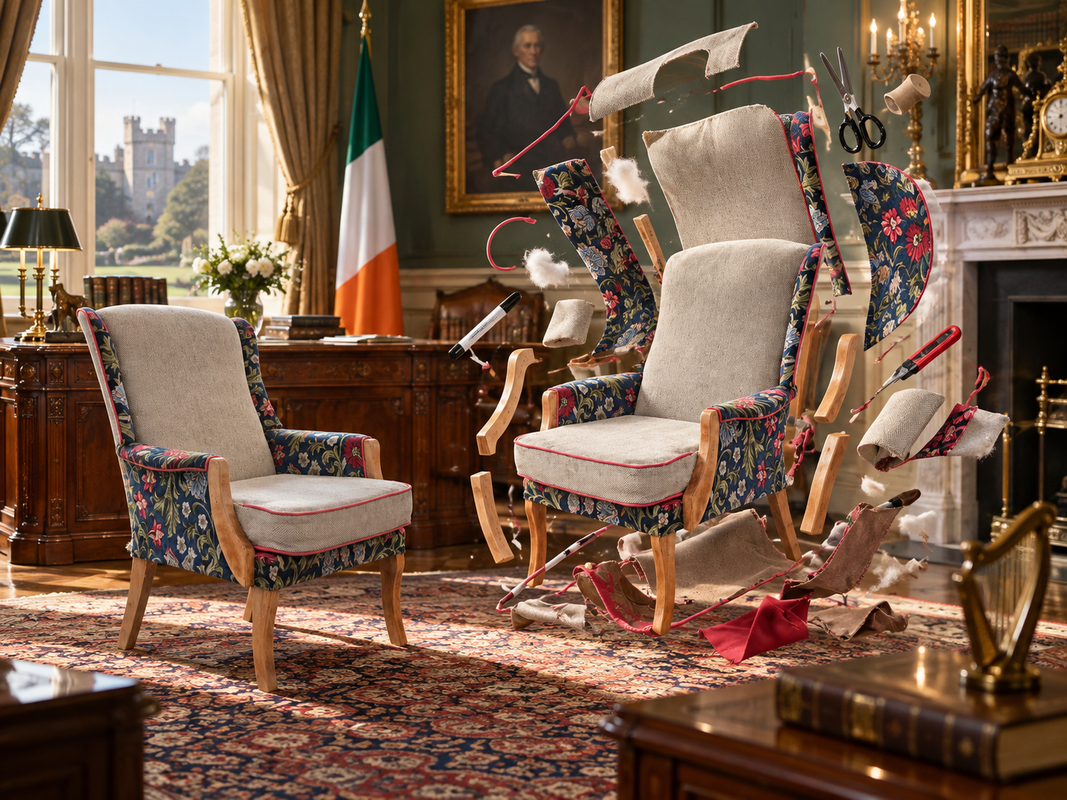
The chair is shown here in a presidential office — a staged composition, and the last room in this record. Not decoration: an argument about standing.
We are used to the idea that dignity belongs to new things, and that a repaired object is a compromise kept out of sight. Placing this chair in a room built for formality inverts that. A restored object is not a lesser object. It is an object with more behind it.
Select the image to view it full size.
08 Object Record
The chair was not replaced.
It was understood, repaired and allowed to continue.
Nothing here began as new. That is precisely the point.