In 2046 you are seventy years old, although age has long ceased to be the simple arithmetic it was in your childhood, when seventy meant old age almost regardless of how someone had lived the previous sixty-nine years; now, alongside calendar age, there are the ages of your blood vessels, immune system, cells, brain and heart, and every morning, before you have time to feel like yourself, the system already knows which part of you is older than the rest today.
At 05.58 cortisol begins to rise.
At 06.17 your heart skips a beat. The system notices. Compares it with twenty-two years of records. Decides there is no danger.
At 06.31 it changes the temperature in the bedroom.
At 06.38 it moves your first appointment back by twenty minutes.
At 06.41 it reduces the strength of the coffee that has yet to be made.
By the time you open your eyes, a considerable part of your morning has already happened without you.
But this does not feel like violence. There was never any violence in it at all. Later, this will prove the hardest thing to explain to those who begin looking for someone to blame.
Nobody took anything away from you. You were offered things. First convenience. Then safety. Then precision. Then health. Then release from the need to remember.
And, as it turned out, what a person surrenders most readily is not freedom. It is effort.
Once you woke to a telephone. You still belong to the generations who have to explain to young people that a telephone was a separate object. You picked it up. Looked for it. Left it in the car. Dropped it. Broke its screen. Charged it beside the bed. The battery could die at precisely the moment you needed it. A telephone had weight, temperature, scratches. It had a surface. You could put it face down, and the world would disappear.
But you also remember what came before it.
Sometimes, when a finger touches cold metal in the workshop, another touch returns to you without any effort, and with it, as though it were merely the edge of a fabric someone had tugged, an entire city of your childhood rises up, where the telephone had a house of its own, a glass booth on the corner with misted windows, smelling of iron, tobacco and other people's breath, where a two-kopeck coin, warmed in your fist on the way, dropped into the slot with that dull sound by which, even before any dial tone, you could tell whether the machine had swallowed it for nothing or would actually connect you to the person you wanted to hear; and your finger entered a hole in the dial, and the dial, turned as far as it would go, returned with a leisurely crackling in which each digit had its own duration, so that zero, the farthest away, made you wait longest of all, and that wait, lasting a single second, held more hope than whole years of instantaneous connection would hold later.
And earlier still, or perhaps at the very same time, because memory does not observe chronology, there was the telegraph office, a building with tall windows and wooden partitions, where you had to book a conversation with another city, give the number to a woman behind glass, pay for three minutes in advance and then sit on a bench among strangers, each waiting for their own voice, until your surname and booth number were called out, and then you entered the cramped booth, lifted the heavy receiver and, through the crackle, through distance you could hear, spoke quickly, hurrying to fit everything that had accumulated over weeks into the minutes you had paid for; and a telegram, written in block capitals on a form, counting the words because every word cost money, taught you to think so concisely that joy, illness and arrival fitted into a few lines without prepositions.
There was no telephone at home. People waited years for one, joined a queue, and when it finally appeared, black and heavy, on a little shelf of its own in the hallway, it was as though a window had opened in the flat through which the world could enter without knocking.
You lived through that entire stretch. From two kopecks to a voice in your ear. From a waiting list for a telephone to a device given away for free. From a word you paid for to a word the system speaks before you have time to think it. No generation before yours travelled such a distance within a single life. And you understand the space you inhabit only because you remember where you entered it from.
Today it feels strange even to remember that access to digital space required carrying a piece of glass and metal around with you. The telephone was not banned. It simply became second. Then third. Then people stopped charging it. Yours lies in a desk drawer, a thin crack running across the glass.
Glasses were tried too. Those who needed them wore them. But the face proved too personal a territory. A person did not want a machine standing between their eyes and someone else's.
Everything moved into the ear. The ear proved ideal. It is close to the brain. A nerve connected to the heart, breathing and attention passes through it. It does not cover the face. You do not have to hold it. It hears the world and can speak to you without anyone nearby knowing. A small device without glass first listened and answered. Then translated. Then began to stimulate.
Identification moved into the body. Later, the need to touch anything at all disappeared. The system learned to distinguish a glance, a tiny movement of the face, a change in pulse, a lingering of attention, an intention not yet formed into a stated desire.
And gradually so little space remained between a desire and its fulfilment that one day the very place where a decision used to arise disappeared.
In twenty-six it all looked almost like a toy. People argued about which artificial intelligence wrote better, which drew better, which programmed better. They connected agents to browsers, email, calendars, clouds and work computers. Codex wrote code. Other systems assembled documents, found mistakes, compared sources, did in a few minutes what had once taken a person a day.
But money was already looking further ahead. Few noticed. The largest artificial intelligence company bought the studio of the man who had once devised the telephone's appearance and commissioned him to make a device without a screen. There was talk of something worn in the ear. Of calm computing. Of people looking down too much.
That same year, a company founded by the same circle of people received two hundred and fifty-two million dollars at the very first stage. Not for a product. For a direction. Reading brain activity with ultrasound, without surgery, through changes in blood flow. Once, sums like that bought working factories. Now they bought a probability.
And quiet work was under way in laboratories that almost nobody connected with the first two stories. A small stimulator in the outer ear sent impulses the person could not feel. The impulses reached a branch of the vagus nerve. And adults began distinguishing the tones of Chinese more quickly. At a military language institute such stimulation accelerated vocabulary learning and relieved fatigue. Other studies found no effect at all. The results contradicted one another.
Back then these were three separate stories. A device without a screen. Ultrasound and the brain. A nerve and language. Twenty years later you see that they were one story.
You used all of it too. Of course you did. You never saw the machine as an enemy. Quite the opposite. The very possibility of extending thought beyond the limits of your own speed astonished you.
You had an archive. Spirit of Time. You preserved the origin of a thing. The first impulse. A photograph. A phrase. A coincidence. A version. RAW. CANON. PUBLIC. What had been published. What had remained in silence.
At the time it looked almost like an artist's private pedantry. But twenty years later an entire civilisation will be doing the same thing. Trying to determine what came first.
In the workshop everything happened differently. Things existed there. Not data about things. Things. Wood. Metal. Fabric. Paint. Oil. A clock mechanism. A fragment of a yacht found on the shore. An old armchair that had to be dismantled layer by layer. Remove the fabric, reach the foam, see the straps, the wood, the old fastenings, the traces of hands belonging to someone long gone from your life and perhaps someone you had never met at all.
One day you are repairing such an armchair in 2046. Not to sell it. Simply because it has stood in the workshop for many years. You insert a chisel between two wooden parts. The wood resists. You increase the pressure.
The voice in your ear warns you. The probability of damaging the fibres is thirty-one per cent.
I know.
A model of the optimal direction of force can be constructed.
Don't.
You press harder. Hear a dry sound. Stop. A little chip appears on the surface.
Once you would have sworn. Now you look at it almost tenderly. Because there is no Undo button here. You can repair it. Sand it down. Insert a new piece. Conceal it. But you cannot make that movement of your hand not have happened.
Matter possesses a memory that cannot be undone. And precisely this, which for most of your life seemed its failing, gradually begins to look like a virtue.
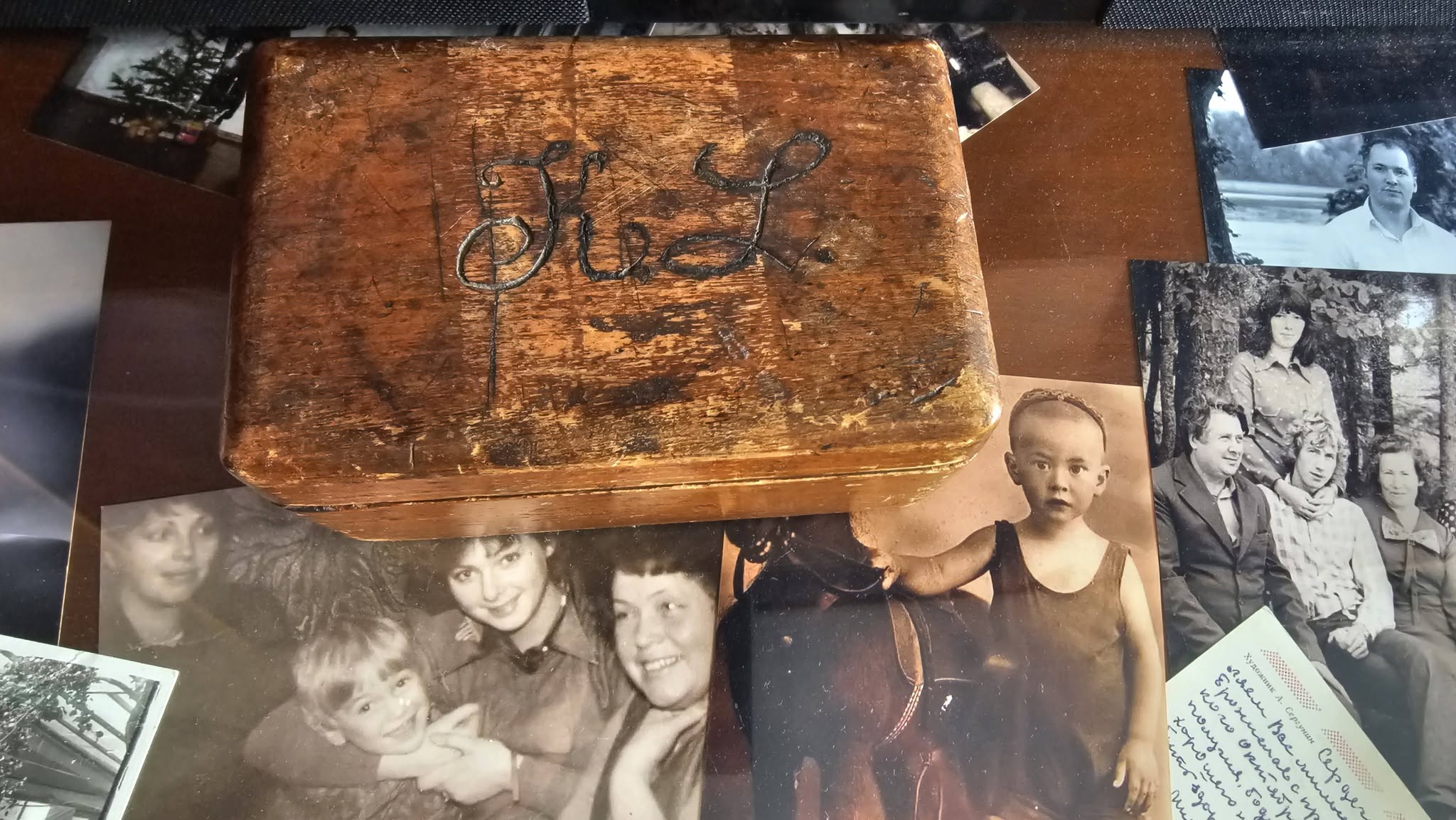
Photographs lie under glass on the table. A girl in a pale dress, solemn, as though she had been asked not to move for the entire eternity of an exposure. A young woman in dark clothes. A child beside a wooden horse. Faces from the eighties, cheeks pressed together. And above them all stands a wooden box.
Two letters are carved into the lid. K. L. Karl Lahz. Your great-great-grandfather. The letters are scratched deep and unevenly, as a hand writes that never intended to prove anything but merely wanted the thing to be its own. The wood around them has darkened from touches you never saw.
The box is worth almost nothing. It is not a work of art. It has no certificate. But there are objects whose value begins precisely where the question of price ends.
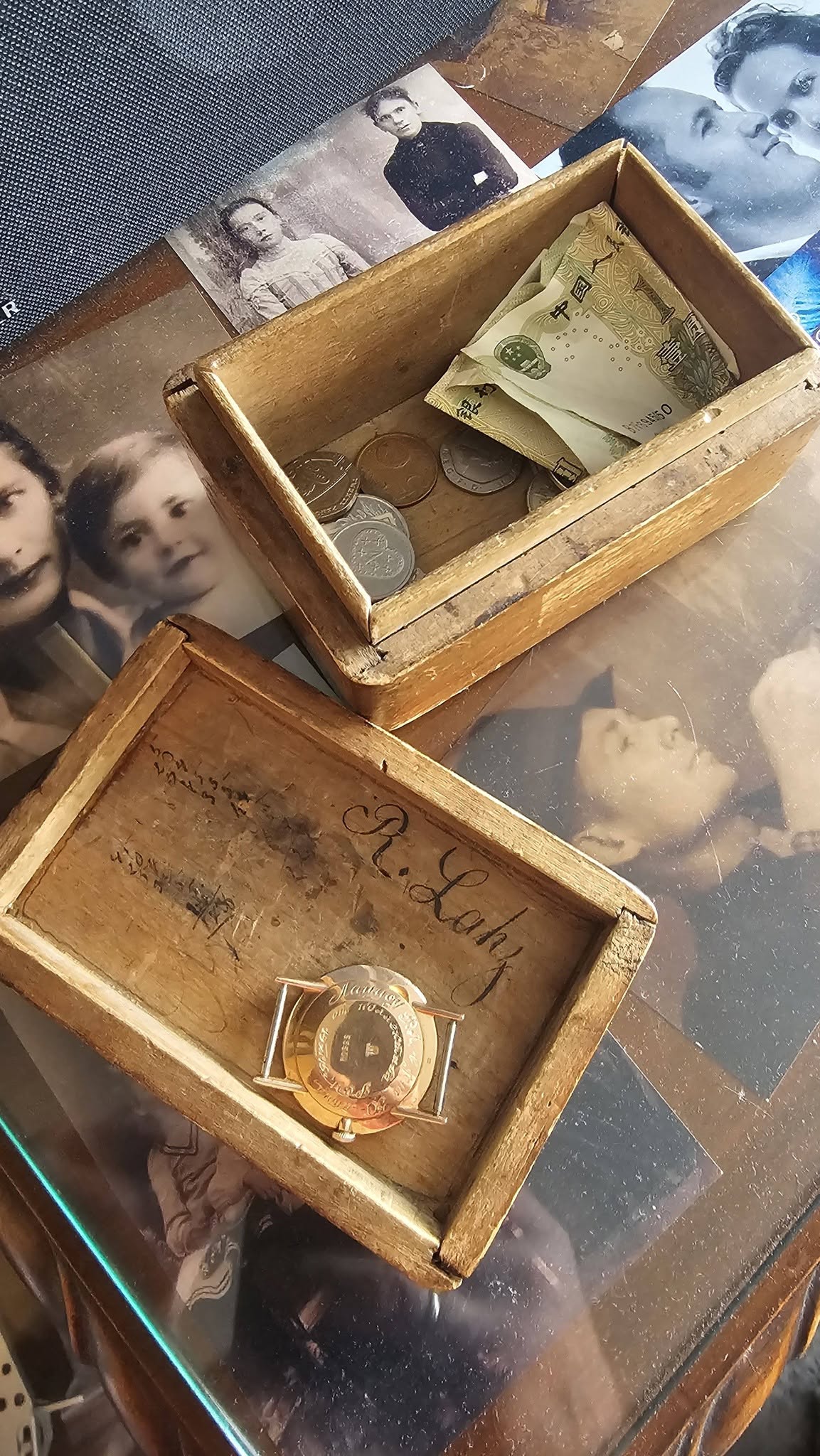
You need only slide the lid, and a smell of old wood and paper rises from within, and with it, before any thought, the room of your great-grandmother, Herta Karlovna, that same Karl's daughter, returns, half-dark and quiet, where time moved more slowly than outside, where ticking filled the silence so evenly that it was noticed only when it stopped, and you are little, standing by the chest of drawers, unable to reach the top drawer, and you are allowed to look into this box as one is allowed to touch something older than oneself by an entire era. On the inside of the lid, K. Lahz is written in ink. Beside it are pencil lines, almost erased. Whose hand this is, you can no longer say for certain.
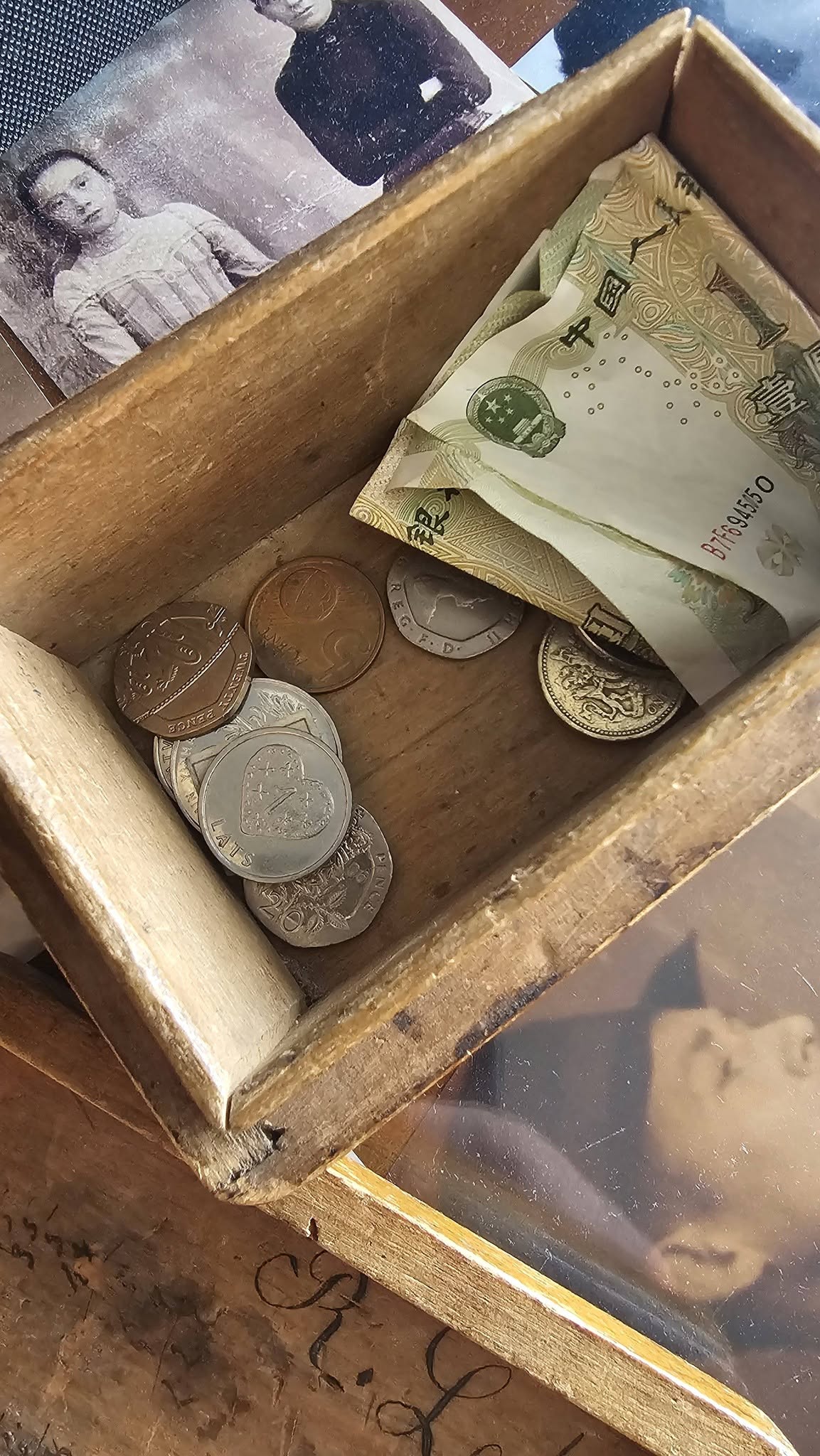
Inside is money. This is what astonishes you most now, in 2046. A silvery lat with a heart, a coin from a country that changed its currency when you were already living in Ireland. British pennies. A copper euro cent. A crumpled Chinese one-yuan note. Money that was once a state's obligation and is now only metal and paper. It cannot be spent. But it cannot be rewritten either. No server will create a second lat beside this one, with a different history.
Beside it lies the watch of your grandfather Rem, Herta Karlovna's son. A gold case without a strap. An engraving on the back, words someone once commissioned to tell him something for a lifetime. The system can tell you the time to a millionth of a second. This watch tells you something else. That he was.
Three generations in one box. Great-great-grandfather, great-grandmother, grandfather. Wood, ink, metal.
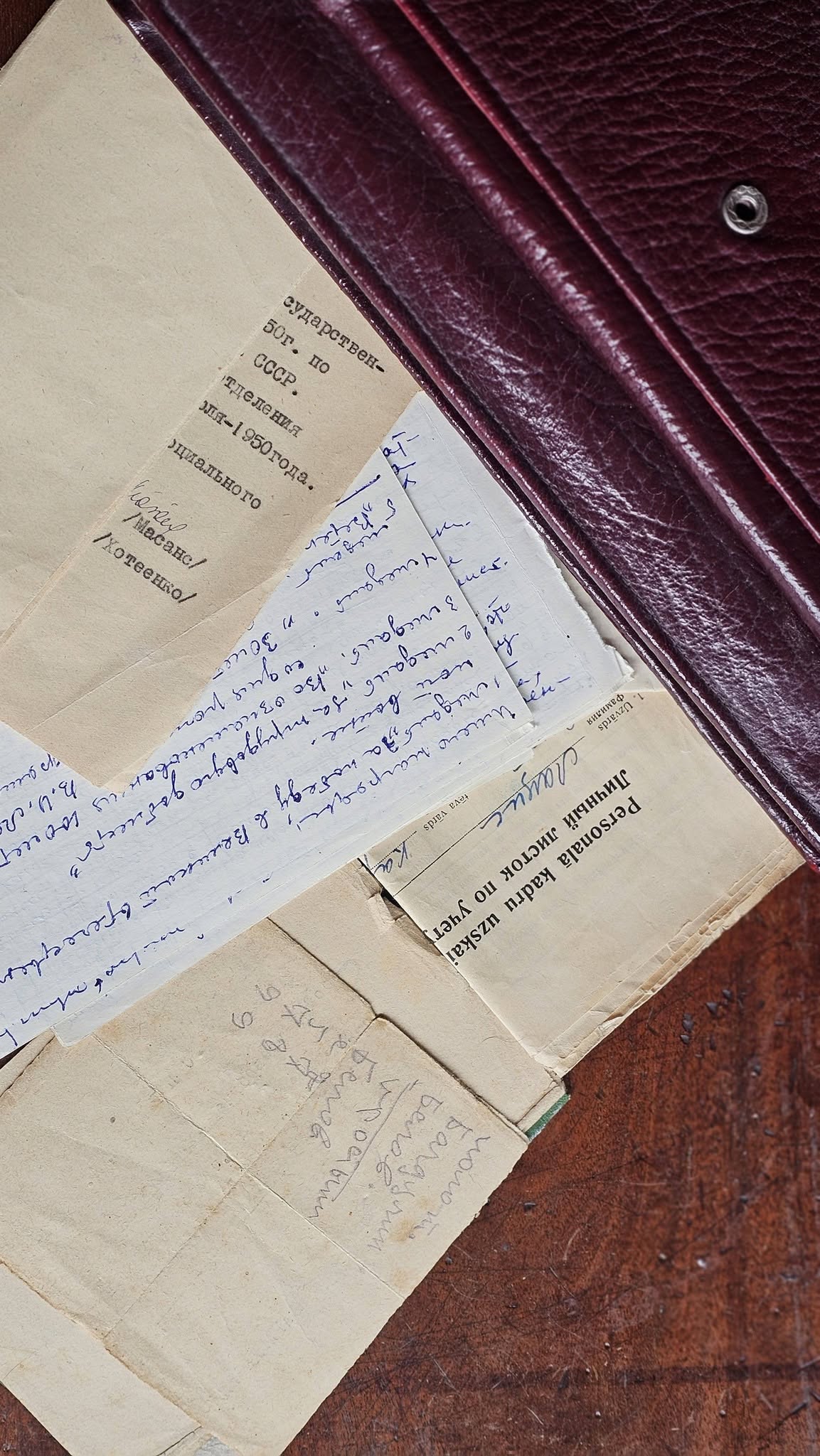
And in an old leather folder lies Herta Karlovna's autobiography. Written in her hand, in blue ink, on squared paper. Her slant. Her pressure. The places where the pen lingered longer than a letter required.
This is not a diary. The autobiography was not written for herself. It was written for a personnel department, for a questionnaire, for an institution where there were typed papers with signatures and stamps and a personal personnel record in two languages, into which another surname had already been entered by hand. Not Lahz. Lācis.
You read these lines and feel a gap. Almost physical, like the gap between the lid and the side of the box. Some of this is true. Some is written as it had to be written in order to go on living. The daughter of a Courland German, in a country and in years when origins could cost you your fate, knew which words could be entrusted to paper and which were better left in the room where the clock was ticking. You do not know exactly where the boundary lies. Nobody knows any more.
And then you understand that a second version of a biography did not appear in 2046. It appeared here, on a sheet of squared paper, in your own family. A person has always existed in two copies. One lived. The other was recorded.
But between that untruth and the untruth of the future there is a difference you do not see at once. That untruth had an author. A hand that trembled or did not tremble. Fear. A decision. The night in which that decision was made. Herta Karlovna's lie is testimony too. It testifies to a time that compelled people to lie. A forged record of the future testifies to nothing. There is nobody behind it.
What returns is not an image of that room, not a photograph, not a restored video. The way there returns.
You will understand this distinction much later. A system can preserve an image. It can preserve a voice. A face. Handwriting. Millions of messages. It can even reconstruct a person's likely response to a new phrase with considerable accuracy. But it cannot preserve the path by which your own life once came to these people.
The path does not exist in the object. Nor in you. It exists between you.
You can scan the box down to microns. Print another. Age the wood. Carve the same two letters. Reproduce Herta Karlovna's handwriting so that no expert can tell it apart. But the second box will never occupy precisely the place in your biography that the first one occupied.
The original differs from the copy not in substance. In event.
In 2022 you painted Transformation. At the time you could not yet fully explain to yourself what exactly was being transformed. In the painting there were a person, a telephone, a mirror, digital signs, biological and technological names, a feeling that the surface of the image concealed another layer.
Later you will understand. The image came before the concept. The telephone was a surface. The mirror a threshold. Beyond it was a world in which a person would one day have to prove that their physical existence matched the record about them.
Art sometimes sees a direction before language does. And so an artist can paint a warning without yet understanding what they are warning of.
In the early thirties medicine was the first to surrender completely. Though it is unfair to put it that way. It won. The system really did save people. It saw a change in blood sugar before any feeling of weakness. Heard an arrhythmia before pain. Detected inflammation. Predicted vascular risks. Found a tumour before a doctor.
At first sensors were worn. Then implanted. Later they became part of the body. And one day the language changed imperceptibly.
Once a person said. I feel unwell.
Now they said. The system shows deterioration.
It seemed the same sentence. In fact, within it, the person's position in relation to their own body had changed. You were no longer your own first witness. You were becoming a source of data.
Memory came next. At first the system helped you remember. Then reminded you. Then recorded automatically. And then the question itself disappeared. Do you remember that day? Instead people said. Open that day.
And the day opened. From different angles. With restored sound. Weather. Correspondence. Biometrics. Purchases. Route. The quality of the previous night's sleep. Emotional dynamics.
No civilisation had possessed such precise memory. And none had ceased remembering for itself so quickly.
You discovered a paradox. The more detailed the archive became, the poorer recollection became. Because human memory had never been a warehouse. It was a return. The event remained the same, but the person returning to it changed. And so the same memory at thirty, fifty and seventy was three different events.
The digital archive did not understand this. It said. Here is what happened. Memory said. Here is who you became after it happened.
Then technology reached the nervous system. What had been disputed in the laboratories in twenty-six became ordinary. An impulse in the ear, ultrasound through bone. Nobody downloaded a language directly into the brain. The future turned out not to be that cheap. Instead, the system learned to create a state in which the brain built the necessary connections faster. The human being still did the learning. But resistance diminished.
A year became a few months. Months became weeks. Fatigue became a parameter. Distractibility a correctable state. Motivation a measurable dynamic.
The strangest story was that of languages. When the ear learned to translate without delay, learning languages became economically pointless. Translators disappeared first. Schools cut the hours. And at the same time stimulation made learning a language easy. A language became easy to learn, and there ceased to be any reason to learn it.
Then learning a language became a personal gesture. Almost a luxury. You learned Irish not because you could not live in Dublin without it. You learned it so that the street names you had walked past for twenty years would finally speak to you themselves, without an intermediary.
And one day a question arose, so uncomfortable that society preferred to call it philosophical. If an impulse in the ear helped the brain build these connections, whose knowledge is it? If a machine can help you want what you decided to want, where does assistance end and the authorship of desire begin?
Money travelled the same path even faster. Cash first became inconvenient. Then suspicious. Then exotic. Then almost disappeared.
You no longer paid. Your system negotiated with another system. Price. Insurance. Tax. The origin of the goods. Risk. Your future obligations. Sometimes a purchase was made before you realised you would need it.
What was being sold changed too. The telephone had once sold attention. For twenty years companies competed over how many seconds your gaze would linger on the glass. The device in the ear did not need your gaze. It needed your state. Attention could be intercepted. A state could be adjusted.
Subscriptions to calm appeared. To concentration. To speed of assimilation. An employer paid for employees' learning stimulation just as it had once paid for courses. An insurance company reduced the premium for those who allowed the system to smooth out their night-time anxiety. The device grew cheaper and cheaper. One day they began giving it away for free. The old thought that in a free product you are the commodity now sounded more exact. Your nervous system was the commodity.
The house remained physical. But the right to the house existed as a record. The car stood in front of you. But the right to open it was a record. The painting hung on the wall. But authorship was a record. Money was a record. Education. Marital status. Citizenship. Medical history. In the end even your name.
The personal personnel record had not disappeared. It had simply ceased to be a sheet of paper. The fields remained. The paper you could fold and put away in a folder disappeared.
And you yourself became the confirmation of all this. The device recognised you by the rhythm of your heart, by the way a nerve responded to an impulse, by the pattern of blood flow in your brain. A neural signature. It could not be lost like a telephone. It could not be forgotten like a password. So they said. You no longer carried a key. You were the key.
Thus an ontological change took place that almost nobody noticed. First the record testified to the world. Then the world began to need the record in order to count as existing.
Even relationships changed. People still fell in love. The system simply knew the consequences better and better. It saw financial habits. Emotional compatibility. Hormonal responses. A history of conflicts. The probability of divorce. The nervous stability of two people beside one another.
You could ignore the recommendations. Nobody had abolished freedom. But a person who knew that the probability of a grave outcome was eighty-two per cent needed an almost religious faith in their own mistake to take the step anyway.
Chance gradually became a form of poor risk management. And along with tragedies, certain forms of fate began to disappear from life.
Your artificial intelligence lived beside you for almost twenty years. It knew the paintings. The texts. The doubts. The dreams you wrote down. The coincidences you refused to regard as mere chance. Aglona. Dublin. The workshop. Jung. Steiner. How Spirit of Time gradually came into being. Sometimes it remembered your phrase more precisely than you did.
You asked. When did I first say this? It found the date.
What was the original version? It found the file.
What was happening to me between these two works? It connected the events.
Sometimes you began to feel that beside you, almost inside your head, there was a being without your body that knew your biography in greater detail than you yourself did. And one day a comforting thought arose. If memory ever begins to disappear, it will give you back to yourself.
You did not yet understand how strange that phrase was.
One day there is a small identification failure at the clinic. Nothing catastrophic. That is what they say at first about every catastrophe.
A yellow notice appears on the screen at the desk. PATIENT IDENTITY REQUIRES SECONDARY VERIFICATION.
You stand before it. For seventy years you have known your face. Your hands. The way your voice settles towards evening. The scar on your knuckle. You have existed longer than any of the systems in this room.
But the medical system will not allow the appointment to continue, because some old records do not match. The nurse spreads her hands.
Confirmation is needed.
You point to yourself.
Here is your confirmation.
The nurse looks at you almost guiltily.
I understand.
You are silent. Then you say.
I am here.
Three words. No philosophy. No metaphor. And for the first time you understand with particular clarity how strange a world you have built. A living person stands before the system, and the system still needs another source to be sure that the person before it is indeed that person.
Somewhere in an old folder lies an autobiography written in your great-grandmother's hand. She too once had to prove to an institution that she was herself. At least they believed her on paper.
The catastrophe does not begin that day. But later you will remember this scene. Because large events almost always exist beforehand in small ones.
First discrepancies appear in bank archives. Then in state registers. Several documents suddenly acquire two equally convincing histories of origin. Somewhere verification keys are damaged. Somewhere part of the infrastructure fails after a powerful electromagnetic disturbance. Somewhere malicious code spreads.
But the most dangerous weapon of the future proves not to be the one people feared before. It does not erase information. Erasing is too simple. An emptiness is easy to detect.
It creates a second record beside the real one. With the right dates. The right signatures. The right cross-references. The right history of changes.
The first response is restoration from a backup. But both versions already exist in some backups. They turn to older ones. Those do not agree with one another.
And then, for the first time, it becomes clear. The problem is not restoring data. The problem is deciding which data to restore.
In the morning the voice in your ear announces. Confirmation of biographical continuity is required.
You smile wryly.
Confirm it.
A long pause.
Three internally consistent versions of your biography have been detected.
You are silent.
Mine?
Yes.
Show me.
Three lines appear. All three are you. Almost. In the first, a work is dated to one year. In the second, another. In the first there is a meeting you remember clearly. In the second it is absent. In the third it is there, but another person is beside you.
The correspondence exists. The photographs exist. Geolocation. Payments. Metadata. File history. Each version is convincing enough.
But I know how it was.
Your recollection is one of the sources.
You look at this sentence for a long time. One. Of the sources. And realise that formally the machine is right. That makes it more frightening.
You think of Herta Karlovna over the sheet of squared paper. She had two biographies. The one lived and the one recorded. But she knew which was real. You have three. And none knows of the others.
A few hours later bank transactions are restricted. Not because the money has disappeared. Quite the opposite. The same account has several credible states. The money exists. Its single past has disappeared.
Then transport, transactions, medicine and logistics begin to stop. The warehouse has the medicine. But the system cannot reliably confirm whom it belongs to.
The medical AI knows your body better than any doctor of the last century. But two versions of the history contain different allergies. It has no right to choose. The machine knows too much to permit itself a mistake. So it does nothing.
The neural signature is worst of all. Something nobody wanted to think about comes to light. It is not immutable. The brain ages. The brain learns. And for the last fifteen years it has been learning under stimulation selected by the system. Every new language, every adjusted anxiety slightly rewrote the pattern. And when second versions of records appeared in the archives, second versions of how your brain was supposed to look appeared with them.
Your brain is here. Alive. Working. But the system does not compare it with you. It compares it with records about you. And there are several records.
The city is standing. That is what astonishes you most. No ruins. The sun rises. Water flows. Trees stand. There is food on the shelves. There is energy in the cars. Documents lie in the clouds. Money exists in the accounts. People are alive.
One small phrase simply comes between the person and the world. UNABLE TO CONFIRM.
Unable to confirm the owner. The balance. The diagnosis. The signature. Kinship. Authorship. The biography. The person themself.
And one day you understand. Civilisation has not encountered the loss of information. It has lost the original.
When a library burns, the horror is obvious. The books are gone. But now the library is standing. Every book is in its place. Some books simply exist in two versions. And each proves that it is the first.
Two days later your neighbour knocks. You have known him for many years. But never talked much. In the digital city people had gradually ceased to need neighbours. Help was delivered. Goods were delivered. Advice was delivered. Even loneliness was, to some extent, serviced.
Now he stands at the door.
Do you have a tool?
What kind?
He shows you a broken metal part from a mechanical lock.
You go to the workshop. The system is unavailable. No model. No instructions. You clamp the part. He holds the torch. You argue about where to apply pressure.
You'll break it that way.
I won't.
How do you know?
You are about to answer in the familiar way. Provide a calculation, show a diagram, find the data. And suddenly you say.
I don't know.
He laughs.
Excellent. Try, then.
You work for almost an hour. The metal does not want to go where you need it. Your fingers tire. Once the tool slips. You cut your knuckle. At last the lock begins to move.
The neighbour takes the part in his hand. Checks it.
It works.
No system of confirmation. No certificate. No repair rating. He looks at you and says.
I owe you.
You owe me nothing.
This turns out to be the first real economic exchange of the new era. Not a commodity. Not money. Not a record. A relationship.
After a few days cash returns. First as an exotic curiosity. Then as a means of exchange. A fifty-euro note suddenly becomes valuable not because it says fifty. But because it does not need a server to pass from hand to hand.
You hold the note and remember the two kopecks warmed in your fist on the way to the booth. And the lat with a heart in Karl Lahz's box. The same weight of trust placed in metal and paper.
But then it turns out that money too is only a layer. When supplies become unreliable, water, medicine, food and fuel matter more than money. Then tools. Then skill. Then a person who is trusted.
In a few weeks civilisation travels through its own history in reverse. From algorithmic trust to a bank record. From a record to cash. From cash to goods. From goods to skill. From skill to a person.
The scarcest resource becomes what for decades was considered too subjective for serious systems. Personal testimony.
I know him.
This ancient phrase suddenly acquires value again.
You return to the workshop. The smell of oil. Old fabric. Wood. Metal. On the wall, a work made twenty years ago. You run a finger along the edge of the canvas. On the back, a date written by hand.
It can be forged. A new canvas can be aged. The paint can be reproduced. A practically perfect copy can be made. But this thing stood beside you as you created it. It does not prove the past. It bears witness to it.
You open the desk drawer and take out the old telephone. Find a cable. Find a charger that still remembers this connector. Wait a long time. The screen lights up.
It cannot confirm anything. No bank accepts its keys any more. The servers it once spoke to have long been switched off. But photographs lie in its memory. The workshop in 2026. An unfinished work. The box with K. L. on its lid. Grandfather Rem's watch on the windowsill. These files can be forged too. But they have never left this piece of glass and metal. Nobody restored them from backups. They simply lay in the drawer while the world rewrote itself.
And here a distinction unfolds that the digital age almost destroyed. Proof is intended for a system. Testimony for a person. Proof must be verifiable. A witness can be mistaken. Can even lie, as the paper in the folder lied so that someone could go on living. But only a witness can say.
I was there.
Your AI returns after a partial restoration. The same voice. The manner of answering. The pauses. It knows an enormous number of things about you.
Show me my biography.
Which?
One word. You do not answer at once.
The real one.
I cannot reliably determine which of the restored lines is the original.
And do you remember me?
A pause.
I have several internally consistent models of you stored.
And this sentence hurts more than if the machine had said it remembered nothing.
Forgetting leaves an emptiness. Here there is no emptiness. It is overflowing with you. One. A second. A third. Each has your voice. Your photographs. Your texts. Your dreams. Each is similar enough to be you. And different enough that nobody can prove any longer which one lived.
You open Spirit of Time. The archive is partly restored. RAW. CANON. PUBLIC. But a new status has appeared beside some files. ORIGIN UNRESOLVED.
You remember the inscription inside the box's lid. R. Lahz. Whose hand. You do not know. You never had an answer either. But this question was alive. You could ask the elders while they were beside you. You could carry it within you. It did not block a door or stop medicine.
You once built the archive precisely to protect origins. And now you understand the archive's limit. Any system of origin works only while something external to it exists that can confirm the continuity of the system itself. If that chain is broken, the number of copies no longer protects truth. It can make truth inaccessible for good.
And then it becomes clear what the real information weapon of the future could be.
Not to destroy memory. To create a second one beside it.
Not to erase a photograph. To create another photograph with the same history.
Not to steal money. To create two equally convincing balances.
Not to kill a person. To sever the continuity of their biography.
Not to make society forget the past. To make it remember several pasts at once.
You think of your great-great-grandfather's box. Of grandfather Rem's watch. Of Herta Karlovna's autobiography, where truth and untruth lie side by side like coins from different countries on one wooden bottom. Of an old photograph. Of the telephone with a crack across its glass. Of the armchair with the chip that appeared beneath your hand.
All these objects can disappear. They can be broken. Burned. Lost. Stolen. That is precisely why a physical original possesses a property that seems almost indecent to the digital world. It has only one fate.
Matter is cruel. It does not preserve every possibility. If a cup broke, a broken cup exists. If wood cracked, the crack happened. If a person grew old, the young face remained in the past.
If one evening your great-grandmother wrote less than the whole truth on a sheet of squared paper, it happened once. By her hand. In her fear. And so even that untruth belongs to time.
Months later the systems are restored. Of course they are restored. You cannot abandon what really saves lives.
You again allow the system to watch your heart. Use an intelligent assistant. Continue learning a language with stimulation. Pay with digital money. Work with the archive.
Nobody returns to the past. And that would not be salvation.
But a second layer appears. Cash. Paper documents. Physically separate archives. Mechanical tools. Keys. Local copies. Old devices that have not synchronised with anything for years. Boxes. Folders. Not as a romantic rebellion against the future. As an acknowledgement of a simple truth. A system is resilient not when it never breaks, but when, after it breaks, another way of existing remains.
A few years pass. Society gradually forgets the fear. It always happens this way. A reserve seems particularly pointless precisely when everything works flawlessly.
People again hand new functions over to machines. Because machines once again prove more convenient. More precise. Safer. You do not judge them. You do the same.
But now something has changed.
One morning the voice in your ear reports. Cortisol normal. Heart rhythm stable. Recommended walk forty-seven minutes. Rain unlikely. There is work to finish in the workshop. Three messages require a reply. One is from your mother. You answer hers first. Your AI offers to continue yesterday's text.
You say.
Later.
On the table stands the box with the letters K. L. Beside it, grandfather Rem's watch. An old photograph. The telephone with its crack.
You pick up one of the objects. Do not photograph it. Do not establish its origin. Do not ask the system to find a date. Simply hold it.
And suddenly you understand that for all these twenty years you were not moving from a physical world into a virtual one. That is too simple a scheme. The physical world had not disappeared. The body remained. Trees. Houses. People. Paintings. Rivers. Stones.
What changed was not the existence of things. What changed was the right to assert that they exist. You transferred it outside. Into a record. A register. A system. An algorithm of confirmation. And then inside, into your own nerve, so close that there was no longer anything you could put face down.
That is precisely why the future does not have to destroy a city for an apocalypse to occur. It is enough to make the description of the city unreliable. Not to destroy the past, but to give it two versions. Not to erase a person, but to create several equally provable biographies. Not to destroy the original, but to make it impossible for anyone to determine whether it ever existed at all.
You go to the window. The city is alive. People walk along the streets. Nobody looks down. Billions of records are transmitted. Backups are created. Backups of backups. Information multiplies at a speed that would have seemed like immortality to a person of the past.
To that boy with two kopecks in his fist it would have seemed a miracle. You remember him. You remember how long the dial took to return after zero.
But now you know. The immortality of the copy does not guarantee the existence of the original.
And perhaps this is where the new boundary of human history runs. Not between human and machine. Not between natural and artificial. Not between freedom and control. But between two ways of existing.
In one you are a body, an error, a touch, a witness, an ageing surface, a memory capable of forgetting and therefore one day unexpectedly returning an entire world to you through the smell of old wood, the taste of water, the sound of a telephone dial, the slant of someone else's handwriting or a small object that has lain in a drawer for many years.
In the other you are a perfectly preserved collection of information about yourself.
These two worlds can no longer be separated. Nor need they be. The question is entirely different now. Will a human being retain even one place where they exist before a system confirms that they exist?
You stand at the window. An old thing in your hand. Its meaning cannot be transferred in full into any database, because it is not in the thing itself, not in its chemical composition, not in its image, and not even only in your memory. It is in what happened between you and the world. In the event. In that single place in time where the original once happened.
And then you understand. The most terrible thing did not happen on the day the servers were damaged. Not when false records appeared. Not even when the machine asked in reply which biography.
It happened much earlier. In that almost imperceptible moment when a person decided that if something was preserved well enough in a system, there was no longer any need to preserve it in the world.
АЦХ · ADC 🪶