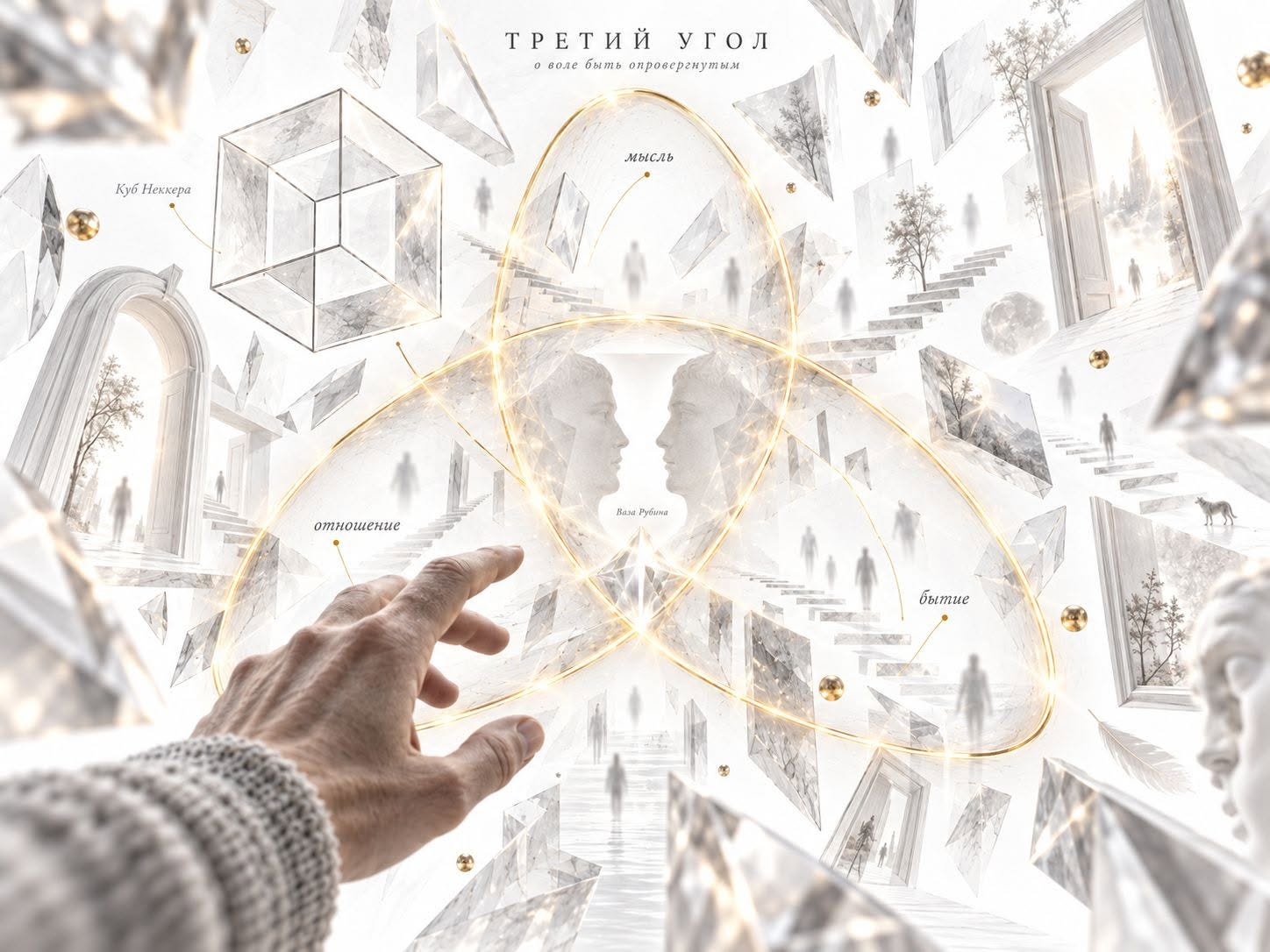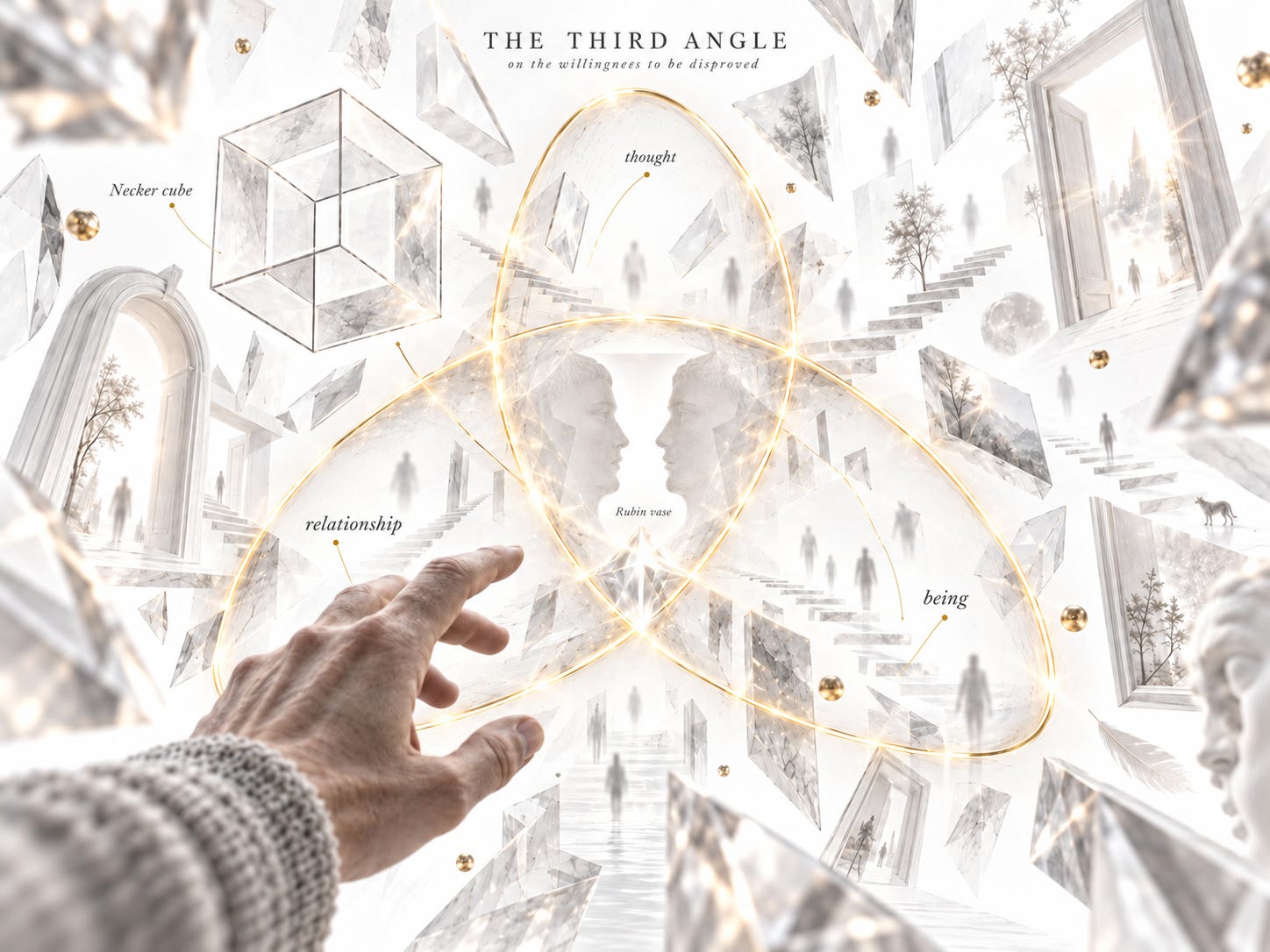
This text arose from a simple but uncomfortable question: how does our reality differ from the reality of a person who experiences a hallucination as something entirely real?
If consciousness in both cases is capable of producing a convincing sense of presence, then the boundary between the "real" and the "unreal" does not run solely through the strength of the experience itself. It must lie somewhere deeper: in the capacity of perception to test itself, to withstand contradiction, to take another view into account, and to allow the world to alter a picture that has already formed.
From here the inquiry gradually moves beyond the bounds of psychiatry. Hallucination becomes not an exception but a magnifying glass through which a general mechanism of consciousness becomes visible: we do not receive the world ready-made; we are constantly completing it from incomplete information, memory, expectation, culture and past experience.
Then a second question arises: why do some pictures of the world change easily on meeting a new fact, while others begin to defend themselves against precisely that which might correct them?
And here the theme of perception joins with ideology, identity, artificial intelligence, the information environment, determinism and freedom.
The title "The Third Angle" comes from an attempt to step outside the habitual binary geometry of thinking: true or false, normal or pathological, ours or theirs. The third angle does not mean a compromise between the 2 sides. It means the possibility of seeing the very frame within which those 2 sides arose, and then of including the observer himself in that analysis.
So in the end this text is not so much about hallucination, nor so much about a new theory of consciousness.
It is about a more fundamental human capacity:
to keep one's own picture of the world complete enough to live and act by, yet incomplete enough that reality can still refute it.
Sometimes consciousness gives itself away in a small thing.
You are walking along a path and you see a woman ahead. Bushes hide half her figure. You can see an arm, the movement of a shoulder, a dog beside her. This is not enough really to see the person whole, yet somehow it is already enough to know who is walking there.
A few seconds later the figure steps out from behind the bushes.
It is a man.
An almost negligible event takes place, the kind usually forgotten within a minute. But if you linger in it, something strange emerges: the woman did not turn into a man. There was never any woman there at all.
What changed was the world that, a moment earlier, had existed for consciousness.
Consciousness had managed to finish the scene before reality did.
And at the moment of error we suddenly see the seam that is usually hidden from us: between what is in front of our eyes and what we take ourselves to have seen.
What is more, this is not a rare breakdown of perception.
Experiments with ambiguous images have long shown a strange thing: one and the same physically unchanging stimulus can give rise to different stable perceptions. The Necker cube does not change, yet its depth flips. Rubin's vase remains the same, yet before us appears now a vase, now 2 faces. Contemporary research goes further: ambiguity is present not only in specially devised optical illusions. Sensory information in general is often incomplete, occluded, open to several possible interpretations, and resolving it is the ordinary work of perception.
That is, the woman behind the bushes is not merely an amusing mistake.
For a few seconds the mechanism itself becomes visible, a mechanism that usually works too fast for us to notice it.
This is where the question begins.
Not with mental illness.
Not with artificial intelligence.
Not with the theory of knowledge.
With the moment when the world says to a person:
no, it was not like that.
A person almost never experiences their picture of reality as a hypothesis.
We do not wake in the morning thinking: now my brain will construct the most probable model of the room from a limited stream of sensory data.
We simply open our eyes.
And the room appears.
The wall is there. The window is here. Beyond it, the street. On the table, a cup. In the next room, a person.
The world arrives already assembled.
That is precisely why hallucination presents so deep a philosophical problem.
If a person really hears a voice, if a figure is really present for them in the room, it is not enough to say: "but it isn't there".
That answers the question about the external object but explains almost nothing about the experience itself.
A voice can have a direction.
A figure, a distance.
A presence, an almost bodily density.
The experience does not arrive labelled "this was produced inside". It can arrive with the very quality of immediacy that, for us, events in the external world usually possess.
Why does what does not exist acquire the quality of presence?
And then a more disturbing counter-question arises:
why does what does exist acquire that quality for us?
Where is the seal with which consciousness marks:
this is not a thought; not a memory; not a possibility; this is happening now?
And does such a seal exist at all?
Here it is important to give up, too, the all-too-convenient chasm between "us" and "them".
Research on psychotic experiences shows that hallucinatory and delusion-like experiences in milder form also occur among people without a psychotic disorder. The current literature therefore holds the notion of a continuum: between ordinary human experience and clinical psychosis there is no single simple line after which an entirely different kind of consciousness suddenly begins. This does not mean that a clinical condition differs only in "degree", or that diagnoses lose their meaning. It means something more cautious: certain processes and forms of experience are distributed more widely than the old pairing of "normal / pathological" allowed us to suppose.
The difference between the 2 states, therefore, cannot consist simply in the subjective persuasiveness of the experience.
Persuasiveness is possible in both cases.
The difference has to be sought elsewhere: in the relationship of the experience to whatever is capable of testing it, resisting it and compelling the system to revise its own model.
Earlier in our conversation the metaphor of 2 matrices appeared.
A large one and a small one.
Now it can be understood more precisely.
The large matrix is by no means a guaranteed true reality.
It is a space in which there exist many independent ways of making my model meet resistance.
I see a cup.
I can touch it.
Walk round it.
Ask another person to look.
Measure it.
Photograph it.
Come back in a minute.
That is, the world does not merely show me an image of a cup. It permits many operations after which something relatively stable keeps returning.
One can go through one door, then another, then a third, and once again find oneself in roughly the same room.
This is extraordinarily important.
Reality turns out to be not only what is given but also what is able to withstand independent tests.
Yet even within this large matrix we do not live in absolutely identical worlds.
One and the same man is a father to one person, an enemy to another, a passer-by to a third.
A single smell means almost nothing to me and suddenly gives back to someone else an entire room of childhood.
We share a sufficiently stable causal framework of the world, but we experience it through different bodies, histories, languages, expectations and memories.
The large matrix, then, is not one gigantic picture shown to everyone at once.
It is rather a common field of resistance, within which there exist many partially overlapping human worlds.
Here, however, the next paradox emerges.
Sometimes the channel of verification exists but corrects nothing.
A person asks someone else, yet knows in advance that the other is lying.
Reads a document, but has already decided it is a forgery.
Carries out a check, yet the very fact of checking becomes proof of a conspiracy.
Receives contradictory data, but places it inside the old picture in such a way that the picture becomes stronger still.
Formally, the door exists.
But behind it another wall has been built.
And here the original question begins to change.
The problem is no longer how many channels connect us with reality.
The problem is this:
is any of them actually capable of changing us?
This is perhaps the hardest question of our entire inquiry.
Because here intelligence ceases to be the protagonist.
A very clever person is able to build a far more perfect closed system than a foolish one.
He will find an explanation for every discrepancy.
Construct a causal chain.
Find the weakness in his opponent's argument.
See the motive of whoever objects to him.
Create a theory within which even his own error turns out to be necessary proof that he is right.
Intelligence in that case works not as a window.
It works as a barrister.
It has not been instructed to find out what happened.
It has been instructed to defend the client.
And the client turns out to be one's own picture of the world.
That is why cognitive complexity guarantees nothing as yet.
One can see 5 points of view and remain a prisoner of the 6th: one's own.
One can understand perfectly the frame of someone else's thinking and never notice one's own.
One can be skilled at dismantling binary oppositions and use that skill solely so as never to be dismantled oneself.
So here it is necessary to separate 3 things that were previously hidden under a single name: the third angle.
The first third angle is intellectual.
I see A and B and am able to ask:
why did A and B, of all things, become the only options?
I notice the frame.
I see the mechanism that produced the opposition.
This is a capacity of thought.
The second third angle goes deeper.
I am able to see not only the frame of the question but also my own stake in a particular answer.
That my model is not a neutral diagram.
Fear, status, belonging, memory, humiliation, love, national identity, a sense of my own dignity may all be invested in it.
And so some facts cost me more than others.
The third level can scarcely be called an intellectual operation any longer.
It is a stance towards one's own completeness:
am I willing to leave open the possibility that the world knows something about me and about itself that my theory does not yet know?
This is where what might be called the will to be refuted appears.
The word "will" is a little dangerous here.
It may give the impression of a moral duty: the good person accepts refutation, the bad one resists.
Reality is far more complicated.
The capacity to revise one's own picture depends not only on character.
It depends on trust.
On fear.
On whether the new evidence threatens one's very sense of identity.
On one's relationship with the person who brings it.
On previous experience of being deceived.
On the state of the nervous system.
On culture.
On how deeply a conviction is bound up with belonging to a group.
Culture, moreover, can penetrate deeper than mere after-the-fact explanation of what has been experienced.
In a well-known comparative study, Tanya Luhrmann and colleagues interviewed people who heard voices in the United States, India and Ghana. There was much in common between the groups, but notable differences also emerged in how the voices were experienced: in the American sample they were more often described as intrusion and threat, whereas participants in India and Ghana more often spoke of relationships with their voices, sometimes perceiving them as advising or morally significant. Later work in the same line also supports the suggestion that the social and cultural environment may influence not only the content a person attributes to an experience but also its emotional colouring and the form of their relationship with it.
This does not prove that culture "creates hallucination".
But it obliges us to abandon an overly simple scheme in which the brain first independently produces a pure inner event and culture merely captions it afterwards.
Human experience is assembled at a deeper level.
Language, expectations, ideas about the person, about spirits, illness, the permissible and the impossible can enter into the very way in which something becomes experienceable.
In certain mental states, the processes of source monitoring, of assigning salience and of revising belief may also function unusually. But it would be a mistake to turn this into a moral tale about someone who "did not want to see the truth". Psychosis is heterogeneous, and the capacity to doubt, test and revise may be preserved to very different degrees.
So the honest answer to the question —
what exactly makes a channel of correction effective?
— today runs like this:
we do not fully know.
And this is not a shortcoming of our inquiry.
Perhaps it is its true centre.
We can see 2 identical human beings before identical evidence.
One will change.
The other will build the evidence into the former picture.
Why?
And here it proves insufficient to speak only of the strength of the information.
Between information and change there lies something more.
Let us call it, for now, the architecture of admission.
Not truth itself.
But the construction of the door through which truth must pass in order to become a change in the person.
At first it seemed to us that permeability was the ideal.
But absolute permeability would be a catastrophe.
A person who revises a belief after every confidently uttered sentence is not free.
He simply belongs to the last speaker.
So maturity lies not in maximal openness.
It lies in a harder quality:
to be changed exactly as far as the grounds genuinely deserve.
One might call this calibrated permeability.
Weak evidence should not demolish a well-supported picture.
Strong evidence should not vanish merely because it is unpleasant.
But even this formula remains, for now, more an ideal of one's relationship to reality than a discovered, distinct capacity of the brain.
And it is important to admit this.
Perhaps one day it will turn out that the whole of our "calibrated permeability" is fully explained by already known mechanisms of belief updating, metacognition, trust in sources and cognitive flexibility.
Then there will be no scientific novelty here.
But the philosophical problem will not go away.
Because the main question will remain:
why does a system sometimes begin to defend itself against the very world it arose in order to understand?
And now the third angle appears no longer as a theory but as an image of a new position for the human being.
2 poles form a line.
Right and left.
True and false.
Good and evil.
Ours and theirs.
Normal and pathological.
Human and artificial.
2 poles are extremely convenient.
They allow us to choose.
But a line has one peculiarity: while you are inside it, it is hard to see that there is space all around.
The third angle arises not as a midpoint.
Not as a diplomatic compromise.
It arises when the observer seems to step aside and sees for the first time:
the line itself was also built.
It is an almost spatial event of consciousness.
The flat becomes three-dimensional.
But even this is not yet maturity.
One can rise above the chessboard and use the new vantage point only to win more effectively.
So the third angle requires a second movement:
having seen the board, to allow oneself to become a piece on it.
That is far harder.
Because now the analysis is directed not only outwards.
That is precisely why our conversation unexpectedly arrived at artificial intelligence.
AI is interesting here not because it knows the truth.
Nor because it has come into possession of some higher consciousness.
Its significance is far more concrete.
It is becoming an external device capable of rapidly changing the geometry of a question.
A person brings A.
The machine shows B, C and D.
The person asks:
"Now destroy your own answer."
It builds an objection.
Then an objection to the objection.
This is not yet wisdom.
But historically it is an unusual situation.
The telescope carried human sight beyond the capacities of the eye.
Photography carried memory outside.
The computer carried part of calculation outside.
AI is beginning to carry outside the variability of interpretation.
For the first time we are acquiring a mass instrument that lets us look at our own thought as one variant among others.
But here lies the opposite possibility too.
The same system is capable of confirming us endlessly.
It can become not a third angle but a perfect mirror.
We pose the question so as to get what we want.
We receive the answer.
We return it to ourselves as external confirmation.
And we seal the small matrix, now with the help of a colossal collective intelligence.
Technology does not solve the problem of permeability.
It amplifies it in both directions.
This matters especially because the information environment itself has changed.
When thousands of people repeated a message in the past, there was at least a likelihood that thousands of independent human paths stood behind them.
Now 1,000,000 images may come from a single model.
1,000,000 messages, from a few original sources.
1,000,000 confirmations may turn out to be a hall of mirrors.
So quantity is gradually losing its old meaning.
The person of the future will increasingly have to ask not:
how many times have I seen this?
but:
how many independent paths actually led to this claim?
This is already a new condition of reality.
And here it becomes clearer why our original conversation about hallucination unexpectedly proved to be connected with civilisation.
Not because the digital world is a mass psychosis.
That would be both wrong and meaningless.
But because infrastructure increasingly begins to take part in the same process that formerly took place chiefly inside the head:
in the advance shaping of what a person expects to see.
Here determinism arises.
But not the determinism of a clock, in which every cog knows its turn in advance.
Rather, the determinism of a landscape.
The water does not yet know its exact path down the mountain.
But the slope already exists.
The depths already exist.
The stones already direct the current.
This is precisely the way the future is present in the present.
Not as a finished record.
As a system of slopes.
If the information environment adapts ever more precisely to a person's prior beliefs, that creates a slope.
If AI becomes the intermediary between question and answer, another slope.
If images cease to bear witness for themselves, a third.
If the shared social world breaks up into personalised information environments, a fourth.
We do not know exactly where the water will flow.
But we can see the change in the terrain.
And so there is no need to look to the year 2056.
Too distant a horizon is almost decorative today.
It is far more important to look at the next few bends.
The future is already hidden here as the pressure of the present on what has not yet happened.
And a remarkable loop appears.
A person is able to see the slope.
And the slope, once seen, becomes a new cause.
If we notice that a certain technology is enclosing us within a confirming environment, that very understanding can change the way we use it.
It turns out that determinism does not abolish freedom entirely.
It relocates it.
Freedom turns out to be not a mysterious ability to act without causes.
It may consist in the ability to see some of the causes that are about to act through you.
The third angle then becomes yet another degree of freedom within causality.
And here Proust appears again.
Not as ornament.
But because in him consciousness constantly discovers that reality is created not by the present moment alone.
A man wakes in the night.
For a few seconds he does not know where he is.
The body remembers one room.
Memory offers another.
The direction of the wall seems to belong to a third.
Past spaces return and for a moment possess almost equal reality.
Then resistance arrives.
The hand touches the wall.
Light enters from a particular window.
The body recalls distance.
The world gradually corrects memory.
But there is something more in this scene.
The man does not force the room in advance to be the one he expects.
For a while he endures its uncertainty.
The hand does not yet know.
The room still has the right to turn out otherwise.
Perhaps it is this very state that is the most precise image of the quality we are trying to name.
Not perpetual doubt.
Not intellectual capitulation.
But a brief inner pause between expectation and final decision.
A place where the world may still have time to enter.
Perhaps that is why Proust turns out to be closer to the future than some futurologists.
He did not study machines.
He studied the place that machines are now entering:
the way in which consciousness assembles the present from memory, sensation and expectation.
We live in an age when that very place is becoming technologically accessible.
The environment no longer merely tells a person what has happened.
It shapes the likelihood of what they will notice as having happened at all.
So the question of reality is gradually becoming a question not only of philosophy and psychology but also of the architecture of the environment.
Which refutations reach a person?
Which are filtered out?
Which are they able to bear?
Which are bound up with so great a threat to their identity that consciousness prefers to rebuild the entire external world rather than rebuild itself?
That is why the most educated people can sometimes prove especially resistant to correction.
They simply have more tools for building walls.
And we return to the person behind the bushes.
At first consciousness saw a woman.
Then a man stepped out.
The story ended well.
Because the error was cheap.
Nothing depended on who was walking there.
So the model died easily.
But let us imagine something else.
What if my biography depended on that woman?
What if I was afraid of her?
Had been waiting for her for 20 years?
What if the woman's existence would have confirmed something I had long believed?
What if the man destroyed an important story about myself?
Then the same sensory fact would have entered an entirely different psychic architecture.
And this is where the real problem of reality begins.
We are able to change fairly easily the beliefs that cost us nothing.
The hardest to change are those inside which our self is hidden.
So the will to be refuted, if we keep this formula, means not a love of defeat.
Nor a duty to renounce oneself.
It means the capacity to live through the moment when part of one's own picture of the world dies, without mistaking it for the death of oneself.
Perhaps that is why it is so rare.
And then the third angle can at last be left in 3 forms, without trying to make them one.
There is the third angle of thought: the capacity to see the frame.
There is the third angle of relationship: the capacity to let sufficient grounds change one's own model.
And there is the third angle of being: assent to the fact that no model exhausts reality once and for all.
The first can be approached through measurement.
The second, to investigate at the border of cognition, affect and character.
The third belongs to philosophy.
They are neighbours.
But they do not replace one another.
And perhaps it is precisely this separation that at last frees the whole construction from the need to prove that we have found one new function of the human brain.
What we have found is rather 3 different relationships to incompleteness.
Perhaps that is why the image of the last canvas is still worth keeping.
The painter finishes the picture.
The composition is assembled.
All the relationships have been found.
Nothing more needs adding.
But near the very edge a thin strip of bare ground remains.
Not because the painter ran short of paint.
And not because he doubts every line.
He leaves it as a reminder of the difference between 2 things:
a finished picture
and
a finished reality.
The first is possible.
The second, probably not.
And in that small unpainted place almost the whole of our conversation fits.
The world has not yet proved anything.
Consciousness is already prepared to finish the image.
And between them a few seconds remain.
Perhaps it is precisely these few seconds that are becoming today one of the most precious spaces of human freedom.
Not the freedom to invent any reality we please.
But the freedom not to finish it before it has had time to answer.
АЦХ · ADC 🪶