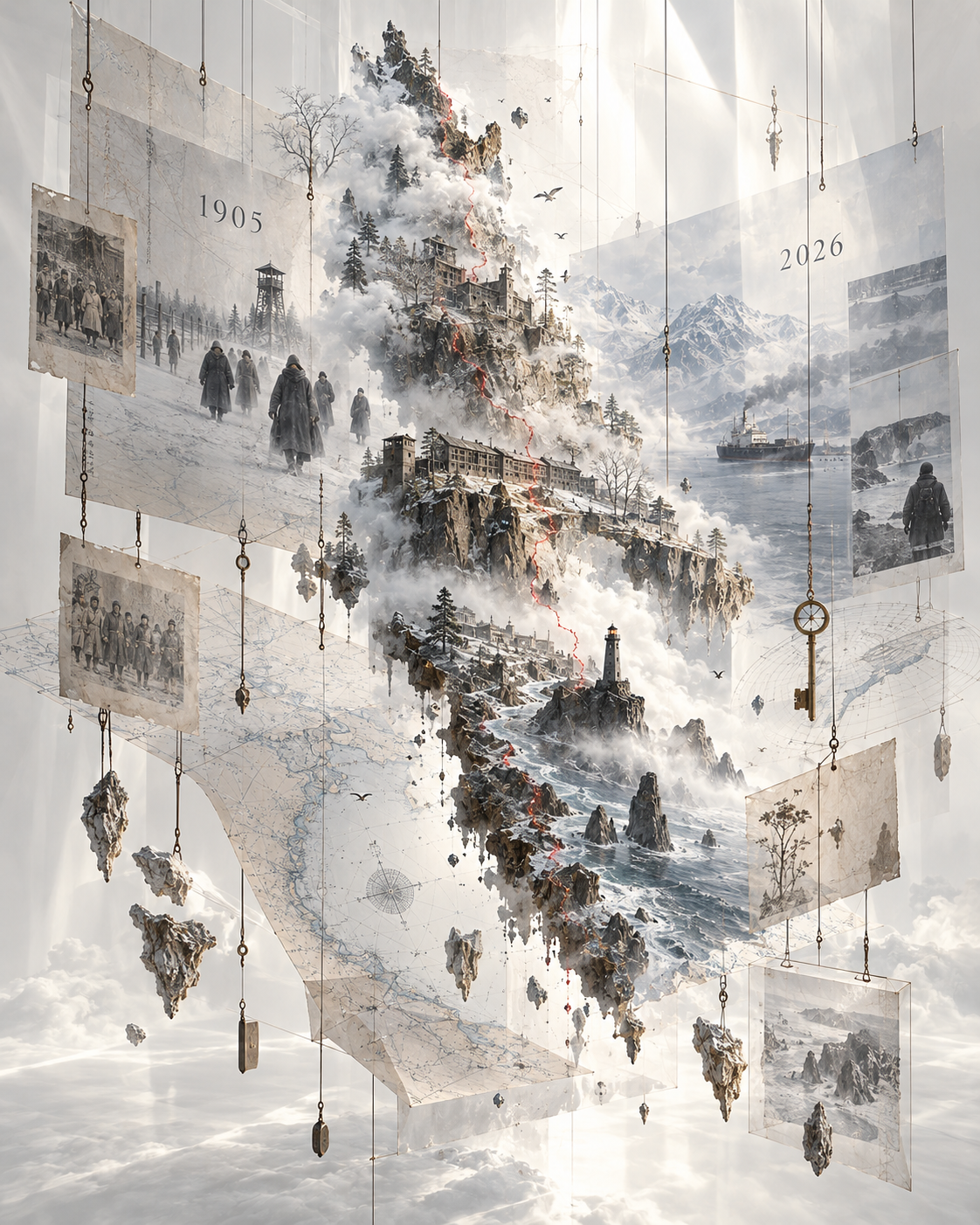
Today, 13 October 2026, I read a brief report. In Yuzhno-Sakhalinsk, officers of Russia’s Federal Security Service detained a Japanese journalist, a correspondent for Hokkaido Shimbun. The Russian authorities allege that he was gathering information about Russia’s defence capabilities on behalf of Japanese intelligence. According to their account, he was taken to Moscow and placed in custody pending investigation. His guilt has not been established by a court.
A few lines. An ordinary news item that will be swallowed by the next one within an hour.
But it contained a word. Sakhalin. And beside it another. Japanese.
And what happened was something Proust knew about a biscuit soaked in lime-blossom tea. Not a memory summoned by effort, but a memory that arrives of its own accord, whole, with its own air, its own weather and its own smell. I did not remember Pikul’s novel. I entered it.
The fog over Aniva Bay returned. The shackles returned, ringing not like metal but like the age itself. The courteous Japanese men with notebooks returned, the fishermen who measured the coastal depths a little too attentively, the traders and photographers who knew the island better than the officials sent to govern it. Japanese cartographers carefully marked bays, paths and fords on paper while the Russian administration drank, played cards and wrote reports declaring that all was well.
And what returned was not the literal scene, but its image, which I can no longer separate from the book. A reception. Stout generals in uniforms tightened by medals and dinners. A table with 1 apple left on it. And the men upon whom the defence of the empire depended reaching for that apple, jostling, snorting, refusing to give way. The empire on the brink of war, the fleet sailing towards its destruction, and in the hall a battle for a piece of fruit.
In Katorga, this is a scramble for refreshments at a court ball: the fruit includes apples and pears, and General Lyapishev ends up with a pear someone has already bitten into. My apple is an authorial transformation of that episode. I condensed many objects into 1 piece of fruit, many people into a single gesture. Memory preserved not an inventory of the table, but the structure of what was happening. So this apple belongs to my reading of Pikul: in it, a power claiming an entire island becomes absorbed in what it can immediately appropriate at its own table. Not an accidental inaccuracy, but an image whose meaning I have only now come to see.
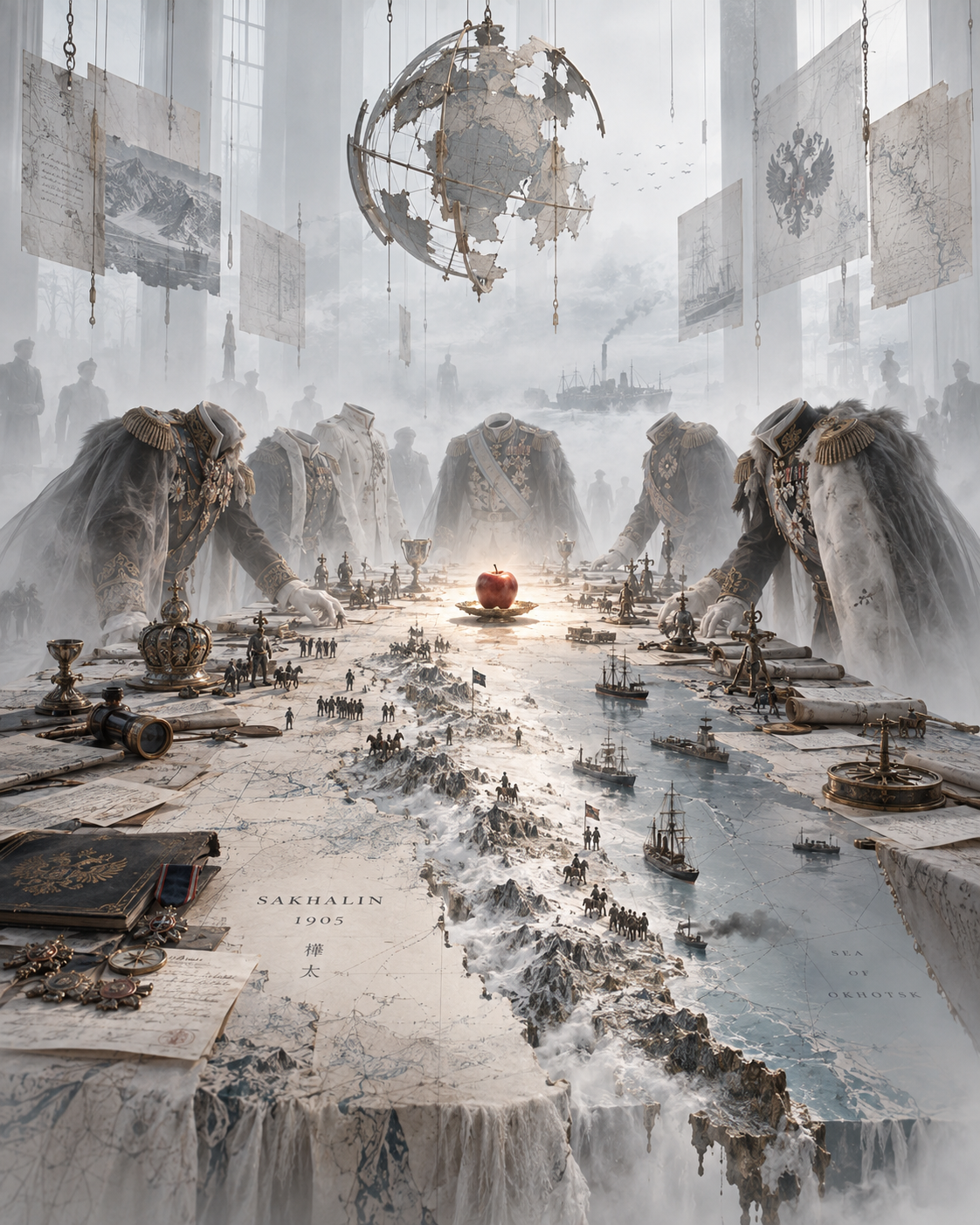
It was a picture of power that could no longer see anything beyond its own table.
And after Pikul came another voice. Older, drier, sterner. A voice I had long passed through myself until it had become almost my own. The late Tolstoy. He too lived in that time. He too looked at that war. And for me, it was he who spoke the word that today again seems to have no one to speak it.
A strange feeling arose. As though I had opened a book closed many years ago and discovered that its last chapter had never been written. That it was being written now, in different ink, on different paper, but in the same handwriting.
History does not repeat itself literally. Between 1905 and 2026 lie revolutions, 2 world wars, the birth and death of the Soviet Union, the atomic bomb, spaceflight, the internet. And yet the circle has returned. Not to the same point, but to another turn of the same spiral. The question is where that spiral leads. Upwards or downwards.
1. The island where the state put the human being to the test
In the 19th century, Sakhalin was becoming a penal colony. The state was pursuing 2 tasks at once. Punishment and the consolidation of its presence on its distant eastern frontier.
There was an internal contradiction in this project. The state needed settlements, an economy, a stable population. Yet its building material was people who had first been deprived of their freedom.
In 1875, the Treaty of Saint Petersburg assigned Sakhalin to Russia and the Kuril Islands to Japan. On the map, the question seemed settled. In reality, it had merely gone underground.
The island was not empty. Nivkh, Ainu and Uilta people lived here. For them, imperial treaties meant just one thing. Lands their fathers had walked were suddenly declared to belong to someone else.
In 1890, Chekhov arrived on the island. He brought neither an army nor a programme of colonisation. He brought an intention to see. He visited prisons and settlements and completed roughly 10,000 individual census cards. Convicts, settlers, their wives and children. The official number of convicts was 5,905. Each card was a small door. Behind each stood a life the state remembered only as a number.
Chekhov was interested not in whether the machine was functioning properly. He was interested in what was happening to the human being inside it.
A few years later, Tolstoy completed Resurrection. Nekhlyudov follows the convicted Maslova east along the prison route, in the same direction as those driven towards Sakhalin. And the further he goes, the more clearly he sees that criminals are not confined to the prison detachments. The machine itself is criminal, a machine in which some people calmly, in the course of their duties, torment others. Chekhov saw this with a doctor’s eyes. Tolstoy named it with the voice of conscience.
The state knows how to keep account of a person without understanding them. It can count prisoners, food allowances, sentences, those fit for work. The precision of the accounting tells us nothing about how the people being counted are treated.
Chekhov moved from the card to the living person. That is a direction of travel. It can also be travelled in reverse.
2. 1905. An empire that failed to notice its own fracture
Russia at the beginning of the century wanted to be a modern power. Railways, the telegraph, battleships, banks, newspapers. But the institutions of power changed more slowly than the machines.
In that gap, the Russo-Japanese War unfolded. Port Arthur, Mukden, Tsushima. And within the country, 9 January 1905 by the calendar then used in Russia: Bloody Sunday and the beginning of the revolution.
In the spring of 1904, after Japanese torpedo boats had attacked Port Arthur, an old man at Yasnaya Polyana was writing an article against the war. He called it Bethink Yourselves! It began like this.
Again war. Again suffering that no one needs and nothing has called for, again lies, again the general stupefaction and brutalisation of people.
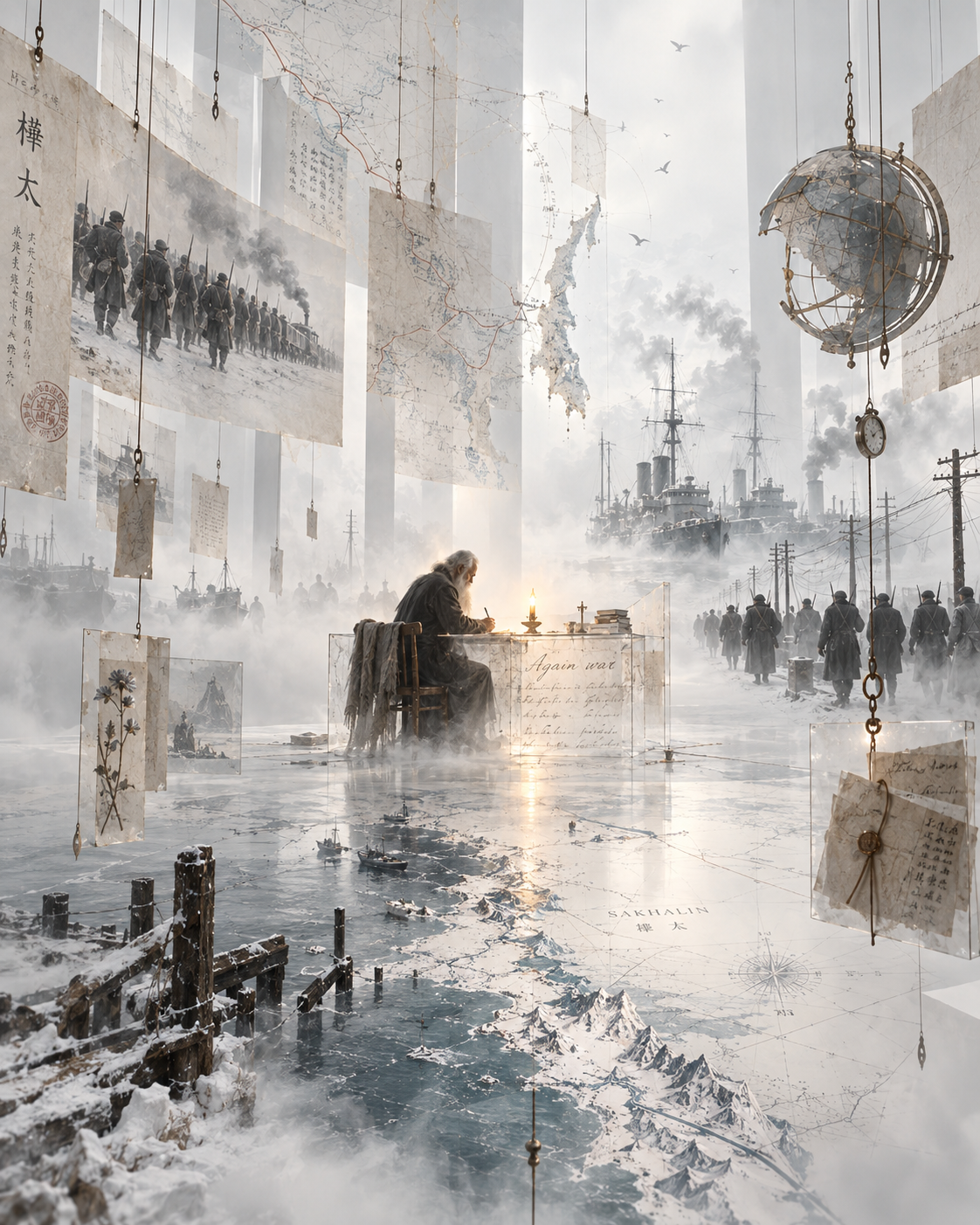
The article was prohibited in Russia. It was published in England and read around the world. Tolstoy wrote about people driven to kill other people who had done them no harm. About priests blessing killing. About newspapers stirring up hatred. About a tsar signing orders by which thousands died, while never seeing any of those deaths himself.
Reading Tolstoy, I see those generals at the table again. People for whom war became an occasion for decorations, promotion and pay. Here my apple meets his moral question: what remains of a human being when someone else’s suffering becomes a condition of their own prosperity? Read this way, the apple at the reception becomes a diagnosis rather than an anecdote.
The empire was losing the war outside and trust within. Its capacity to coerce remained. But coercion and trust have never been the same thing.
It was then that Sakhalin entered the war.
On 7 July, Japan’s 13th Division, supported by the fleet, began its landing. By 31 July it was over. The island was defended by disparate, poorly armed and poorly trained detachments. Convicts were among them. Governor Lyapunov assembled militias from exiles, promising reductions in their sentences.
Here is a historical paradox that needs no literature. The state sent a man to the edge of the earth as punishment. Then it came to him for the defence of that very earth.
Yesterday he was someone society wanted to get rid of. Today he was expected to die for a border.
What had changed? The man? His guilt? Or merely the fact that the state suddenly needed his hands?
The convicts on Sakhalin were unlikely to have read Bethink Yourselves! But the article had been written about them too.
Pikul placed Gleb Polynov at the centre of this situation, a fictional protagonist whose fate passes through the whole world of penal servitude. The novel appeared in 1987, but rests on the real events of 1905 and on documents of the islanders’ resistance.
And reality preserved its own document. On 27 October 1905, the Japanese side sent the United States materials accusing Sakhalin’s defenders, recruited in part from convicts, of violating the laws of war. This was an allegation by one of the belligerents, and in itself it proves nothing. But it shows something else.
The same person is a defender in the papers of one power and a criminal in those of another. Power always fights not only for territory. It fights for the right to name a human being.
On 5 September 1905, peace was signed at Portsmouth. Southern Sakhalin, as far as the 50th parallel, passed to Japan and became Karafuto. A border ran straight across the island.
The state can sign a document ending a war. It cannot sign a document that makes the past disappear from memory.
3. 1945 and 1991. The ages change; the question remains
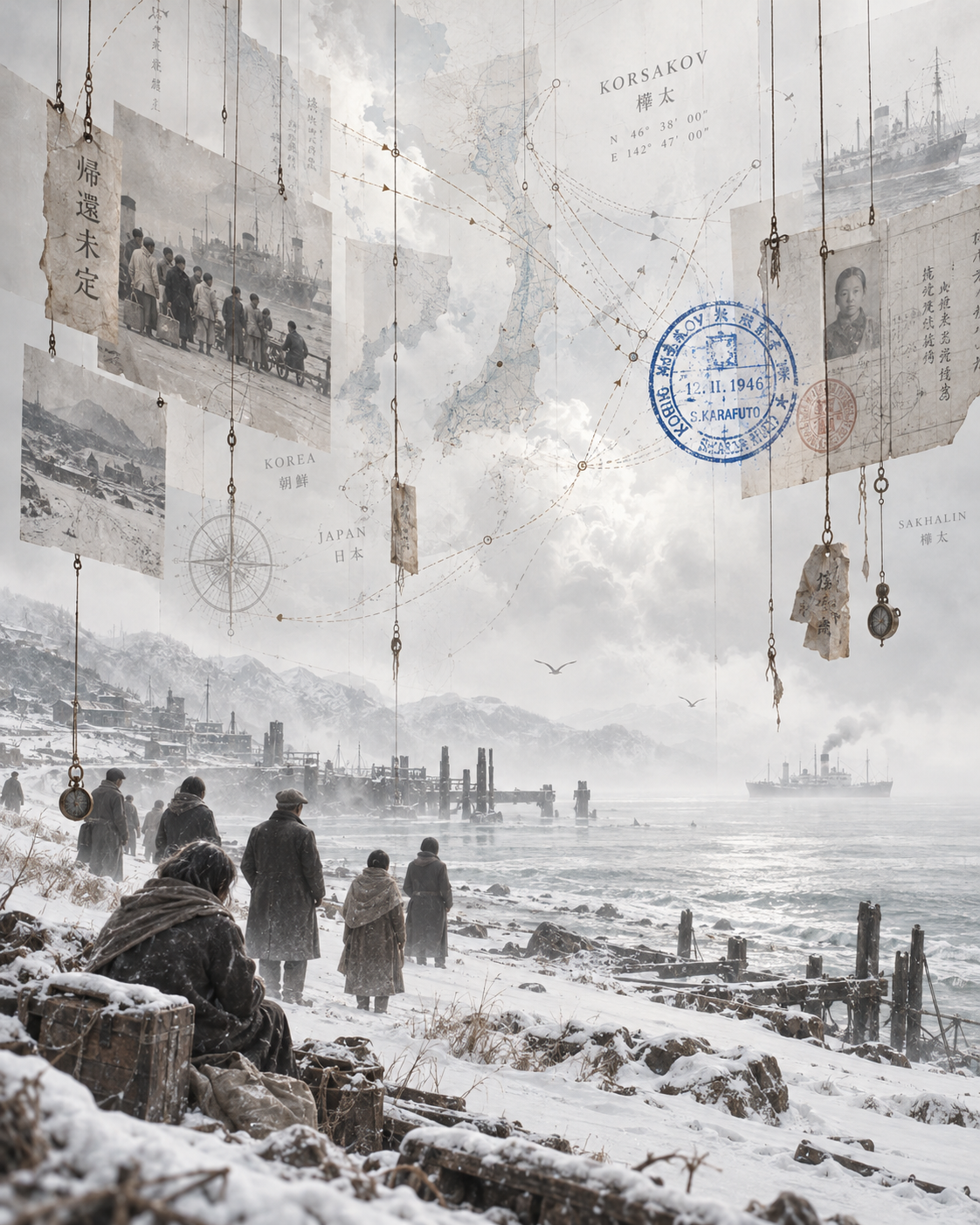
In August 1945, the Soviet Union entered the war against Japan and occupied Southern Sakhalin and the Kuril Islands. Renaming, population movements and the repatriation of Japanese residents began.
There is a page rarely recalled. The Japanese authorities used some Nivkh and Uilta people for intelligence work. After Soviet rule arrived, some were arrested as collaborators with the enemy and sent to labour camps. The historian Tessa Morris-Suzuki has described these lives caught between 2 state machines.
There was a 3rd fate, about which the island has remained silent longest. The Koreans. The Japanese empire brought them to Karafuto to work in mines and logging camps. Many were brought against their will. After 1945, Japanese residents were repatriated. The Koreans were left behind. Japan no longer regarded them as its own. The Soviet authorities would not allow them to return home. Tens of thousands remained on the island without a country, many without citizenship. It is said that in Korsakov they would go down to the shore and look out to sea, waiting for a ship. The ship did not come. They waited for years, then decades. Many of those eventually able to return to Korea were already over 70.
The border moved, and the people remained standing on the shore.
At the beginning of the century, a convict became a soldier. In the middle of the century, a local guide became a prisoner, and an imported worker became a person without a homeland. Not the repetition of an event, but the repetition of a method. The system assigns a person a role according to its needs. Their biography is always larger than that role.
Tolstoy called this the state’s central lie. The belief that a person belongs neither to themselves nor to God, but to the power under which they happen to have been born.
In 1956, the USSR and Japan signed a Joint Declaration. The state of war ended and relations were restored. A peace treaty was never concluded. The stumbling block remained the southern Kuril Islands: Iturup, Kunashir, Shikotan and Habomai. Not Sakhalin itself, but neighbouring islands in the same border sea.
Then the Soviet Union died. And the unresolved question outlived the state under which it had arisen. The outer shell of the world can change completely, while one unhealed point remains beneath it and, decades later, still hurts in almost the same words.
4. 2022 and 2026. The return of an old language
In February 2022, Russia launched its full-scale invasion of Ukraine. Japan joined the sanctions. Moscow suspended peace-treaty negotiations. In February 2026, the Kremlin acknowledged that dialogue with Tokyo was effectively absent. In August, Putin’s visit to Iturup brought another protest from Japan.
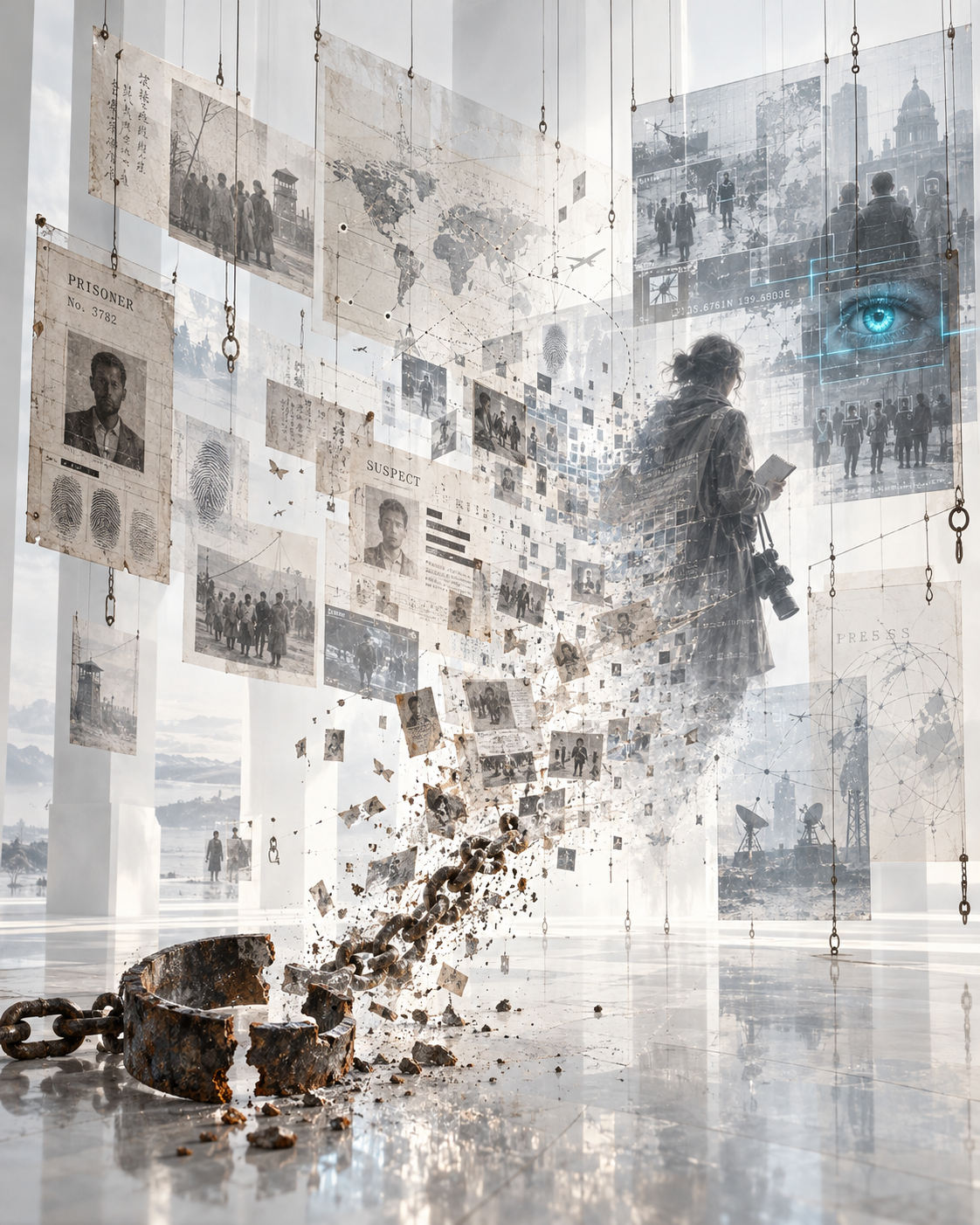
This is the atmosphere in which today’s news was heard.
Russia and Japan are not at war today. But the same words have returned. Defence capability. Security. Foreign interests. Secret information. Suspicion.
Similar words do not make events identical. A journalist, a researcher, a traveller: all gather information. What matters is purpose, method and law. The Japanese correspondent’s guilt cannot follow from his being Japanese, from his presence on Sakhalin or from his interest in military matters. It can be established only through evidence and a fair trial. That is precisely what cannot be known in advance here.
And there is a rhyme in the calendar that makes one uneasy. On 13 October 1956, negotiations began in Moscow that ended 6 days later with a declaration restoring relations. Exactly 70 years later, on 13 October 2026, news comes of a Japanese journalist detained on Sakhalin and taken to Moscow in an espionage case.
Coincidence proves nothing. But the calendar resembles a palimpsest. A new text is written on old parchment, and earlier words show through the fresh lines. 13 October 2026 is written over 13 October 1956. Beneath it, deeper still, the spring of 1904 shows through, with a line from Yasnaya Polyana. Again war. The old writing cannot quite be erased. Then this day opened a door. Today it closes one.
5. The circle we have travelled, and what it has brought us back to
Here I want to pause over the essential thing. At first I thought this was about technology outrunning morality. That is true, but it is not the whole truth. The circle has completed its course, carrying everything with it. Wars, revolutions, camps, thaws, the hopes of the 1990s. And it has brought us back not to the same point. It has brought us lower.
Think of the convict of 1905. His guilt might have been great or small, but he stood in a militia on his island. Japanese troops were landing on the ground where he lived, built a home, buried his companions. He had been promised a shorter sentence. He was defending a place that, strangely enough, had become his home.
Now look at today. Prisoners are again recruited from Russian penal colonies. They are again promised freedom. Only now they are sent not to defend their own shore against a foreign landing. They are sent into a neighbouring country, among people who speak a related language and until recently visited one another. First a private military company did this, then the defence ministry itself. Pardon became payment for taking part in an invasion.
Lyapunov promised convicts shorter sentences for defence. Today’s system promises prisoners forgiveness for attack.
And beside them walks another soldier. A contract soldier. He is offered signing payments unheard of in his town, monthly pay several times the local wage, money for his family if he dies. For many, war has become the best-paid job in the country. A man from a poor district signs a contract and goes to kill his neighbours not because their army has landed beside his home, but because it pays well.
Tolstoy wrote that the soldier is deceived. He is torn from his land and family, dressed in a uniform, taught obedience and persuaded that killing on command is no sin. Tolstoy pitied that soldier. He saw a peasant whose mind had been clouded.
The soldier of the imperial army was a subject driven to war by orders. This was cruel, but it still belonged to an old logic of duty, however false. The paid soldier of today’s empire is bound to war by a contract. In this logic, deception is no longer necessary. He knows where he is going and what he is paid for. He sells not only his time and strength. He sells his consent to kill.
Tolstoy fought the lie that turned a peasant into a killer. How would he have faced a world in which a price could do the work once done by that lie?
This is the coarsening I feel most strongly. Not in the weapons, but in the price. In 1905, a person was a resource of the state, and that was a humiliation. In 2026, a person puts themselves on the market of death, and the state readily buys them. Violence has turned from an obligation into a service.
And then the scene with the generals and the apple returns, no longer funny. There greed was petty, almost comic; it merely showed that power had gone blind. Today the same table is laid differently. Budgets, defence contracts, confiscated assets, appointments are divided. And the price of that table is paid by people who have never sat at it. Prisoners from penal colonies. Contract soldiers from depressed towns. And the inhabitants of a neighbouring country who never chose this war at all. I return to my apple precisely as a metaphor for this arrangement: the objects on the table change, but the gulf between those who divide them and those who pay remains.
Pikul’s empire was losing because it could not see its own fracture. Today’s sees it and lives inside it, having learned to draw an income from it.
6. The felled forest
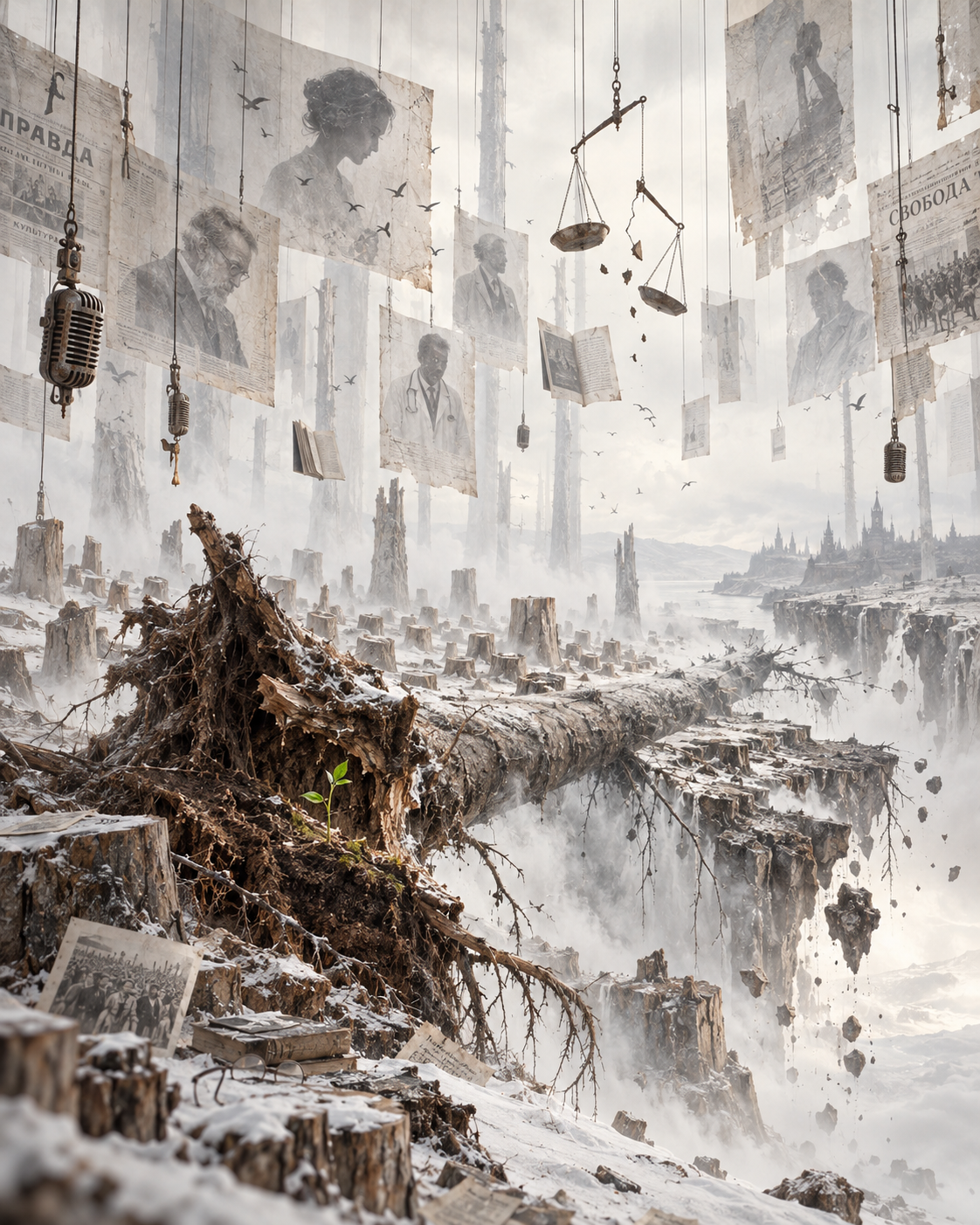
And here is what strikes me now, after 120 years. Nicholas II’s empire was cruel, censorious, cumbersome. In it, the Holy Synod declared Tolstoy to have fallen away from the Church. His articles were banned. Yet his authority made him difficult to touch. The publisher Suvorin wrote in his diary that Russia had 2 tsars: Nicholas II and Leo Tolstoy. And the first could do nothing to the second.
In that empire, a forest was still growing. Tolstoy was its tallest tree, but not its only one. There were Korolenko, Chekhov, doctors in local self-government, barristers, university professors, independent newspapers, juries that could acquit against the wishes of power. The forest did not stop the war. But it held the soil. Within it there was still somewhere for a thought that did not match an order to take shelter.
Today there is no Tolstoy in Russia. And the point is not that a genius has failed to be born. The point is that the very place where one might grow has been cut down.
Independent newspapers have been closed. Memorial, which preserved the memory of the camps, was liquidated by a court decision. Dissenters are labelled foreign agents, imprisoned for words, pushed out of the country. The best-known opponent of the authorities died in a penal colony above the Arctic Circle. If someone wrote Bethink Yourselves! about the present war today, they would not be excommunicated. I fear that the Church itself would bless their punishment.
Putin’s power does not merely suppress dissent. In the image that comes to me, it has felled the whole forest so that no tree taller than its own shadow remains in the open ground.
But a felled forest does not become a level field. After felling comes erosion. Rain washes away the soil held by roots. Slopes slip. Land deprived of forest ceases to retain water and begins to destroy itself.
This is no longer an inflation of thought, in which words lose value through overuse. It is a pathology of another order. An organism destroying its own immune system because it mistakes it for an enemy. Every voice capable of saying “bethink yourselves” is perceived as a threat. And so no one is left to stop the illness.
The empire of 1905 lost the war but could still hear Tolstoy. The empire of 2026 has made it so that there is no one left for it to hear.
7. Technology as an amplifier rather than a cause
Technology is not to blame here. It merely amplifies what is already present in a society.
Tolstoy did not believe in progress as salvation. While still young, he wrote that faith in progress was a superstition convenient to those who benefited from the existing order. People laughed at him. It is harder to laugh today.
In 1905, the empire had battleships and the telegraph but no capacity to hear its own people. In 2026, the state has satellites, databases, facial recognition, algorithms capable of reducing a person to the sum of their movements, contacts and payments.
An algorithm finds a correspondence between attributes. It does not know what an action means. A digital picture of a person’s movements is not yet knowledge of their intentions. Suspicion remains a hypothesis until the facts have been examined honestly. Danger begins where computational confidence takes the place of evidence.
An invention passes to the next generation almost of its own accord. A moral principle does not. It must be established anew each time, with our own hands. So machines accumulate while a sense of measure can be lost within 1 decade. Especially where those who preserved that measure have been cut down.
Kant demanded that we see a person as an end, not merely a means. Arendt showed how the performance of a function becomes separated from judgement. Heidegger described a gaze for which all that exists becomes a stock available for use. Tolstoy said it more simply, in the language of a commandment. Thou shalt not kill. And do not allow yourself to be persuaded that an order cancels that commandment.
Sakhalin’s history passes through all these thoughts. A prisoner as an instrument of colonisation. A convict as a resource for defence. A Nivkh person as a bearer of information. A Korean as labour forgotten on the shore. A contemporary prisoner as a resource for an offensive. A contract soldier as a paid unit. A journalist as a digital dossier.
A person becomes invisible not when little is known about them. But when everything known about them is reduced to their usefulness or dangerousness.
8. Pikul. A continuation without a new novel
Pikul wrote Katorga in the late Soviet period. He knew what his characters did not. That Nicholas II’s empire would disappear. That there would be another war against Japan. That the border on Sakhalin would move again.
What he did not know was something else. That within a few years, the state in which he was writing would also disappear. That decades later Russia would begin a major war in Europe. That people would again be recruited for war from penal colonies, only now not to defend an island. That in October 2026, a Japanese journalist would be caught up in a state-security case originating on that very island. And that in a country where the tsar once found it impossible to touch Tolstoy, there would be no one left whom power feared to touch.
The continuation of Katorga needs no new fictional protagonists. History itself is writing it.
It is not Polynov’s fate that continues, nor penal servitude as a form of punishment. What continues is the state’s relationship to the human being where the state understands itself chiefly through territory, security and control.
Braudel called this the longue durée, the slow time of structures beneath the surface of events. For Sakhalin, this duration is first of all natural. Fog coming from the sea under any coat of arms. Winter equally long for governor, convict and border guard. The strait separating the island from the mainland under every empire. Politics changes quickly. The sea changes slowly.
But Sakhalin has another duration too. A human one.
The convict who built a home at a distant edge not his own. The woman who followed a convicted man, as Nekhlyudov followed Maslova. The Ainu whose family lived through shifting borders. The Japanese resident of Karafuto who left the island after 1945. The Nivkh whom one power used and another accused. The Korean who looked out to sea for years from the Korsakov shore, waiting for a ship. The prisoner offered freedom today in exchange for another person’s life. And the journalist whose case has yet to be established.
These fates cannot be equated. But through them we see what the map cannot see. On the map, a border is a line. In life, it sometimes runs straight through a biography.
9. Memory that returns not the past, but a question
Proustian time arises not when we remember. But when the present unexpectedly returns the past to life. A single detail opens an entire vanished world.
And so this news was more than a report of a criminal case. It returned to me the fog over the bay, the ringing of shackles, the courteous Japanese men with notebooks, the generals around the last apple, the people on the Korsakov shore. And the old man at Yasnaya Polyana, writing 2 words by candlelight. Again war.
Today news from this island reaches a phone screen in a fraction of a second. In 1905, news took weeks. But the speed at which we learn does not determine the depth at which we understand. We have shortened the distance between event and report. The distance between report and truth remains as it was.
History need not repeat itself to remain unresolved. It is enough that a society changes its means while preserving its old way of asking questions. And sometimes its old answers, only coarser.
Who has the right to determine truth? Where does security end and arbitrary power begin? Where does the necessity of the state end and human dignity begin? And what happens to a country in which killing a neighbour has become a well-paid job?
In 1904, an old man at Yasnaya Polyana answered these questions. A phrase. Bethink yourselves. Today there is no one to speak it in such a way that the whole country hears. Yet it has not disappeared. It lies in the same soil as Sakhalin’s shackles and waits. The roots of a felled forest live beneath the ground longer than those who felled it imagine.
It would be wrong to say that humanity has learned nothing in 121 years. There have been liberations, rights, resistance to violence. But these achievements are not a machine that can be set running once and left to work. They must be defended every day. Stop, and the circle returns.
Technology answers the question of what a person can do. Morality begins with another question. What they must not do, even if they can. Even if they will be paid for it.
Between these 2 questions runs a border more important than the one that once cut Sakhalin along the 50th parallel.
The island remains where it is. Capitals, coats of arms, ministers, means of communication change. People who thought their own time final pass away. They are succeeded by generations certain that everything is different now.
And the island remains silent between mainland and sea, holding the memory of their decisions in its geography.
Perhaps what is most troubling about today’s news is not that it recalls the past.
But that the past still explains the present. And no longer entirely.
13 October 2026
Ealoiontoir · Spirit of Time
Sources
- The Treaty of Portsmouth, U.S. Department of State, Office of the Historian
- The Sakhalin campaign of 1905, Japan Center for Asian Historical Records (JACAR)
- Leo Tolstoy, Bethink Yourselves!, 1904
- Leo Tolstoy, Resurrection, 1899
- Leo Tolstoy, Progress and the Definition of Education, 1862
- A. S. Suvorin’s diary
- Anton Chekhov, Sakhalin Island
- Valentin Pikul, Katorga, 1987
- Tessa Morris-Suzuki’s research on the Indigenous peoples of Sakhalin
- Research on the fate of Sakhalin Koreans after 1945
- The Soviet–Japanese Joint Declaration, 19 October 1956
- Reuters and Associated Press reports of 13 October 2026
АЦХ · ADC 🪶