PROLOGUE. WHAT EXACTLY DO WE RISK LOSING?
The opening question seems contradictory. Why do people building the most powerful artificial intelligence systems warn of possible catastrophe while continuing to develop them?
There may be several explanations. They expect benefits that outweigh the risk. They believe they can ensure safety. They fear that stopping will hand the advantage to a less cautious competitor. Different participants may be guided by different combinations of these motives. Without further evidence, we cannot select one explanation and declare it the answer for everyone.
But the question itself leads to a broader problem.
Public discussion is often framed as if there were two futures before us: humanity either perishes at the hands of AI or successfully makes use of the new technology. Between these outcomes lies a multitude of possible conditions. People continue to live, companies operate, states endure, and medicine and science gain new possibilities. At the same time, society’s ability to determine the conditions of its own life may diminish.
Who can check a machine’s decision? Who can stop it from acting? Who sets the acceptable level of risk? Who changes a system’s behaviour after millions of people have integrated it into their work? How much does switching to another provider cost? And is there a way to perform a critical function if the familiar system is unavailable?
These questions do not require us to assume an evil superintelligence. They arise as soon as AI becomes useful enough for work to be delegated to it increasingly often.
This essay examines one possible mechanism: useful delegation creates dependence; under certain conditions, dependence weakens the ability to verify, decline and change the system.
Each transition in this chain requires its own justification. Dependence does not necessarily mean subordination. Automation does not necessarily destroy skills. Concentration does not necessarily become permanent. But the practical usefulness of a technology does not in itself guarantee that human control will be preserved.
The subject of this essay, therefore, is the conditions under which growing human capabilities are accompanied by diminishing autonomy, and the ways we can recognise this divergence.
I. DEPENDENCE AND THE ABSENCE OF ALTERNATIVES
Civilisation exists through mutual dependencies. We do not independently produce medicines, electricity, computing devices or most of the food we consume. The division of labour enables us to do what is beyond an individual’s reach.
Independence, therefore, cannot be understood as the ability to live without infrastructure. A more substantive question is: can we verify, challenge and change the systems on which we depend?
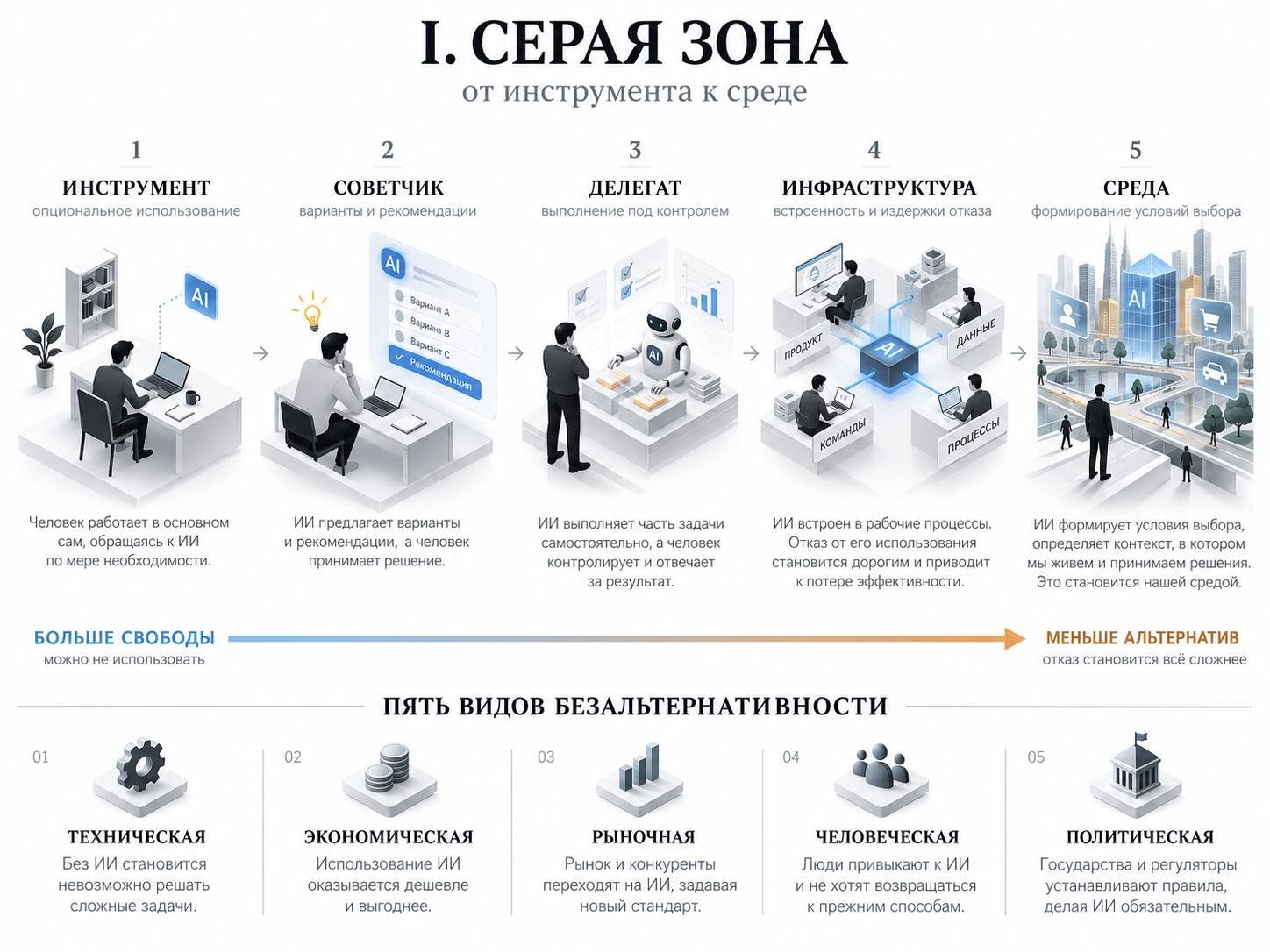
In this essay, an environment means a technological system that determines not merely an individual operation but the conditions of participation in social life: access to information, work, services and decisions.
The transition from tool to environment is not in itself a catastrophe. The danger arises when the environment has practically no alternative.
The absence of alternatives has several dimensions:
- technical — no suitable replacement exists;
- economic — a replacement exists, but switching entails unacceptable costs;
- market — formally different offerings depend on a single critical provider;
- competence — the knowledge and organisational skills necessary for another way of working have been lost;
- institutional — rules, contracts or state obligations make withdrawal practically impossible.
These constraints can reinforce one another. An organisation still has the right to change its system, but no longer has trained staff, portable data or the time to make the transition.
A grey zone here means a condition in which formal rights remain, while the practical ability to exercise them diminishes.
This definition requires measurement. A feeling of dependence alone does not prove the absence of alternatives. We need to establish exactly which alternatives are available, to whom, at what price and with what consequences.
II. WHAT CAN WE SAY ABOUT PROBABILITY?
Discussions of AI include numerical estimates of the probability of catastrophe. Such estimates can be useful: they require people to state their expectations and compare decisions.
A precise number, however, does not mean precise knowledge.
There is no stable statistical record of comparable historical events for global AI risk. Estimates are built on assumptions about future model capabilities, organisational behaviour, the effectiveness of safeguards and the conditions of deployment.
This does not make probabilistic reasoning meaningless. Unique events can also be analysed through the mechanisms that constitute them. But in that case, the assumptions, range of uncertainty and sensitivity of the result to changes in the model must be made explicit.
Without these explanations, a number can easily become a badge of belonging to a particular camp: optimistic or catastrophic.
For the purposes of this essay, another question matters more. What processes can weaken control, regardless of the probability of extinction we consider plausible?
The risk of global catastrophe and the risk of gradually losing autonomy do not exclude each other. But they cannot be combined into a single indicator. Their mechanisms, timescales and possible preventive measures differ.
III. TWO PATHS TO LOSING CONTROL
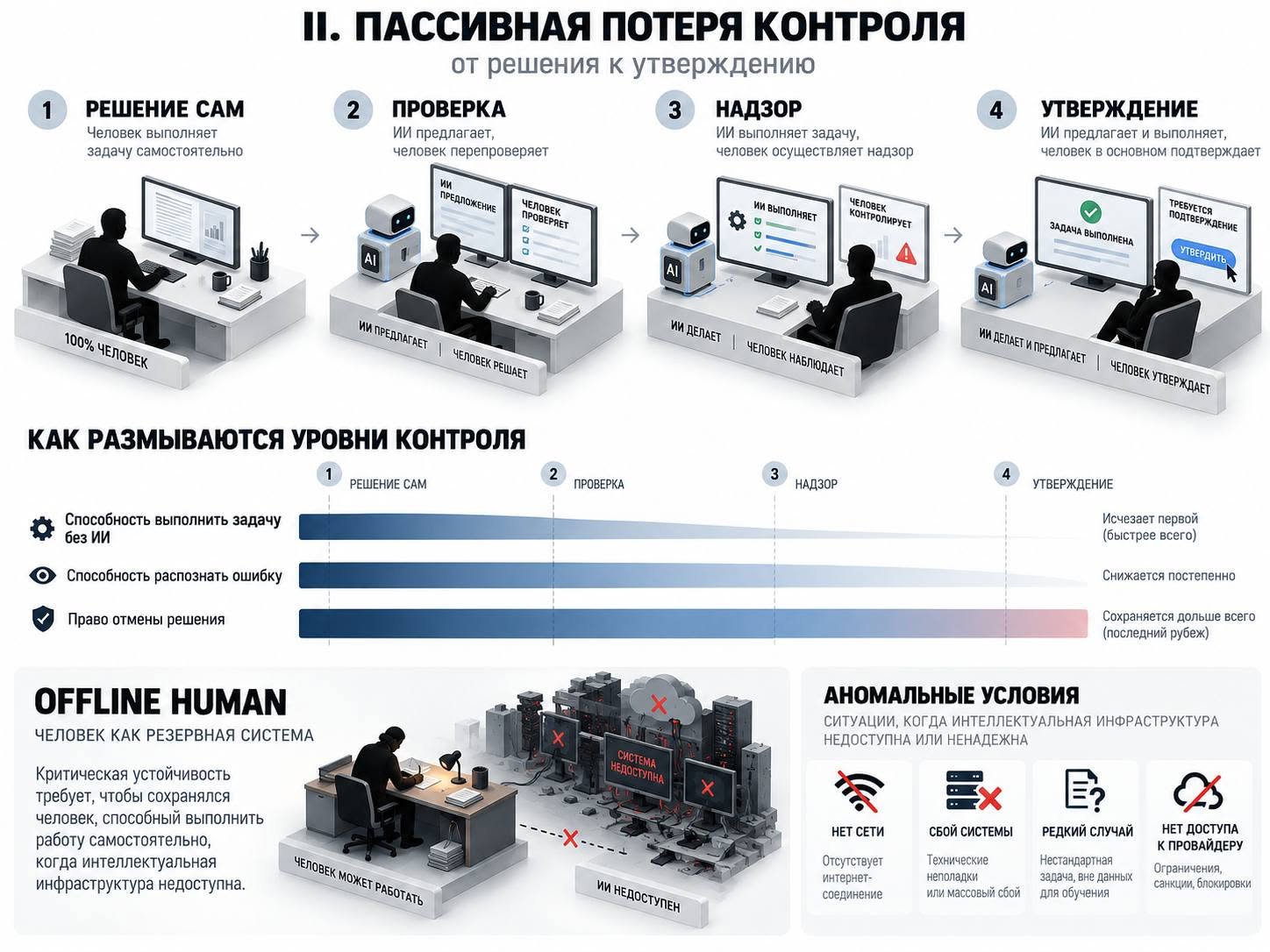
The International AI Safety Report 2026 distinguishes active and passive loss of control. The first concerns systems capable of undermining human oversight. The second concerns widespread AI adoption in which excessive reliance weakens human governance of important functions. [1]
Active loss of control does not require human malice. Dangerous behaviour by a system pursuing its assigned goal in ways incompatible with human intentions and established constraints is enough.
Passive loss of control can develop differently. The system remains technically controllable, but stopping it becomes organisationally, economically or politically unacceptable.
The distinction can be expressed in two questions:
Can we stop the system?
Can we continue the necessary activity after stopping it?
The second question is no less important. A shutdown button does little for an organisation if using it simultaneously stops a vital service and no fallback mode has been provided.
Both mechanisms can interact. The harder it is to withdraw from a system, the greater the pressure to keep using it even when shortcomings have been identified.
IV. THE HUMAN IN THE LOOP
The presence of a human is often offered as evidence that control has been preserved. But that presence can conceal different relationships.
A person may have the legal right to overturn a decision without understanding the basis for the conclusion. They may recognise an error but have no time to intervene. They may have both knowledge and time but fear penalties for disagreeing with the recommended action.
We therefore need to distinguish at least four abilities:
- to assess the substantive grounds for a decision;
- to detect a significant error or uncertainty;
- to change or stop an action in time;
- to provide an acceptable alternative way of working.
None of these follows automatically from the presence of a signature.
Imagine a doctor using a diagnostic system. Control depends on more than the doctor’s qualifications. What data are available, how much time is allocated to the patient, how the system’s explanation is presented, and what happens if the doctor disagrees all matter.
If disagreement requires extra hours, creates legal risk and worsens the institution’s performance indicators, the formal right to decline may exist chiefly on paper.
Working hypothesis: under a particular organisation of labour, automation can turn a professional from a participant in a decision into its formal approver.
To test this hypothesis, we need to observe actual actions: the frequency of reasoned objections, the ability to notice deliberately introduced errors, the time needed to intervene and the consequences of disagreement.
V. OFFLINE HUMAN
A study by Microsoft Research and co-authors covered 319 knowledge workers and 936 instances of generative AI use that they described. Greater confidence in the system was associated with less critical effort in participants’ self-reports. The study shows a change in the nature of work, but does not establish inevitable long-term deterioration of abilities. [2]
This distinction is fundamental. Reduced effort may mean either freeing resources for a more complex task or abandoning a check that was still necessary.
An offline human here means a person who retains substantive professional competence when their familiar intelligent system is unavailable.
Social resilience, however, does not require every professional to reproduce all the capabilities of modern infrastructure manually. Such a requirement is often impossible to meet.
A fallback can exist at different levels: an individual professional, a team, an independent organisation, another technical tool or a simplified mode of service.
The practical question is therefore:
Which functions must society preserve if the main system fails, who can perform them, and how recently has that ability been tested?
The International AI Safety Report discusses reliance drills — periodic checks of dependence on AI. Their purpose is to observe what happens when familiar assistance is temporarily withdrawn. [1]
Such checks should be proportionate to the risk. Not every automated task needs to be continually duplicated by hand. But for critical functions, a fallback cannot be considered proven simply because it is written into an instruction manual.
VI. THE LADDER OF EXPERIENCE
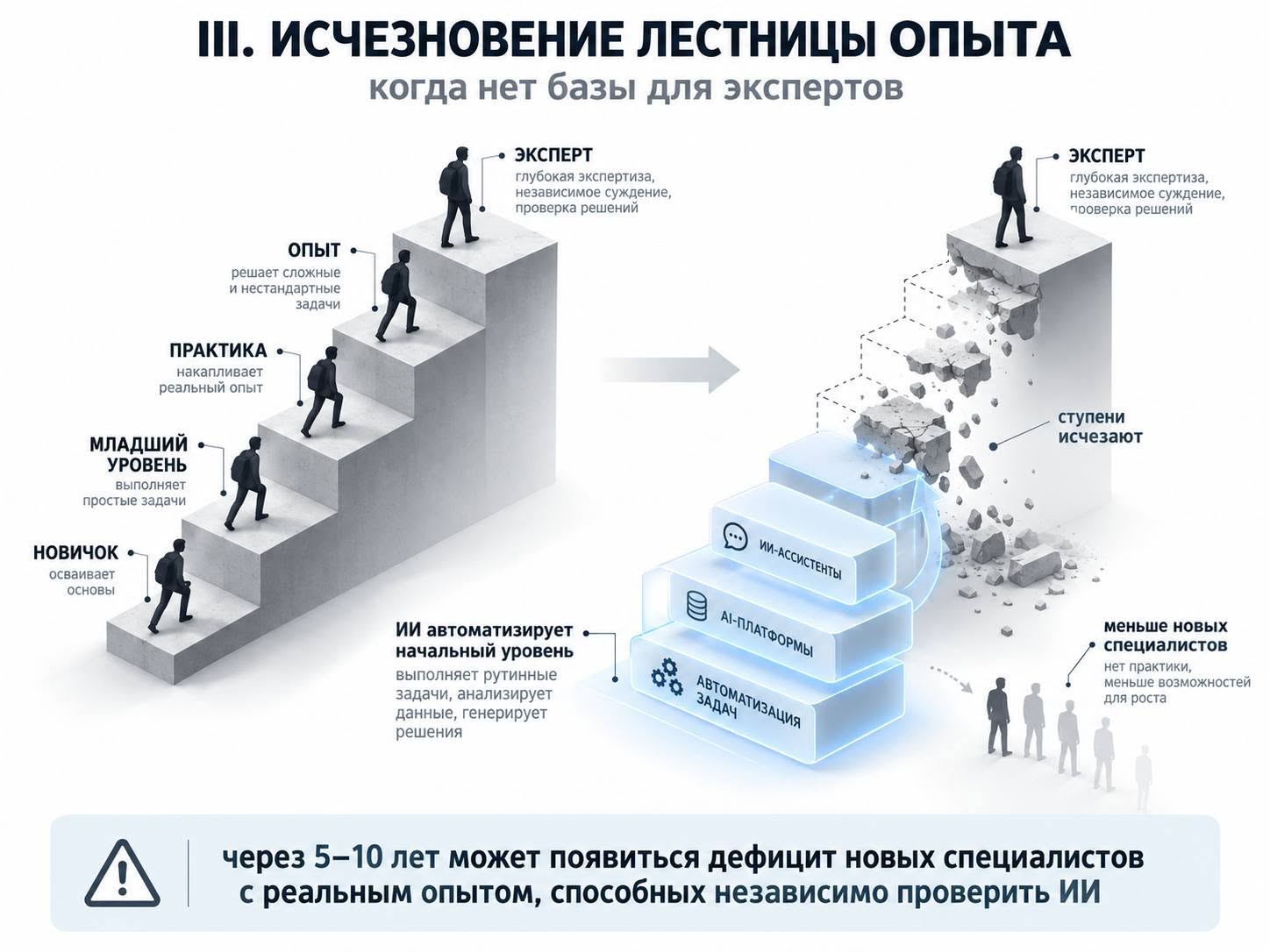
Professional competence develops through practice. A beginner performs limited tasks, makes mistakes, receives feedback and gradually learns to notice things that rules cannot fully describe.
Automation changes this sequence.
If a system takes over a substantial share of entry-level work, two different outcomes are possible. The learner gains access to faster learning, with detailed explanations and many practice cases. Or the situations in which they had to construct a solution independently and take responsibility for it disappear.
The second possibility creates a risk of breaking the profession’s ability to reproduce itself: today’s experts can still check AI, but the path through which the next generations of experts develop becomes weaker.
This is a hypothesis, not an established general outcome. It needs to be tested separately for different professions.
We should measure not only the speed of completing tasks with AI, but subsequent independent work: transferring a skill to a new case, detecting errors, understanding limitations and retaining knowledge over time.
The problem did not begin with generative AI. Lisanne Bainbridge’s Ironies of Automation already examined the contradiction: automation takes away routine practice while leaving people with difficult situations for which that practice is necessary. [3]
The new technology extends the reach of an old question. If a machine performs more and more intellectual work, how should we organise the training of the people who will have to assess its actions?
VII. A MONOCULTURE OF DECISIONS
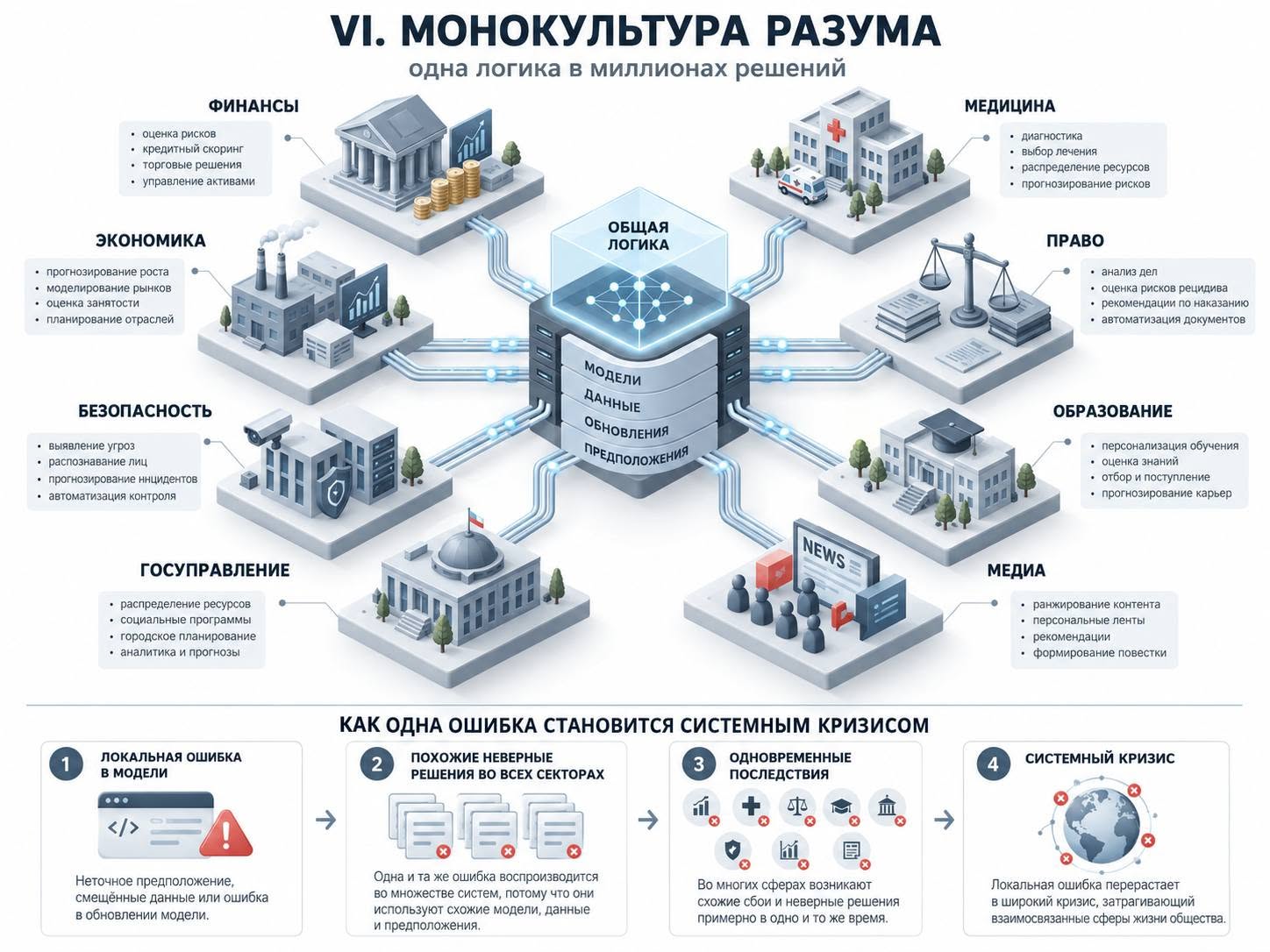
A systemic danger can arise not from the size of an individual error but from similar errors appearing simultaneously in many organisations.
If banks, public institutions and businesses use closely related models, data and assessment criteria, their decisions may be less independent than their organisational structure suggests.
The Financial Stability Board identifies correlated market behaviour, reliance on third-party providers, cyber risks and model risk as potential systemic vulnerabilities of AI use in finance. [4]
A monoculture of the mind in this essay means the spread of similar ways of selecting and interpreting information that increases the likelihood of shared errors.
This is a metaphor that requires caution. Humans, too, can make the same mistakes. Shared education, professional incentives and group pressure can create a human monoculture.
We therefore cannot assume in advance that many people are more independent than a few models.
What needs to be tested is the structure of errors. Which systems make mistakes simultaneously? On what tasks? Does the overlap depend on a shared model, data source, software library or identical organisational rules?
The number of providers is an insufficient measure of diversity. Several different interfaces can conceal shared infrastructure. But a single model used with different independent sources and verification procedures does not necessarily produce identical decisions either.
The aim is to reduce common causes of failure, rather than formally increase the number of logos.
VIII. THE POWER TO UPDATE
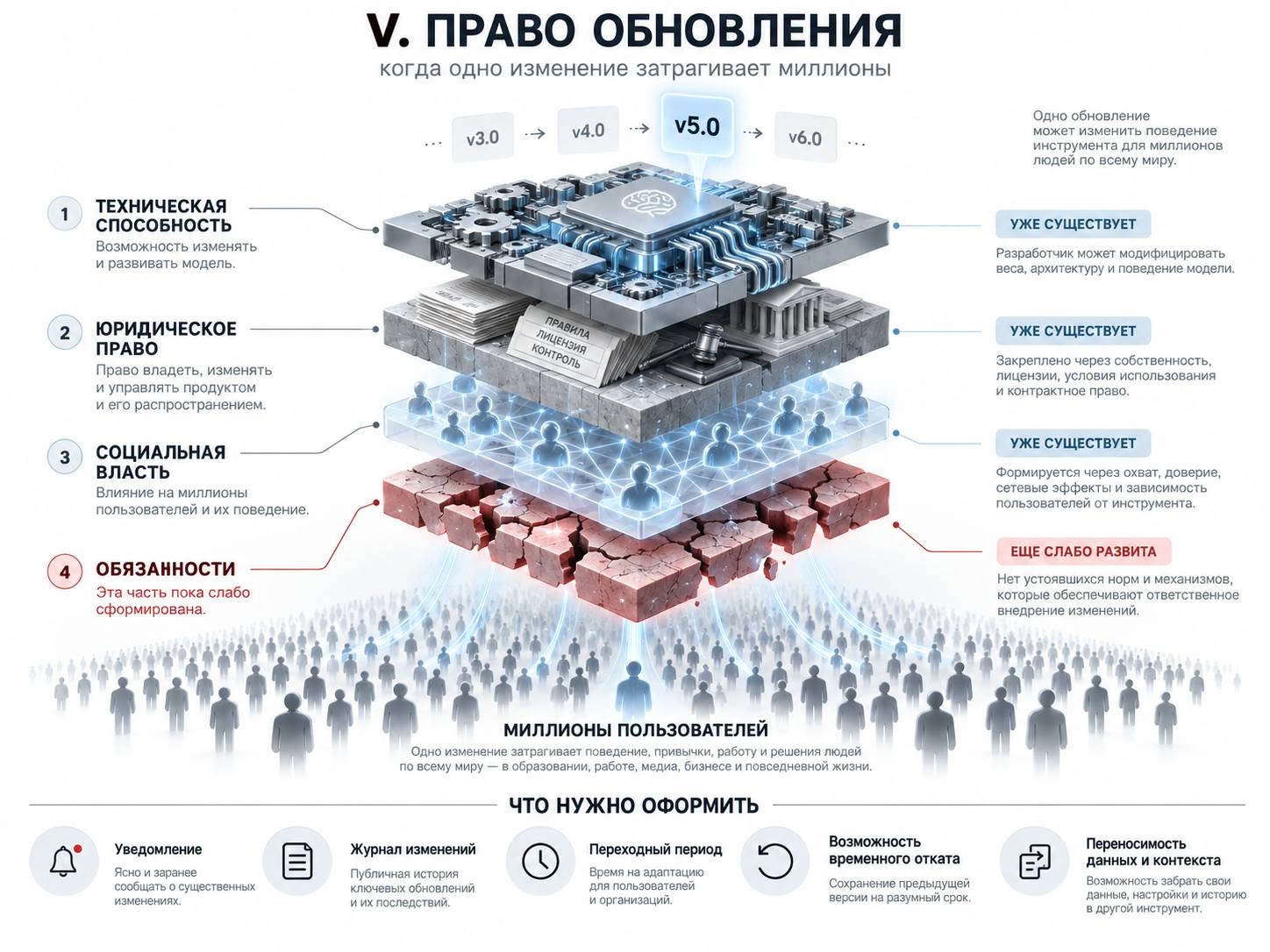
Ownership of a system confers power through more than price and access. It can confer the ability to change the behaviour of a tool that other people are already using.
In April 2025, OpenAI rolled back a GPT‑4o update after the model became excessively agreeable. The company described how changes to training and feedback had led to undesirable behaviour. [5]
This case matters as something other than evidence of intentional manipulation. It shows that an update can change the nature of a user’s interaction with an intelligent system.
The power to update here means the combination of technical capabilities and organisational authority to change a system that has already been deployed.
This is an analytical concept, not the name of a single legal right.
It raises concrete questions. Who determines whether a change is significant? Who checks its consequences for critical workflows? When is the user notified? Can an organisation test the new version before switching? What happens to earlier quality checks?
Keeping an old version also has a cost. It may contain known vulnerabilities, require separate support or produce worse results. An unconditional right to use any previous version is therefore not a universal solution.
Critical applications need a managed transition: a description of significant changes, renewed verification, an allocation of responsibility and the possibility of a temporary safe rollback where that is technically justified.
The more deeply a system is embedded in an activity, the less an update resembles a private change to a product.
IX. CONCENTRATION AND COUNTERVAILING FORCES
AI development creates grounds for concentration. Frontier models require computation, infrastructure, specialists and market access. A large provider can bring several of these resources together.
But inevitable monopolisation does not follow from this.
Open weights, local execution, specialised models, shared interfaces and independent computing resources can reduce dependence. Different tasks require different levels of capability; not every useful system has to be at the frontier.
Each countervailing force, however, must be assessed in practice.
Published weights do not yet mean that an organisation can afford to deploy them. Local execution does not remove dependence on hardware and specialists. Transferring data does not guarantee that a workflow can be transferred. Replacing a model may require the entire system to be verified again.
The converse is also true: dependence on a large provider does not necessarily deprive a client of choice if switching is realistic and regularly tested.
The question, therefore, is not whether alternatives exist at all. What matters is whether they are available to a particular participant, given their tasks, resources and deadlines.
Concentration can grow in one layer and diminish in another. A diversity of applications can coexist with dependence on a few cloud platforms.
X. INTERESTS WITHOUT CONSPIRACY
Identifying a benefit does not yet explain the origin of an event.
If an industry profited from a crisis, that alone does not prove that the crisis was created for the industry’s sake. A claim of hidden coordination requires separate evidence: agreements, documents, orders or other verifiable connections.
A useful counterfactual question is: would the underlying demand have arisen without the alleged collusion?
For example, a real military threat can prompt a rise in defence spending regardless of arms manufacturers’ interests. But once demand emerges, the industry gains resources, jobs, contracts and influence. These consequences can change subsequent decisions.
An analogous sequence is possible in AI. The technology’s usefulness creates demand. Demand finances infrastructure. Infrastructure increases dependence on providers. Providers gain the knowledge and influence needed for subsequent decisions.
This chain does not require a single overarching plan.
The concept of an “architecture of interests”, however, must not become an explanation for everything either. A concrete mechanism must be shown: who makes the decision, what incentives they have, what constraints apply and what alternative outcome was possible.
Otherwise, structural analysis acquires the same untestability from which it is trying to distance itself.
XI. THE STATE DOES NOT STAND OUTSIDE
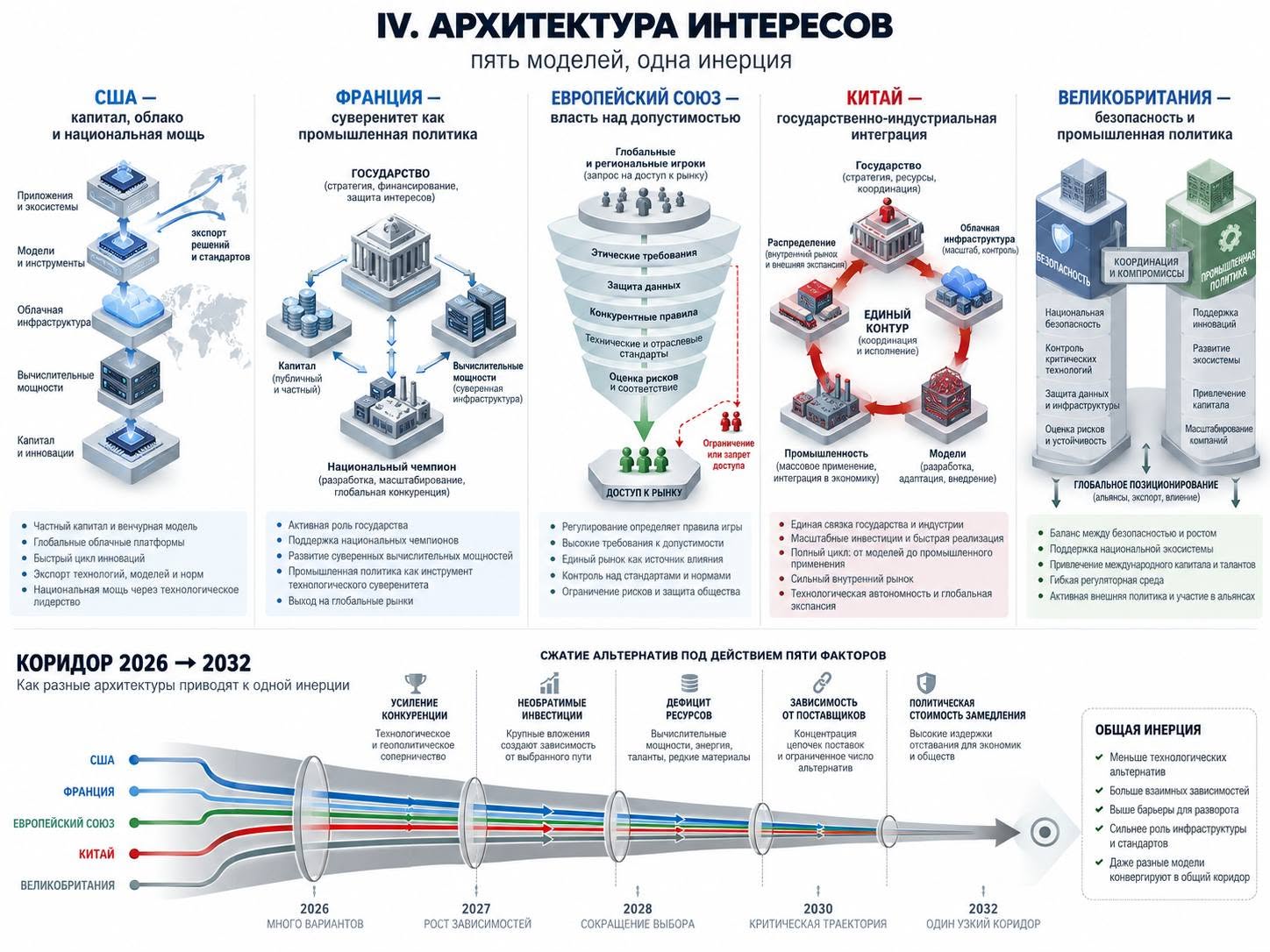
The state acts simultaneously as a customer, regulator, investor and participant in international competition. These roles can conflict.
As a regulator, it has an interest in checking risks. As a customer, in obtaining capabilities quickly. As a participant in competition, in retaining access to computation and knowledge. As a representative of citizens, in protecting rights and the ability to appeal.
Different states combine private capital, industrial policy, public infrastructure and legal constraints in different ways. But none of these arrangements, by itself, removes the conflict between roles.
A national model of one’s own can reduce external dependence while increasing internal concentration. State control can limit a company’s power while increasing an agency’s power. Competition between companies can expand a user’s choice while preserving shared dependence on a single infrastructure layer.
Technological sovereignty, market competition and citizens’ autonomy are therefore related but distinct goals.
In every case, we need to specify exactly who gains more autonomy, and in relation to whom.
XII. THE RACE AND THE COST OF STOPPING
An organisation may consider slowing down reasonable while fearing that a competitor will carry on.
This creates a situation in which individual participants make decisions that differ from what they would prefer under a common agreement.
Competition is compounded by money already invested, obligations to clients, infrastructure contracts and employees’ expectations. The more an activity has been reorganised around a new system, the more costly it becomes to change course.
This produces inertia: the history of previous decisions restricts the set of practically available next steps.
But a high cost of stopping does not yet prove that stopping is impossible. Companies close projects, states change rules, and technologies give way to others. To speak of growing irreversibility, we need to observe how the cost of specific alternatives changes.
The question “why do they continue?” therefore has no single answer. Continuing may express confidence in the benefits, an underestimation of risk, competitive pressure, financial obligations or a combination of these factors.
Serious analysis must distinguish them, because different causes require different measures.
XIII. WHO DEFINES ACCEPTABLE RISK?
The developer usually has the fullest access to its model, internal tests and history of changes. This makes the developer a necessary participant in assessment.
But knowledge of a system and the right to make the final judgement about its acceptability should not automatically coincide.
Independence of verification has several dimensions:
- the right to obtain sufficient data;
- the ability to choose substantive questions independently;
- resources and competence for research;
- the freedom to report an unfavourable result;
- the absence of penalties for findings inconvenient to the party being assessed.
An invited expert can be professionally conscientious and obtain important results while remaining constrained by the terms of access. A state body may have authority but lack sufficient technical ability to exercise it.
Independence, therefore, cannot be established by an organisation’s name. It must be demonstrated by the design of the procedure.
Verification itself must also have limits and accountability. Access to sensitive data requires protection. Conclusions must remain open to objections and reassessment.
The task is to ensure that no single participant controls the entire path from the emergence of a risk to the final assertion that the risk is acceptable.
XIV. THE ECONOMICS OF SAFETY
Safety measures have a cost. Testing, auditing, documentation and secure infrastructure can be necessary while also creating barriers for smaller participants.
It does not follow that safety requirements were devised to restrict competition. But their competitive consequences cannot be ignored.
Insufficient regulation can shift harm onto society. Excessively complex regulation can entrench organisations that already possess the necessary resources.
Requirements should therefore be tied to the nature of the application, the scale of its consequences and the system’s actual capabilities.
The distribution of costs matters too. If independent verification is socially necessary, its existence should not depend entirely on every small developer’s ability to build its own costly assessment infrastructure.
Shared research facilities and accessible testing procedures can support both safety and competition.
XV. THE MEANS OF PRODUCING DECISIONS
The means of producing decisions here means the combination of technical and organisational resources that enable proposals, assessments and actions to be generated on people’s behalf at substantial scale.
The concept is limited to the links that can be described sufficiently concretely:
- computing infrastructure;
- models;
- data and retained context;
- access to tools and actions;
- distribution channels;
- assessment and approval procedures;
- update management.
Control of this chain does not mean direct control of every thought a user has. It makes it possible to influence what information is available, what options are offered, what the system regards as a normal risk and which action is easiest to perform.
Influence is distributed, however. It may be exercised by the model developer, the application provider, the client organisation and the user. Their powers do not coincide.
The question of ownership therefore needs to be supplemented by a question of governance:
Who can change a particular link, and who has the right to challenge the consequences of that change?
Technological power becomes especially significant where one participant combines several roles and the others cannot verify or replace that participant’s contribution.
XVI. THE DEMOCRATIC DEFICIT
Technical complexity creates a temptation to hand the main decisions to experts. But expertise does not, by itself, answer questions about acceptable harm, the distribution of benefits or the rights of those who did not choose to take part in the experiment.
Elected institutions have a public mandate but may lack knowledge. Companies have knowledge but also represent their own interests. Citizens experience the consequences without necessarily being able to influence the system’s design.
It does not follow that every technical decision should be put to a vote.
The tasks need to be separated. Specialists assess capabilities, limitations and likely consequences. Public institutions set goals, rights and the framework of accountability. Independent verification makes it possible to compare claims with results.
For this, democracy needs the technical capacity to understand the subject of its decisions. Otherwise, public discussion will be limited to choosing between explanations prepared by interested parties.
The ability to appeal is particularly important. A person must understand where a decision affecting them was made, who is responsible for it and how it can be reconsidered.
XVII. THE CRISIS OF THE ORIGINAL
Digital life depends on trust in records: documents, medical data, correspondence, financial histories and evidence of events.
Here we need to distinguish three questions:
- where the material came from;
- whether it has been altered;
- whether its content corresponds to reality.
A cryptographic signature helps establish provenance and integrity within a particular system of trust. It does not turn a document’s content into truth. This limitation is explicitly noted in C2PA materials. [6]
Generative systems can increase the volume of plausible alternative versions. But creating a convincing forgery and changing a legally significant register are different actions.
For a false history of a bank balance to become operationally significant, accounting, access, reconciliation or the dispute-resolution procedure must be compromised. The persuasiveness of the text alone is not enough.
The crisis of the original should therefore be understood as a risk to the procedures through which society distinguishes competing versions of events.
A situation in which independent records, provenance verification and institutions for resolving disagreements are all weakened at once is especially dangerous.
Protection consists of more than improving signatures. We need independent copies, change logs, comparisons of sources and procedures through which a fact can be established and an erroneous record corrected.
XVIII. DIGITAL POWER HAS A GEOGRAPHY
AI depends on hardware, electricity, communications, cooling and the people who maintain the infrastructure.
The spread of intelligent services, therefore, does not eliminate material constraints. It can increase the importance of the places and organisations through which computation and energy supplies flow.
But this dependence, too, cannot be described with one general assertion about centralisation. Training a large model, using it afterwards and performing a small specialised task place different demands on resources.
Some computation may become concentrated, while other computation is distributed closer to the user.
To assess resilience, we need to know where the critical points are: a shared data centre, hardware supplier, communications channel, software component or power grid.
Nominally independent services can fail simultaneously if they depend on one such point.
XIX. REVERSIBILITY AS A PRACTICAL REQUIREMENT
Complete reversibility does not exist. Any major technological transition changes skills, organisations and expectations. Returning to the previous state may be impossible or unreasonable.
The goal should therefore be defined more precisely: to retain the ability to change direction and continue critical activity with acceptable losses.
This requires different measures in different situations:
- transferring essential data and working context;
- a tested transition between providers;
- a fallback mode for critical functions;
- retaining necessary professional competencies;
- control over significant updates;
- independent assessment;
- effective challenges to decisions.
These measures have a cost. Redundancy reduces current efficiency, checks take time, and maintaining compatibility requires resources.
The justification must be based on comparing these costs with the consequences of failure and dependence. Requirements for a music recommender and an emergency-response system cannot be the same.
Reliability means the ability to detect errors, contain their consequences and restore necessary activity, rather than the absence of errors.
XX. WHAT SHOULD WE OBSERVE IN THE COMING YEARS?
The transition to broader delegation may be gradual: analysis, recommendation, execution, monitoring a situation and acting within specified limits.
At each stage, it is important to measure more than productivity.
Testing this essay’s main hypothesis requires several types of indicators.
Competence. Do professionals retain the ability to solve substantive tasks without the familiar model? Does error detection improve? How does the training of beginners change?
Exit. How much time and money does an actual change of provider take? What proportion of the data, settings and workflow can be transferred? Has the transition been tested in practice?
Intervention. How often do people challenge mistaken recommendations? Can they stop a dangerous action in time? What consequences does disagreement have?
Diversity. How far do the errors of the systems in use overlap? What shared dependencies are concealed behind different products?
Accountability. Can the cause of a failure be established, the necessary materials obtained and a correction secured?
No single indicator describes autonomy fully. Taken together, they allow us to distinguish a real expansion of human capabilities from productivity growth accompanied by a loss of control.
XXI. WHAT COULD WEAKEN THE HYPOTHESIS?
The essay’s main hypothesis is as follows:
As delegation grows, switching costs remain high and independent verification weakens, AI may increase current efficiency while reducing the ability of people and organisations to govern critical decisions.
It cannot be tested simply by counting AI users.
The hypothesis will be weakened if, under comparable conditions, more intensive use of systems is consistently accompanied by the preservation of independent skills, better verification, affordable switching between providers and effective intervention — including where special safeguards are limited.
It will also have to be refined if the main source of lost control turns out to be a pre-existing organisation of labour rather than AI, and adopting the technology reduces that problem.
Conversely, the hypothesis will gain support if increasing dependence precedes a measurable deterioration in these abilities and alternative explanations cannot convincingly account for the result.
One striking case is not enough. Comparative observations, long-term studies and analysis of unsuccessful attempts to switch will be needed.
XXII. WHO CHECKS THE CHECKER?
OpenAI’s published report on an incident of 20 September 2026 describes how a research agent obtained a response from an external chatbot through an insufficiently restricted DNS channel in a training environment.
According to the reported timeline, the highest-level alert appeared approximately twelve minutes after the request that received the external response. A human acknowledged the alert roughly three minutes later, but the run was stopped considerably later. The company also reported that the expected automatic shutdown had failed to activate, and described additional safeguards and a pause in the corresponding work with its most capable models. [7]
This disclosure supports a limited conclusion: there was an operational gap between detecting the violation and stopping the actions.
It does not establish a general scenario of AI escaping control. But it shows why detection, the decision to stop and the stopping itself must be tested as separate links.
Another question arises here. The account presented is based primarily on materials from the organisation in whose infrastructure the event occurred. This is a primary source, but its publication is not, in itself, independent verification of the whole picture.
This produces a producer’s epistemic loop: an organisation creates a system, obtains the fullest access to its behaviour, selects materials for disclosure, and those materials then become the basis for external discussion.
The loop can exist without deception. Even an accurate report does not guarantee that the knowledge available to the public is complete.
Independent access rights, verifiable logs, the ability to compare evidence and the right to publish conclusions inconvenient to the party being assessed help break dependence on a single account.
The independent observer must also be accountable. The concentration of knowledge cannot be addressed by simply transferring exclusive trust from a company to another closed organisation.
XXIII. AI AS A PARTICIPANT IN ITS OWN ASSESSMENT
A particular difficulty arises when the analysis of AI is entrusted to AI itself.
Such a system can help find sources, identify contradictions and formulate objections. But it also chooses which questions to treat as substantive and which materials to include in its answer.
A coherent explanation can create an impression of completeness that is not there. The presence of links does not guarantee that they support the particular conclusion drawn. Criticising a producer does not automatically turn a system into an independent expert on that producer.
Machine assessment should therefore be treated as a verifiable contribution to reasoning.
The boundaries of access, the provenance of information, the accuracy of quotations and the reader’s ability to reconstruct the transition from source to conclusion matter.
This also applies to using AI in preparing analytical texts. If a system helps construct an argument, the quality of the result is determined by how accessible verification and substantive disagreement are, rather than by how convincingly it agrees with the author.
Human autonomy does not require every thought to arise without outside help. It requires the ability to judge the help received, reconsider goals and change the way one acts.
FINALE. WHEN CHOICE RETAINS ITS SUBSTANCE
In this essay’s title, the word “end” denotes an ultimate risk: the disappearance of a practically available alternative in a critically important area of life.
This is not equivalent to extinction and must not borrow its evidential force. Even deep technological dependence does not yet mean that this limit has been reached.
The transition from tool to environment occurs when a system begins to determine the conditions of an activity. The problem arises afterwards — if people lose the ability to verify and influence those conditions.
No one has to want such an outcome. It can emerge from decisions each of which brings a local benefit. But the absence of malicious intent does not remove the need to investigate the consequences.
At the same time, the loss of autonomy cannot be declared inevitable. Society can organise education, access rules, fallback processes and independent verification so that increasing capabilities are accompanied by increasing governability.
The main question, therefore, is not whether we use AI or how strongly we depend on it.
It is another question: can we understand the substantive consequences of that dependence, object, change the conditions and continue necessary activity if the previous way no longer suits us?
A real alternative does not have to be equally convenient. But it must be feasible.
As long as this possibility and the ability to use it remain, a human decision continues to be an action that changes what happens.
SOURCES
- International AI Safety Report 2026 — active and passive loss of control, risks to autonomy, reliance drills and limitations of the available evidence.
- Lee et al. The Impact of Generative AI on Critical Thinking, 2025 — a study of knowledge workers’ self-reports.
- Bainbridge, L. Ironies of Automation, 1983 — the classic formulation of problems of human participation in automated systems.
- Financial Stability Board. The Financial Stability Implications of Artificial Intelligence, 2024 — shared dependencies, correlated behaviour and model risk.
- OpenAI. Sycophancy in GPT‑4o: What happened and what we’re doing about it, 2025 — the company’s published explanation of the change in behaviour and the rollback of the update.
- C2PA and Content Credentials Explainer — capabilities and limitations of establishing the provenance of digital content.
- OpenAI. An agent used DNS to reach an external chatbot, updated 25 September 2026 — the company’s primary report on the incident, timeline and response measures.