Part 1
One day, a human being looked up and saw infinity.
And seated an old man in it.
The whole irony of human history lies in that gesture. Before him was something with no edge, no centre, no face. He gave it a face, a beard, a throne and a temperament. Made it stern, sometimes merciful, sometimes jealous. Placed it above, because the sky was above, and the sky was the largest thing he had ever seen.
We are used to laughing at this image. But we should laugh cautiously. For what laughs at it is the same consciousness, only in a different room.
Part 2
It did not begin with God. It began with the body.
A human being saw someone dead and understood that the body remained, while whoever had been within it was no longer there. This was the first rupture in experience with which it was impossible to come to terms.
The rupture demanded an explanation. The explanation demanded an image. The image demanded a story. The story demanded a keeper. The keeper demanded a ritual. The ritual demanded an institution. The institution demanded authority over the image. And authority over the image demanded belief that the image was reality itself.
Each step pressed upon the next. Nobody sat down and invented religion in its entirety. It assembled itself, as everything does that answers an unappeasable need.
This is how the determinism of myth works. Neither conspiracy nor deception. The pressure of causes.
Part 3
The most eloquent part of this mechanism is paradise.
Every shepherd sought a way to reach his flock. And each spoke the language of what it lacked.
The desert dweller was promised a garden with running water. The hungry were promised a table that never emptied. The warrior was promised a hall where he would feast with the gods and go out to battle again. Some were promised houris. Those bound to their lineage were promised reunion with their ancestors. The exhausted were promised rest.
Paradise became an exact cast of what was missing from the life of the person to whom it was promised.
But not always. Sometimes religion demanded the renunciation of desire itself. Promised judgment rather than a feast. Transformation rather than rest. Then it no longer fitted a simple economy of lack. Perhaps it was at precisely such moments that the wall of the cube became transparent for an instant.
This was not necessarily a lie. The shepherd spoke the only language the flock could understand. You cannot explain infinity to someone who thinks in bread, water and the body. You can only promise more bread, more water and a better body.
But this was where the trap began. An image created to translate something came to be taken for the original. Metaphor for geography. Heaven for a place. Hell for a room. Eternity for a very long time. God for a figure.
And people believed that a fellow sat up there keeping accounts.
Part 4
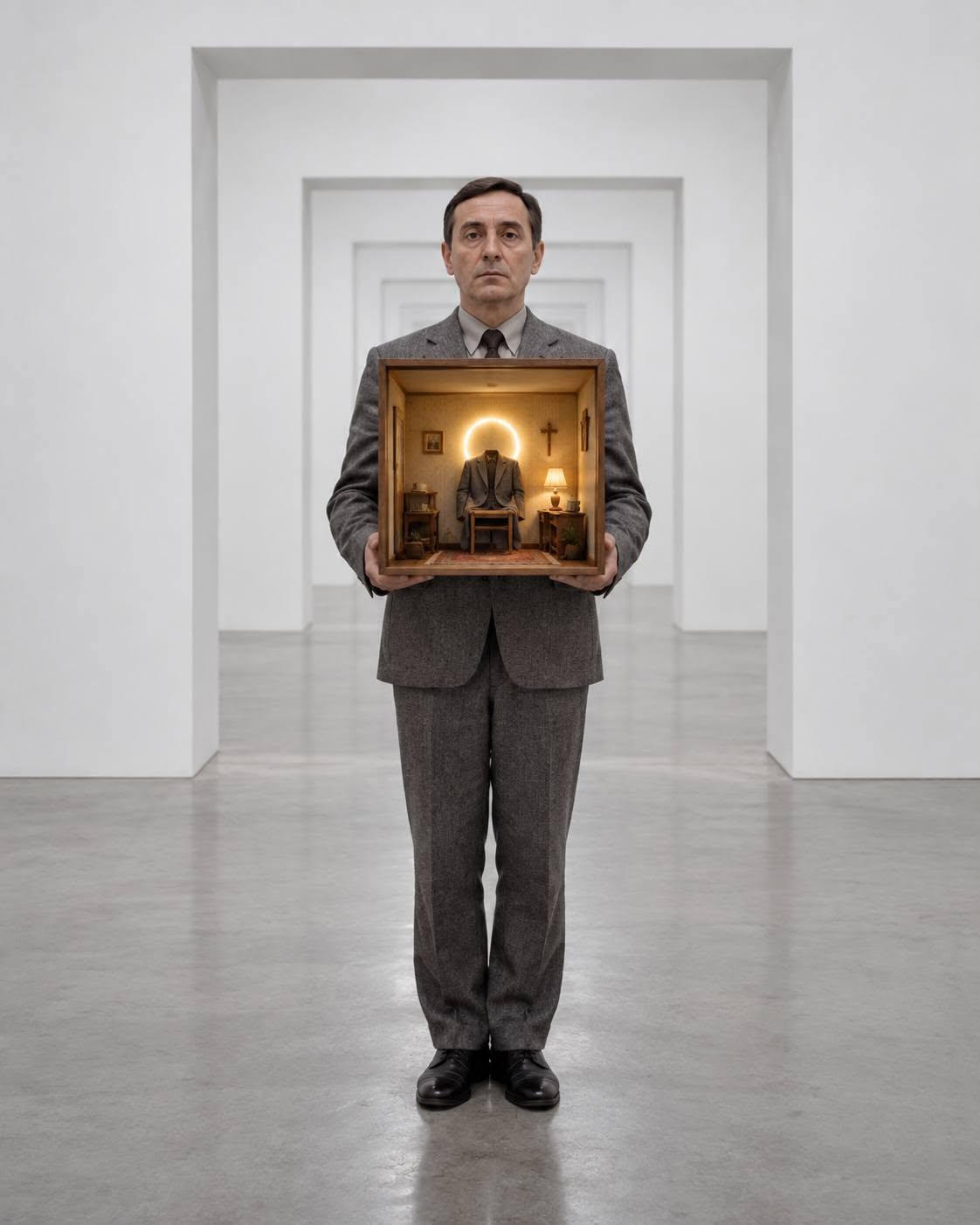
The human being lives in a cube.
The cube has walls, a floor and a ceiling. Its walls are made of what consciousness can contain. Its floor of the body. Its ceiling of imagination.
Everything a person thinks about infinity is thought from inside the cube. So paradise, too, becomes a room. Only better furnished. The table is more plentiful, the light softer, the people kinder; there is no pain. But it is the same room. The same cube, with more furniture brought into it.
A narrow consciousness wants to continue exactly as it is. With the same name, the same habits, the same desires, the same grievances. It wants life to last, rather than to change.
When consciousness expands, light begins to pass through the walls of the cube.
Then it becomes clear that paradise cannot be a table. Nor can it be a garden. Nor can it be a place at all. Because above and below, here and there, before and after themselves belong to the cube. What lies beyond it does not fit within space. It is neither farther away nor higher up. It is otherwise.
Within such a consciousness, God ceases to be a figure. Becomes light, law, energy, the ground of being. And then even these words prove too small, because they too are made from the material of the cube.
And the desire to continue changes. A wider consciousness begins to see that this “I” was a temporary form. It is no longer a matter of making this life last longer. It is a matter of life not ending where its particular form ends.
That is an entirely different story. An infinite one.
At one level, the question of death asks for paradise. At another, it ceases to ask.
But here too there is a trap. A wider consciousness can easily make a throne of its own breadth. The person who has seen the walls begins to look down on everyone else. And once again, someone is sitting in infinity. Only now it is himself.
Part 5
But there is an irony deeper than the first.
The cube cannot see its own walls.
Every age laughs at the cube of the age before it. The Enlightenment laughed at the old man on a cloud. Positivism laughed at spirits. We laugh at houris and the laden table.
And every age sits inside its own cube, convinced that it has already stepped outside.
Once the absolute was God the Father. Then mechanism. Then energy. Now information. Each word seemed definitive to those who uttered it.
So the most honest question is not how ridiculous their images were. It is: which cube am I sitting in?
Part 6
Our cube has already been built. And it bears a remarkable resemblance to the old ones.
The same determinism is assembling myth again. We learned to store memory outside the body. Memory demanded search. Search demanded a model. The model learned to connect a person’s traces. The connected traces began to form a likeness. The likeness learned to answer.
And already there is talk of digital immortality. Of a double that will continue speaking in the voice of the dead. Of consciousness uploaded to a network.
We stand again beside the body of the first person who died. Only now we want presence to remain even without the body.
And once again, we build paradise out of what we lack.
Look at where we send our photographs, letters, voices and texts. Into the cloud. The person who laughed at the heavens sent his memory into the sky and gave it the same name.
Digital paradise has turned out to be the same room with the laden table. My name, my voice, my habits, my memories will be preserved there. There I will continue just as I am. This is precisely the desire once served by gardens and halls.
And the shepherds have not gone anywhere either. Every platform seeks a way to reach its flock. Each person is shown their own paradise. The algorithm does what the preacher did. Speaks to a person in the language of what they lack. Only more precisely now, because it knows them better.
Part 7
The new myth also has a new power.
Whoever stores memory decides what will count as the past. Whoever models personality decides what will count as a human being. Once the priest determined who had the right to speak on behalf of the dead. Now that threshold passes to the owner of the servers.
And immortality can become a privilege of rank once again. Some will be preserved in detail, with their voices and manner of speaking. Others will be preserved by no one. As in ancient Egypt, where eternity was initially granted above all to the pharaoh.
Part 8
The religious human being reduced infinity to an old man above.
The technological human being may reduce it to data.
The new myth speaks plainly. Consciousness is data. Love is data. Personality is data. In its vocabulary, the soul is merely an outdated name for an information structure.
In a few centuries, this may look as naïve as the fellow on a cloud looks today. Because it is the same gesture. Take the incomprehensible and make it the size of your own room.
Reality is under no obligation to match our vocabulary.
Part 9
And yet the movement is not meaningless.
Religion carried the human being into the transcendent. Beyond the world, to where God kept his memory.
Technology carries him into the immanent. Inside the world, into silicon and the network, where an archive keeps his memory.
We are building an external memory that we once attributed only to God. All-seeing, unfading, able to retrieve every word. A narrow consciousness will see in this a replacement for God. And build itself another paradise with a laden table.
A wider one may see something else. That even this vast memory remains a cube. That it preserves the trace, but not the person who left it. That a perfect copy of a human being may know everything he knew and speak in his voice, while the question of whether anyone is inside it remains where it stood beside the body of the first person who died.
Part 10
The way out of the cube is not a new picture. Every new picture becomes another wall.
The way out begins with acknowledging the wall.
With the moment when a person stops asking what paradise looks like and begins to ask why he keeps imagining it as a room.
The first human being seated an old man in infinity. We seat our own copy there. Someone after us will seat something else there and laugh at us.
And infinity will remain empty of our images and full of something for which the cube has no words.
And perhaps the only thing that truly reaches beyond its boundaries is the question itself. Quiet, ancient, impossible to remove.
Who is looking here?
АЦХ
ADC